Ask any family about results day and they will have a story. Maybe it is the mother who checked the website twenty times before nine in the morning. Maybe it is the boy who could not finish his breakfast, too nervous to eat a single bite.
When the score is good, sweets get passed around and the marksheet gets shown to every visitor. When it is not, the child goes to their room, and dinner is quieter than usual.
Now think of someone you truly respect. It might be a teacher, a grandparent, or a friend who always shows up when things go wrong. You probably respect them because they are honest, patient, or good in a crisis. Nobody thinks, “What a wonderful person. They got 92 in Class IX maths.”
So if marks are not what people remember later, what does success in school really look like?
Rethinking the Meaning of Student Success
Grades matter. Good marks get you into good colleges and show that serious hard work has gone in. But somewhere along the way, marks became the only thing anyone talks about.
Think of that one kid every class has. He fixes the projector when the teacher is struggling with the cables, sets up the stage before every annual day, and knows every junior by name. His marks are fine, nothing to brag about. But at home, the only question is, “How much did you get in maths?”
Student success should count all of that too. And the small wins matter. The kid who used to panic before every exam now just takes a deep breath and walks in. The shy girl finally raised her hand in class, and her marks went up a good few points as well. It may not be a score that impresses anyone at the next family function, but it is progress, and it deserves a little celebration.
Why Holistic Education Matters Today
The world kids are growing up in is very different from the one their parents knew. Back then, the safe options were fixed: doctor, engineer, or a government job. Today, apps and machines already do work that once needed whole teams, and nobody stands in a bank queue just to check their balance anymore. Meanwhile, new careers keep popping up. Try explaining “content creator” to someone in the 90s.
So learning answers by heart does not go very far anymore.
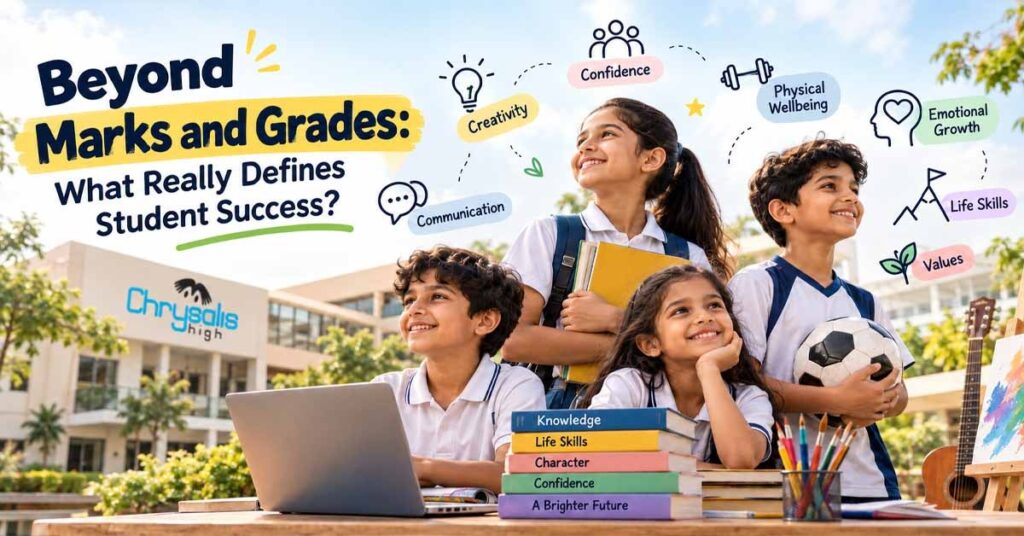
That is why more schools now talk about holistic education. A child is not just a brain that writes exams. They have a body that needs exercise, feelings that need care, and interests that need room to grow. At Chrysalis High, that means sports, arts and clubs sit alongside academics as a regular part of the week, not an afterthought.
Kids pick up a lot from these things. A boy who plays football learns that turning up for practice on a cold morning is part of the deal. A girl in the drama club who once could not look anyone in the eye starts speaking clearly on stage. A student who volunteers at an old age home comes back a little more patient with people. No textbook teaches this, but it is exactly what helps once school is over.
The Real Picture of Student Development
No two kids grow up the same way. One child loves comics in Class I, while another does not read for fun until Class VII. Some top every exam in primary school and then struggle in Class IX. Others stay in the middle for years and then discover they are brilliant at coding, painting, or football. Comparing them with “Sharma ji’s son” only makes them feel they are not good enough.
Good development is a mix of many things happening at once.
Feelings: Kids need to know what to do when they are angry or stressed, especially during exam season, when the whole house turns into a pressure cooker. A bad unit test is just a bad unit test. Life goes on.
People: Making friends, getting through group projects, and sorting out fights without saying things they will regret. Look at any family WhatsApp group and it is clear plenty of grown-ups are still figuring this out.
Health: Outdoor play, proper home-cooked meals, and decent sleep. A sleepy, hungry kid will not focus, no matter how many tuition batches they attend.
Values: Admitting they broke the TV remote instead of blaming the younger sibling. Playing fair, whether in a colony cricket match or over the last samosa.
Thinking: Asking “why” a lot, even when it annoys the elders, and enjoying learning for its own sake.
When parents and teachers keep an eye on all of this, and not just the report card, kids tend to turn out well, as students and as people.
Essential Skills for Student Success
Ask teachers, parents, or anyone who hires people, and they will name similar skills. No exam really tests any of them.
Speaking Up and Listening
Explaining an idea clearly helps in interviews, at work, and with friends. Listening matters just as much, and many people forget to let the other person finish.
Figuring Things Out
Real life does not come with options A, B, C, and D. The bus does not come, or the project partner disappears. Kids who are used to asking “what else can be done” handle these moments better.
Getting Back Up
Every child will fail at something, whether it is a test, a match, or a school election. What matters is whether they try again.
Working With Others
Group projects can be annoying, but they teach kids to share work and deal with different personalities, which is pretty much what every workplace looks like.
Managing Time
School, tuition, homework, sports, family functions, and some time to relax all compete for the same hours. Kids who learn to plan their day, even roughly, find life less stressful.
Understanding Feelings
Knowing why they feel upset, and noticing when a friend is not okay, keeps kids calm under pressure and their friendships strong.
None of these skills are fixed at birth. With patience and enough practice, any child can get better at them.
Looking at Student Success Beyond Academics
Not every successful person was a topper. Many were average, and a few failed a subject or two. They did well because they found something they enjoyed and kept at it. Almost everyone knows someone like this.
Success beyond academics is easy to miss. A boy spends his lunch break helping a friend with maths. A girl gets the colony kids to clean the park one Sunday. A nervous child sings at the annual day after weeks of worrying. Nobody gets a certificate for these things, but they deserve a pat on the back.
Children watch what adults praise. When effort and good behaviour get noticed, not only marks, children feel more confident and studying feels less like a competition.
The Role of Parents and Teachers
For parents, it can start at the dinner table. Instead of “How much did you get?”, try asking: What did you learn today? Was anything hard? Did anything funny happen in class? These questions show children that their day matters, not only their marks.
Teachers can help too. A child who asks a good question or helps a classmate should hear about it. Even a quick “That was a nice question” can stay with them for days.
Children also need room to try things, like music, coding, gardening, debating, or football. They do not have to be good at them. Most find out what they like only by trying a few things they do not.
And no comparisons. Not with the elder sister, and not with the cousin who got 98. Every child is good at something. Comparing them only makes them forget what that is.
A Balanced Approach Is the Way Forward
Marks are still important, and a good score usually means the child worked for it. But effort counts, good behaviour counts, and so do the things children learn outside the classroom. Once the pressure eases a bit, children study because they want to know things, not because they are scared. They also try new things more easily, like the art club or the guitar, just because they feel like it.
Final Thoughts
A report card tells you how a child did in a few exams. It will not tell you that he shares his tiffin with the friend who forgot his, or that she gave her best when the paper was tough. And it definitely will not show how their face lights up when they talk about Virat Kohli’s last century or the comic they have been drawing for weeks.
Ask any Indian parent what they really want, and the answer is simple. They want kids who grow up confident, kind, and able to manage life without calling home for every small thing. Good marks help, but they are one piece of the puzzle, not the whole thing.
Every child is good at something. Parents and teachers just need to look past the marksheet to find it. Schools like Chrysalis High try to do exactly that, so every student comes to believe they are much more than their marks.
(Explore More About Student Corner Blogs)
(Know More About Chrysalis High School)
Frequently Asked Questions
Student success goes beyond exam scores to include confidence, communication, critical thinking, emotional intelligence, creativity, resilience and the ability to work well with others. These skills help children apply what they learn in everyday life.
Holistic education supports a child’s academic, physical, emotional, social and creative development. It combines classroom learning with sports, arts, teamwork and practical experiences to help students become confident and independent individuals.
Essential skills for student success include communication, problem-solving, time management, teamwork, adaptability, emotional awareness and resilience. Developing these skills helps students manage challenges at school and prepare for future opportunities.
Parents can support student development by encouraging hobbies, outdoor activities, reading, creative projects and meaningful conversations. Recognising effort and progress, rather than comparing children or focusing only on marks, also helps build confidence.
Extracurricular activities such as sports, music, drama and clubs help children develop discipline, leadership, creativity, collaboration and perseverance. They also give students opportunities to discover their interests and strengths outside the classroom.
Chrysalis High supports students through academics alongside sports, arts, clubs and other learning experiences. Its educational approach encourages children to develop their interests, life skills, confidence and values while working towards academic goals.