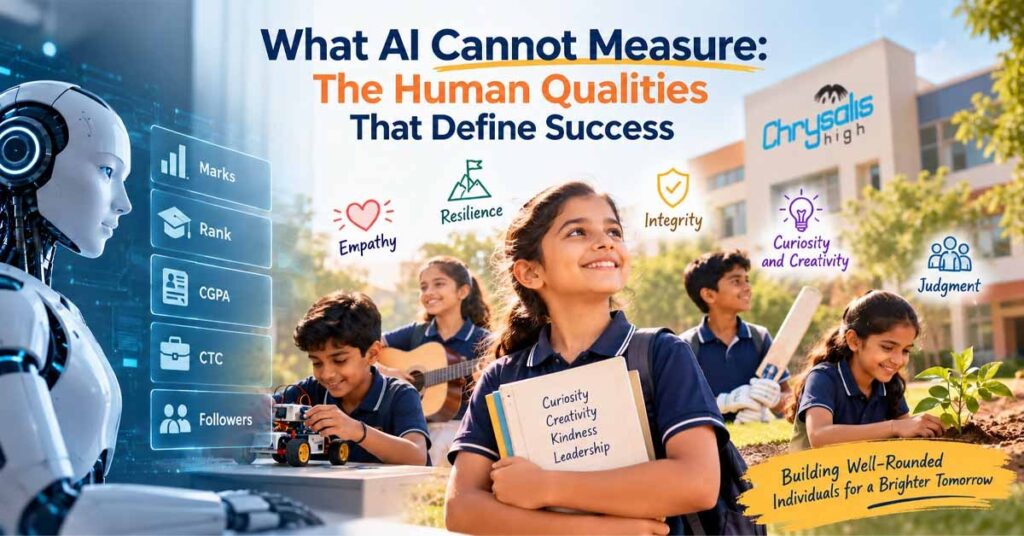
Every family function has that one uncle. He finds you somewhere between the welcome drink and the buffet, pats your shoulder, and the first thing he says is, “So, how much did you score?” Not “How are you?” Not “What are you up to these days?” Just the percentage. And honestly, that question never really leaves us. In Class X it is board marks. Then comes the JEE rank, then the CGPA, then the CTC. These days LinkedIn followers have quietly joined the list too.
AI has only added to it. Hiring software now goes through resumes faster than any recruiter ever could, and plenty of them get rejected before a human even looks. Our phones keep track of how long we slept and how many hours went into reels, a number most of us would rather not see. Some companies even use tools that claim to predict who is about to resign. With all of this around, it is easy to feel like a person is just a set of numbers.
Obviously, we are more than that. Think of someone you really look up to, maybe a teacher, a coach, an older cousin, or your own mother. The reason you admire them probably has nothing to do with a score. It is the way they treat people, or how calm they stay when everything is falling apart.
AI is brilliant with data, but these things were never data to begin with. You only notice them in tough moments, and in what people choose to do when no one is around to see.
Empathy
AI can go through a thousand customer reviews and tell you that 62 percent of them are negative. Useful, yes. But it will not notice the intern on her first day, staring at her laptop, convinced she has ruined a client email and trying very hard not to cry. Or the new student sitting alone at lunch, pretending to be busy with his tiffin box.
Noticing that is empathy. Doing something kind about it is the other half. Think of the best teacher or team captain you have had. He or she was probably not the one with the highest marks. It was the one who caught that you had gone quiet, who checked on you when something was wrong at home, and who could point out a mistake without making you feel small.
Resilience
Every Indian kid has heard at least one of these stories. Someone failed an exam, or did not get into the college they wanted, or lost a job, and then came back stronger. We keep telling them because they turn out to be true more often than you would expect.
Say a hiring algorithm spots a two-year gap on a resume. It will probably flag it. What it will not know is that during those two years, the candidate was looking after a sick parent, running a small tiffin business to pay the bills, and learning digital marketing from YouTube videos at 2 a.m. and that gap is not a weakness, but a proof of grit.
Hardly anyone’s career goes in a straight line. Most look like Bengaluru’s traffic: stop, start, take a detour, honk a bit, and somehow you still reach. The people who do well are not the ones who never fall. They just do not stay down for long. No AI can predict how someone will handle their worst day. You only find out when that day comes.
And the practice starts much earlier than most people think. A bad unit test, a lost inter-house match, a forgotten line on Annual Day. These feel enormous at fourteen. But every time you get back up after one of them, you are building the muscle you will need when the bigger setbacks come later in life.
Integrity
Say you find a wallet on the metro on your way home, with Rs. 5,000 in it, and nobody saw you pick it up. Most of us like to believe we would hand it in straight away. Some of us would at least think about it for a second before doing that.
Whatever you end up doing, it does not show up anywhere. Your manager will not hear about it, and it will not come up in your appraisal. The same goes for the answer sheet you could have glanced at when the invigilator stepped out of the room. But a lot of what makes a life and a career last comes down to moments like this. People go back to the CA or the freelancer they trust, even when someone else is a little cheaper. Teams stay loyal to a manager who keeps promises, and investors usually stick with founders they believe in when a quarter goes badly, pitch deck or no pitch deck.
AI can confirm your degree is genuine and run a background check on you. It has no way of knowing whether you would tweak the numbers to hit a target, or whether you would say something when a deal does not feel right. Those calls usually get made quietly, with nobody watching, and over a few years they turn into the reputation people know you by.
Curiosity and Creativity
Every Indian household has that one person who can fix anything with whatever is lying around. Nobody in the house owns a kitchen timer, because the pressure cooker will whistle three times and that is it. Mummy’s old saree is now the curtain in the guest room. The broken bucket has become a flower pot. And somewhere, an aunty is running a full-fledged saree business with nothing but a WhatsApp group, a phone with a cracked screen and a GPay QR code stuck on the wall.
Nobody calls this creativity. But that is exactly what it is. Looking at a problem, looking at what is lying around, and somehow making it work.
Now, AI can write articles, design logos, even make a decent song these days. Impressive, honestly. But everything it makes comes from stuff that already exists. It has seen a million examples and it gives you something close to them. That is why so much AI content starts feeling the same after a while. The really fresh ideas usually come from someone who looked at the usual way of doing things and thought, why are we even doing it like this?
And those ideas almost never show up when you are staring at a screen. They come on a random morning walk. Or while sipping cutting chai at the tea stall near the office. Or when some silly thing from childhood, like the way your grandfather fixed his cycle chain, suddenly clicks with a problem you have been stuck on for two weeks.
Most of it comes down to curiosity. Walk into any classroom at Chrysalis High and you will spot this kind of student straight away. The one who asks one “why” too many. The one who reads about space or history or food just for fun. The one who joined the pottery club because it looked interesting, or picked up a new sport for no particular reason. None of it seems useful at the time. Then one day it is.
AI is brilliant at answering questions. Ask it anything and it will have something to say. But somebody still has to come up with the question. That part has not been outsourced yet.
Judgment
Remember the 2007 T20 World Cup final? Pakistan needed 13 off the last over. Misbah was batting like he had all the time in the world. And Dhoni walks up and hands the ball to Joginder Sharma.
Most people watching at home had one reaction. Who?
Harbhajan still had an over left. Any sensible fan, any commentator, any stats sheet would have gone with him. Dhoni did not. He had been watching the pitch all evening, watching Misbah, watching how his bowlers were handling the pressure, and something told him Joginder was the man for it. First ball was a wide. Then a six. Every Indian living room went silent. Then Misbah tried that scoop, the ball went up, Sreesanth held on, and the whole country lost its mind.
Funny thing is, if Sreesanth had dropped it, Dhoni would have been roasted for years. The call would have been the same call. That is what makes it judgment. You decide with whatever you have, and you live with what happens next.
You will face smaller versions of this long before any boardroom. Choosing a stream after Class X. Picking who bats first in a house match. Deciding whether to speak up when a friend is being left out. Nobody hands you a formula for these.
AI is useful here, no doubt. Ask it and it will happily tell you Option A has a 70 percent chance of working. Fine. But it is not going to face the consequences if Option A fails. It also has no idea that two people in the team have not spoken properly in weeks, or that a friend goes quiet when he is upset, or that a certain line will not land well with a particular crowd. Nobody writes these things down. You just pick them up.
So Where Does That Leave Us?
This is not a message to stay away from AI. It is a brilliant tool, and anyone ignoring it in 2026 is only making life harder for themselves. Use it to learn faster, research better and get rid of the boring work that eats up hours every day.
Marks, ranks, that 12 LPA package everyone keeps talking about. Yes, they open doors. But once you walk through those doors, nobody really cares about your CGPA anymore. What actually matters is how you treat people, how you bounce back when things go wrong, whether people can trust you, whether you can think a little differently, and whether you make sensible decisions when nobody is telling you what to do.
That is why the holistic approach at Chrysalis High matters so much. Along with academics, students learn to work in teams, bounce back from a lost match, explore sports, arts and clubs, and look out for the people around them. These are the places where empathy, resilience, integrity, curiosity and judgment start to grow, long before any job interview or appraisal.
So the next time some uncle at a family function corners you and asks, “So, how much did you score?”, just smile. Because the scores that really count were never printed on the report card.
AI cannot measure them. Only life can.
(Explore More About AI Blogs)
(Know More About Chrysalis High School)
Frequently Asked Questions
Human qualities such as empathy, resilience, integrity, curiosity, creativity and good judgment contribute to long-term success. They help students build meaningful relationships, overcome challenges, solve problems and make responsible decisions beyond the classroom.
AI can support learning, analyze information and provide personalized feedback. However, students also need emotional intelligence, critical thinking, adaptability and ethical judgment to apply knowledge effectively and navigate real-world challenges.
Holistic education supports academic learning alongside emotional, social, physical and creative development. It helps students develop confidence, collaboration, communication and problem-solving skills that prepare them for life beyond examinations.
Schools can develop essential skills through collaborative projects, sports, performing arts, classroom discussions, leadership opportunities and hands-on learning. These experiences encourage students to think independently, learn from mistakes and work effectively with others.
Chrysalis High promotes learning beyond textbooks through academic instruction, sports, arts, teamwork and opportunities for personal growth. Its learning approach encourages students to explore their interests, build confidence and develop qualities that contribute to well-rounded development.