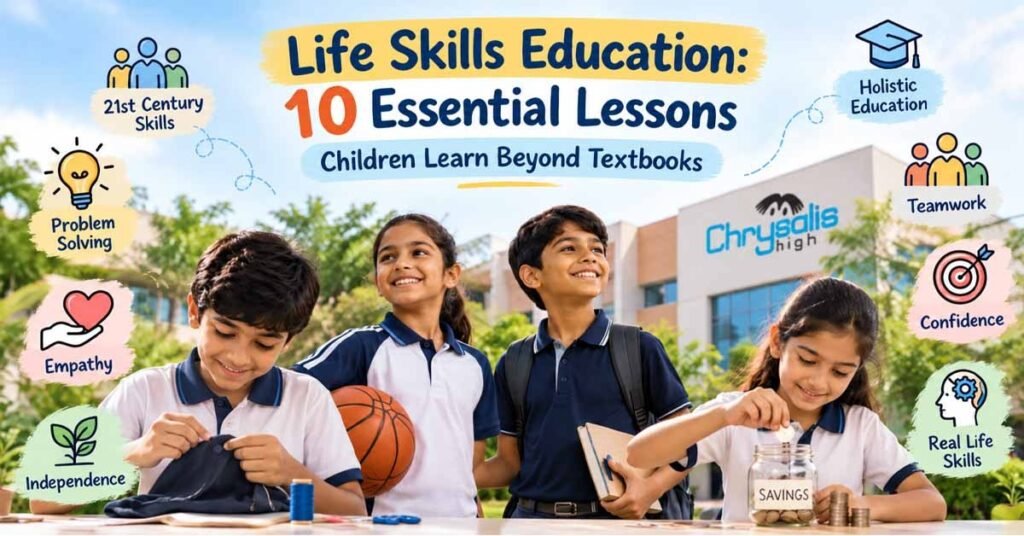
A Grade VI boy sits at his desk with a needle, a loose button and a shirt that has seen better days. Eleven minutes and two pricked fingers later, the button is back on. Slightly crooked, but on. He holds the shirt up for the whole class to see, grinning like he has just won a medal.
Nobody grades that moment. It will not show up on a report card. But ask any teacher and they will tell you it matters, maybe more than a lot of what does get graded.
Educators have a name for this kind of learning: the hidden curriculum. It is everything children pick up at school that is not written into a syllabus. How to share. How to lose. How to wait their turn, speak up, or apologise without being told to.
Most parents in Bangalore grew up in a system that cared a lot about marks. That is not a bad thing. But there is a whole other education happening in the corridors, on the playground and at the lunch table, and it is worth paying attention to. Ten of those lessons stand out.
1. How to Lose (and Try Again)
Every child from Grade I at Chrysalis High has a weekly Games Period. Kho-Kho, Lagori, Kabaddi, Hopscotch. The same games parents played in their own childhood, often barefoot and on very uneven ground.
Getting tagged out in the first thirty seconds of Kho-Kho stings. There might be a sulk, or even a few tears. Then the next round starts, and they are back in line. Do that every week for a few years and losing stops feeling like the end of the world.
2. Teamwork, and Why 21st Century Skills Begin on the Playground
Teachers have noticed something funny over the years. Put two children who do not get along in class on the same Kabaddi team, and give it about ten minutes. They will be shouting encouragement at each other and planning tactics like old friends.
Ask recruiters what they look for in young graduates today and you will hear the same few things again and again: working in teams, communicating clearly, adapting when plans change. These 21st century skills get talked about in boardrooms, but children start practising them long before that, usually while arguing over whose turn it is to raid.
3. Life Beyond the Apartment Gate
A lot of children in this city grow up inside gated communities. Safe, green, comfortable. Also, a little sheltered.
From Sr. KG, Chrysalis children visit children’s homes and orphanages as part of their programme. Teachers say the bus ride back is usually much quieter than the ride there. The questions come later, at home, over dinner. Why do they not have parents? Could the class take them something next time? Some children start putting aside pocket money without anyone asking them to.
Nobody can lecture a child into empathy. They have to meet people whose lives look different from their own.
4. Doing Things for Themselves
Back to that button. Every child from Grades V to VII learns to stitch one on. Parents sometimes laugh when they hear this, until they remember how many of these children will move to another city or country for college, where there is no mother to hand the shirt to and no tailor at the corner.
Here is a detail teachers love sharing: the boys usually enjoy the stitching the most. And in high school, when it is time to learn how to change a car tyre, it is the girls who rush to go first. So much for stereotypes.
5. Life Skills for Children That Keep Them Safe
Some lessons cannot wait until children are older. From Sr. KG, Chrysalis children learn about safe and unsafe touch, explained gently and in words a five-year-old understands. Their body belongs to them. They are allowed to say no. If anything ever feels wrong, they tell a grown-up they trust.
Parents often ask what life skills for children should cover first. This is a good place to start. Reading and writing build confidence. Knowing when to speak up builds a different kind, and it can keep a child safe.
6. What Money Actually Does
Plenty of adults only figure out mutual funds, savings and interest after their first few salaries have quietly disappeared. Chrysalis high schoolers get a head start in Dream Periods, sessions with the school’s Chairman, Dr. Sawal Das Jhetani, that covers saving, investing and why compounding is such a big deal.
Nobody expects a fifteen-year-old to build a portfolio. But a teenager who understands that small amounts grow over time will think twice before spending a whole month’s pocket money in one weekend.
7. Staying Calm When Something Goes Wrong
A flat tyre on the Hosur Road flyover at nine at night is nobody’s idea of fun. Most people would pull over and start calling for help.
High school students at Chrysalis learn to take off a car tyre and put the spare on themselves. The jack, the wheel spanner, the nuts that never seem to want to come loose. It takes a few tries. Being able to do it is useful, sure. Learning to stop panicking and work out the first step might be even more useful.
8. Turning Up Every Week
Through CHAMPS, children from Grade I choose three activities: one outdoor sport, one indoor activity and one performing art. Then they practise all three, every week, with proper coaches and a curriculum for each grade.
Some weeks, swimming is the last thing a child wants to do. They go anyway. The child who clung to the side of the pool in June can usually swim a full length by December, and they know exactly how they got there.
9. Holistic Education Starts With Knowing Yourself
Children are often two slightly different people: one at home and one at school. The chatterbox at the dinner table can go completely silent in class. The quiet one at home might be running the playground.
Chrysalis uses an approach called PUPA, short for Prior Understanding of Pupil’s Attributes, to keep a written record of each child’s talents, skills and behaviour as they move up each year. Teachers pass it on, so nobody starts from scratch. Slowly, children begin to see their own strengths too. That is a big part of what people mean by holistic education. A child’s marks are one part of the picture, not the whole thing.
10. The Small Stuff
Saying thank you to the bus attendant. Eating lunch together, with a teacher at every table. Helping a lost Grade I child find the right classroom.
None of this is on a timetable, and nobody gives marks for it. But children watch the adults around them closely, and they copy what they see far more than what they are told.
Why Life Skills Education Needs Its Own Space in School
A generation ago, a lot of this got picked up at home. Grandparents had opinions on everything. Cousins dropped in unannounced. The neighbourhood aunty told you off if you misbehaved. Today, with more Bangalore families living in smaller, nuclear households, those lessons do not always get passed on.
That is why schools cannot leave it to chance anymore. Life skills education needs real time in the school week, planned as carefully as any Maths or Science lesson. Marks will always matter for college applications. These skills matter for everything that comes after.
A Note for Parents
The next time your child comes home with muddy knees, a wonky stitch on their sleeve or a story they cannot stop telling, give it a minute before asking about the test. Something worth knowing about probably happened that day.
Parents are always welcome to visit a Chrysalis High campus on a regular school day. Ten minutes on the playground or at the lunch table says a lot about what children are really learning.
(Explore More About Child Learning Blogs)
(Know More About Chrysalis High School)
Frequently Asked Questions
1. What is the hidden curriculum in education?
The hidden curriculum refers to the values, behaviours and practical skills children learn through everyday school experiences beyond formal subjects. At Chrysalis High, activities such as teamwork, games, classroom interactions and collaborative learning help students develop empathy, responsibility and confidence.
2. Why are life skills important for children?
Life skills help children become independent, responsible and confident individuals. Skills such as communication, problem-solving, decision-making, emotional regulation and teamwork prepare children to handle everyday challenges at school and beyond.
3. How does life skills education support student development?
Life skills education supports student development by strengthening social, emotional and practical abilities alongside academic learning. It helps children build resilience, develop healthy relationships, make informed decisions and adapt to new situations.
4. How does holistic education benefit students?
Holistic education focuses on a child’s academic, emotional, social, physical and creative development. At Chrysalis High, approaches such as PUPA, CHAMPS and Life Skills help create opportunities for students to explore their strengths and develop abilities beyond academic performance.
5. How can schools teach life skills beyond textbooks?
Schools can teach life skills through sports, group projects, performing arts, practical activities, community visits and everyday classroom interactions. These experiences allow children to practise cooperation, empathy, independence and problem-solving in real-life situations.
6. How can parents help children develop life skills at home?
Parents can encourage life skills by involving children in age-appropriate household tasks, teaching them to manage pocket money, encouraging independent decision-making and discussing their feelings. Allowing children to make mistakes and learn from them also builds resilience and self-confidence.