It is established that education today is preparing students for a world which we have not conceptualised yet. The rapidly changing landscape of the future is being shaped significantly by the changes emerging as Robotics and Artificial Intelligence associated technology evolves at speeds never seen before, and geopolitical forces like the recent conflict in the Middle East, make the future even more unpredictable.
As educators, we cannot stick to erstwhile models of education anymore. It is imperative to equip the learners of today with skills and capabilities that make them productive and balanced citizens of this future world community, albeit with the hope and dream that from such learners, future leaders will emerge.
In this context, STEM education is the need of the hour for our children. Now, it is about preparing children to think, innovate, and solve real-world problems. We have the added advantage of being in Bangalore—a city at the heart of India’s technology and innovation ecosystem— and we must understand STEM education more than ever before.
What is STEM and Why is it Important?
STEM stands for Science, Technology, Engineering and Mathematics but it is not teaching all these four STEM subjects in isolation. It is about an integrated methodology of transacting these subjects encouraging children to explore, question and apply knowledge. Hence, instead of learning concepts in isolation, students engage in
- Hands -on experiments
- Real-world problem solving
- Collaborative projects
- Inquiry based learning
Science is not ‘a subject’ in a text book. It is actually
- A structured approach to discovery that includes asking questions, forming testable hypotheses, conducting experiments, and refining ideas based on evidence. (Scientific Method)
- Observation or testing which can prove or disprove theories developed through the scientific method. (Falsifiability)
- Scientific claims are rooted in measurable data rather than opinion or belief.(Evidence)
Technology is the application of scientific knowledge for practical purposes. Hence it is
- The hardware or ‘machines’
- The software (knowledge and instructions) that run it,
- The processes and methods (organised ways of doing things) for both the machines and the instructions for it, and
- The sum of a society’s skills and understanding used to manipulate the world around them
Engineering is the creative application of science and mathematics to solve real-world problems. While a scientist seeks to understand the “why” of the universe, an engineer focuses on the “how”—specifically, how to use that knowledge to design, build, and maintain structures, machines, and systems that benefit society. There are four elements to this:
- Problem Solving: Identifying a need or a failure and devising a practical solution.
- Design Under Constraint: Creating solutions that work within limited budgets, materials, time, and safety regulations.
- Mathematical & Scientific Rigor: Using physics, chemistry, biology, and calculus to ensure a design is safe and predictable.
- Innovation & Creation: Bringing something into existence that did not exist before, from a new bridge to a line of code.
Now, we see the relevance of Mathematics to all three of the above, because it is simply the study of numbers, shapes, patterns, and logical relationships. Hence science heavily relies on mathematical expressions to prove or disprove its theories, and engineering and technology are also rooted in practical application of mathematics.
Let us understand what STEM really means with an example.
Real world problem: Construct a bridge
Purpose: Easy passage between two points which are otherwise disconnected
Science: helps to understand the materials, their properties and the physical forces at play that will have to be stabilised to construct a usable bridge
Technology: construction methods, and materials developed for optimising the usability of the bridge
Engineering: the design and planning of this based on all available constraints and applying all scientific principles
Mathematics: Measurements, Linear Programming for planning, engineering calculations etc.
When students learn in such a manner, they see the relevance of what they are learning as much as they see how it is applicable. This creates high levels of engagement and results in deeper understanding and long term learning.
Importance of STEM
The importance of STEM education in India can be summarised thus:
1. Future- Readiness
Cities like Bangalore are global centres for IT, startups, and innovation. Many of tomorrow’s careers—from artificial intelligence to biotechnology—require STEM skills. Early exposure helps children build a strong foundation for these opportunities.
2. Building Real-World Skills
Research consistently shows that STEM education develops:
- Critical thinking
- Analytical reasoning
- Creativity and innovation
- Problem-solving abilities
These are not just academic skills—they are life skills.
3. Encouraging Adaptability
Studies on workforce trends in India indicate that students with STEM backgrounds are better equipped to adapt to changing job markets. Whether facing technological shifts or economic challenges, STEM learners tend to be more resilient and flexible.
Making STEM education effective
The benefits of STEM education, we have to approach STEM education with a sense of caution. Research has noted that
- STEM education in India is a by-product of both innate talent and external pressures, such as school environments and parental demands. Due to this, the STEM education programs in India frequently sacrifice individual passion. This often alienates students from the very subjects they are meant to master.
- Scholars also emphasise that the ‘one-size-fits-all’ approach to STEM results in students being funneled into technical fields based on societal expectations rather than their own strengths.
- For genuine engagement, they recommend that:
- STEM education curriculum should be assessed on the basis of problem-solving skills.
- Early exposure to STEM subject concepts which fosters curiosity,
- Teacher quality and hands-on experiential learning which lay the foundation of a successful scientific mindset.
For this the focus has to shift to skill development in STEM. Hands on Project based approach and real world problem solving will ensure an impactful STEM education.
A school based approach where the STEM lessons dovetail into the mainstream inputs of concepts, as the one which exists at Chrysalis High, one of the best CBSE and ICSE school groups of Bangalore, is a highly beneficial approach for strengthening student interest and engagement.
There is a problem in education today where girls are not well-represented in the sciences, engineering, mathematics, and technology fields around the world. Research bears out this Educational Gender Equality Paradox, which is prevalent across the world. However, in India, the numbers are encouraging, as evidenced by the following infographic.
A way to extend this environment to girls in schools are:
- Providing an inclusive and encouraging environment for STEM for all students
- Highlighting and providing role models and mentors for all students which are also inclusive from all aspects
- Providing equal opportunities for all
STEM education has also been shown to empower girls by opening pathways to careers in technology and innovation, contributing to greater independence and confidence.
A way to provide this, which is already present in progressive schools across Bangalore, are the following:
- Robotics and coding labs
- Science experiments and innovation projects
- Maker spaces with design tools
- Interdisciplinary projects connecting multiple subjects
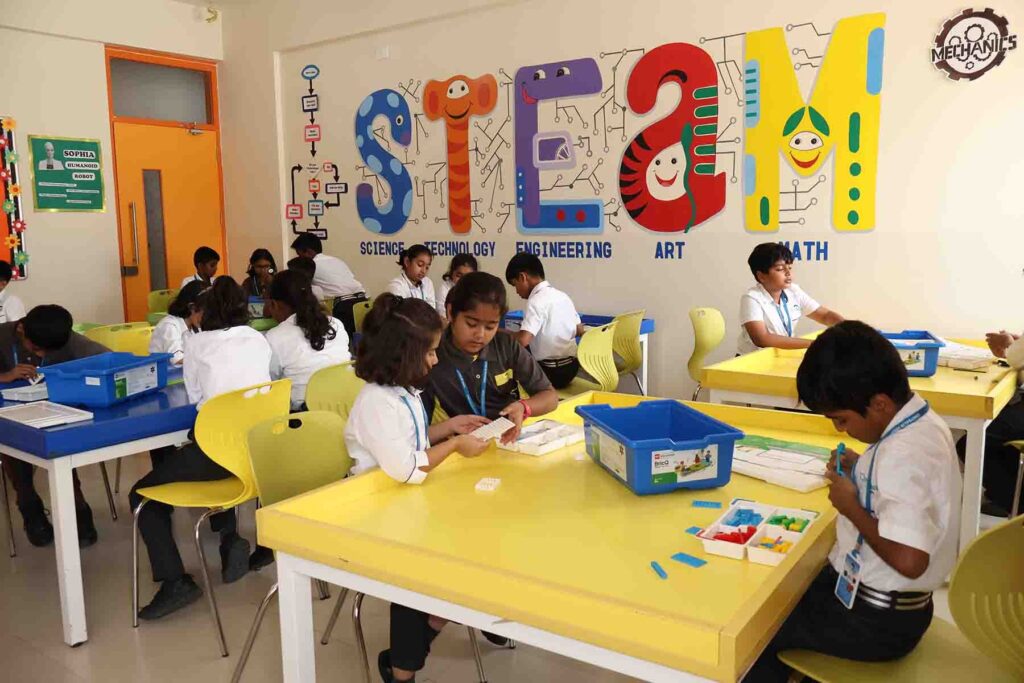
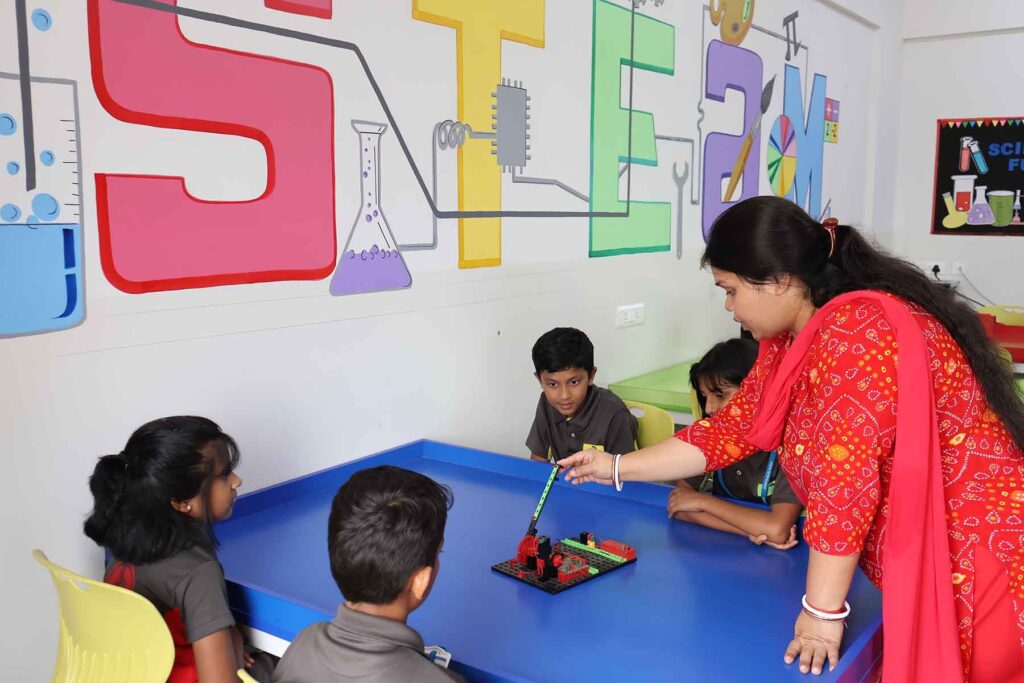
In Chrysalis High, STEM, or rather STEaM labs, are present and engage students from grades I to VIII. Children are given structured guidance to AI and STEM, under the able guidance of specialised facilitators with a technological background.
Especially in Bangalore, students are at an advantage. This is because:
- The city offers strong exposure to technology and innovation ecosystems
- There are opportunities for industry interaction, workshops, and competitions
- Future career pathways are closely linked to STEM subject fields
By embracing the STEM curriculum early, students are not just preparing for exams—they are preparing for life in a global, technology-driven world.
Conclusion
STEM education will not turn every child into a scientist or an engineer. However, due to the way in it hones
- Curious thinkers
- Problem solving, and
- Innovation,
It helps children to develop resilient and future ready skills, which not only give an academic edge but also a headstart in life.
(Explore More About Student Corner Blogs)
(Know More About Chrysalis High School)
Written By – Amrita Paul,
School Coordinator – Chrysalis High
Frequently Asked Questions:
STEM education is an integrated teaching approach that combines Science, Technology, Engineering, and Mathematics. Instead of teaching these STEM subjects as isolated, theoretical classes, it emphasizes hands-on, project-based learning. It is critical because it prepares students for a rapidly changing, AI-driven future by teaching them how to innovate and solve real-world problems rather than just memorizing facts.
A STEM education curriculum includes science concepts, technology applications, engineering design processes, and mathematical problem-solving. It focuses on hands-on learning, real-world problem solving, and collaborative STEM learning experiences.
The benefits of STEM education include improved analytical thinking, creativity, teamwork, and adaptability. It also enhances students’ ability to apply knowledge practically, making them future-ready for careers in STEM fields.
Introducing foundational concepts early removes the intimidation factor often associated with technical fields like engineering and advanced mathematics. Early exposure sparks natural curiosity and builds a safe environment for trial and error. This helps break down gender stereotypes early on, giving all children the confidence to pursue high-growth tech careers in the future.
STEM education in India is growing due to increasing demand for skills in technology, engineering, and innovation. With cities like Bangalore emerging as tech hubs, STEM learning is essential for students to stay competitive in global job markets.
Chrysalis High is widely recognized among the best CBSE and ICSE schools in Bangalore for its forward-thinking approach to technical education. Rather than treating it as an extracurricular activity, Chrysalis High seamlessly integrates STEM and AI concepts directly into the mainstream academic curriculum. Their specialized STEaM labs give students from Grades I to VIII hands-on experience in robotics, coding, and design under expert tech mentors.