There is an unspoken truth about education that does not often feature on fancy posters.
The educational process of a child does not begin at the gates of the school and end once the bell rings. It continues elsewhere in the discussions around the family table, in the late-night anxieties, in those quiet times when the child sits alone and thinks, “Am I good enough?”
And in these instances, a certain truth is brought to the surface.
Education is indivisible, not in terms of school and home and not even between teachers and parents. For children, it does not exist as separate entities.
But that has been the case for many years now: educating in schools, observing from home, having parent-teacher meetings once in a while, exchanging reports, expressing concerns, and trying to find solutions. And it works…. Until a point.
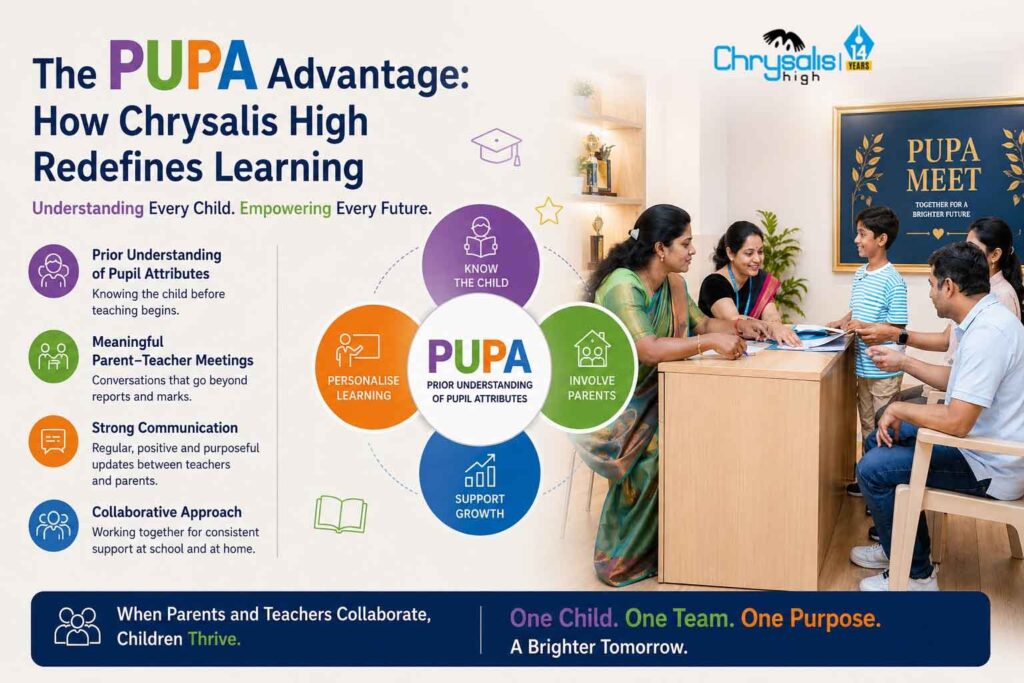
At Chrysalis High, that invisible line between school and home is gently erased through a powerful philosophy: PUPA — Prior Understanding of Pupil Attributes.
It’s simple in theory. Transformative in practice.
And honestly, it’s the kind of idea that makes you pause and think – why wasn’t it always this way?
Understanding the Child Before Teaching
So let us look at that term in some detail about PUPA – Prior Understanding of Pupil Attributes.
The terminology can seem rather academic in nature, yet in reality it is incredibly basic and human.
In advance of opening textbooks or planning lessons, in advance of establishing expectations, there lies an attempt to really understand the child.
Who are they?
What makes them excited?
What stands in their way?
How do they best learn?
How should they be nurtured?
These questions aren’t secondary. They are core.
For one cannot teach effectively without knowing who is being taught; they become words in the wind.
PUPA plays an immense role at Chrysalis High School, influencing how educators conduct classes, how they interact with children, and even how they work with parents.
And that’s where the real shift begins.
Parent-Teacher Meetings That Really Matter
How about starting with a cliché?
Parent-teacher meetings.
Yes, those. Most people think of them as yet another responsibility to get done. You go with some uneasiness, you listen to some information being conveyed within a couple of minutes, you take note of your child’s strengths and weaknesses, and you are either relieved or left with a few concerns.
It’s systematic, structured and predictable.
But there is one thing missing from the list.
A child cannot be assessed in ten minutes.
Parent-teacher meetings at Chrysalis High are not treated as milestones. They are treated as meetings that actually mean something.
They are more contemplative. They are more personal.
Teachers don’t only report about how the child performs academically, but they also speak about other things – about their attitude towards studies, social skills and emotional development, drawing their conclusions from a comprehensive picture of the child.
In return, parents provide insights that teachers could never get from studying children at school – about their habits, difficulties and passions.
In this case, the approach will be different.
It will change from “Here is your child’s performance.”
To: “Here is your child’s development, and here is how we can help him.”
Parent Teacher Collaboration: An Ongoing Process, Not a Scheduled Event
And now comes the reality.
While most schools consider parent- teacher collaboration during scheduled interactions, collaboration should not be an occasional event but a continuous one based on a detailed understanding of a child’s unique attributes.
Let’s illustrate it with an example.
When a child is struggling with concentration in class, it may not necessarily be solved within the four walls of a classroom. It could be addressed at home through small interventions like having a schedule, less distraction, and healthy sleeping patterns. Likewise, when a child appears shy, he or she can be encouraged at home, especially after receiving guidance at school.
This parent-teacher collaboration is essential since when parents and teachers operate independently, such opportunities are often overlooked. When both parties work together with the child in mind, however, such patterns become evident, leading to appropriate solutions and consistent progress.
The same principle applies to Chrysalis High School, which encourages teachers to collaborate with parents in developing strategies to guide a child in different settings.
This collaboration is not aimed at passing duties or responsibilities from one party to another but rather sharing them.
Communication between Teachers and Parents: Breaking the Wall
Communication between teachers and parents often tends to go under the radar while carrying much weight. In many settings, communication occurs only in response to an issue.
An issue occurs. A message is sent. A meeting is called.
However, there is more to communication than that.
The achievements. The gradual improvements. The changes in behaviour that show the way towards growth.
At Chrysalis High, communication does not happen in reaction to issues only.
It happens.
And, above all, it happens with intent, a result of the preceding knowledge of pupil qualities.
Updates from teachers at Chrysalis High are frequent regarding more than just academic achievements. About a student asking questions. About a child being kind to other children. About efforts rather than successes made by one student.
This teacher’s communication with parents might be perceived as minor.
However, they are extremely valuable from the perspective of parents.
They help build confidence and trust in one another. And sometimes even create a feeling of being connected on a deeper level.
A DAY IN THE LIFE OF PUPA
Away from the academic discourse.
Consider a student; let us call her Ananya.
In class, Ananya shows intelligence but lacks enthusiasm. She grasps the concept and yet refrains from sharing her thoughts. Her teacher recognises this as an established characteristic of her learning profile.
Without waiting for the next parental engagement meeting, the teacher takes the initiative to send a note. A few words. An insight. A recommendation.
At home, Ananya’s parents come to know that she shies away from speaking in gatherings outside the classroom too. They decide to make gradual changes in their routine. The teacher advises her to respond to one question in class. They make arrangements at home where she can express her views. This includes having discussions at the dinner table, telling stories or engaging in healthy debates.
Time flies.
Ananya lifts her hand.
Once. Twice.
Gradually, reluctance turns into confidence.
Here’s the catch – It is not the result of efforts made by either side individually.
It happens when both sides understand the child before taking action.
This is what PUPA looks like in practice.
Not spectacular miracles.
But small, significant achievements.
Schooling beyond Labels: Rethinking “The Best Schools”
While looking for good schools in Bangalore, the first question that comes to one’s mind is the following.
Best CBSE schools in Bangalore and Best ICSE schools in Bangalore.
But while the above-mentioned parameters may be significant, they do not exhaust the list of characteristics that should be considered when choosing a school.
Because ultimately, the value of a school cannot be assessed in terms of statistics.
Is the child comfortable with asking questions at school?
Are the parents’ wishes taken into consideration by the administration?
Does the teacher have enough resources to teach more than just the syllabus?
All of the above are qualities you will never see in rankings.
But these are exactly the ones which define the course of development of any child.
Chrysalis High does not strive to be recognized as among the best CBSE schools in Bangalore or the best ICSE schools in Bangalore. It seeks to redefine what those labels mean.
The Child at the Centre
Take away everything else, like the processes, the theories, the philosophies, and there is one constant.
Education is for the child. It’s not the child as we would like to imagine. It’s not the child as we compare ourselves to him or her.
It’s the actual, developing child who stands before us.
The PUPA methodology ensures that this focus is maintained throughout, because knowledge of the child’s attributes comes first.
By working together as parents and educators, a more complete picture emerges. Strengths that wouldn’t necessarily show up on a report card are revealed. Difficulties that might not be apparent from a classroom setting come to light.
And with that picture comes compassion.
The question becomes, “How can I help this child?”
As opposed to, “Why is this child having trouble?”
Trust: The Invisible String
There can be no partnership without trust.
Not an automatic one, but one that is developed over time with consistent action.
At Chrysalis High, this comes about through this mutual understanding of the child.
Parents have faith that the teachers will nurture their children well.
Teachers have faith that parents will give them an accurate picture.
Students have faith that the adults really understand them.
This leads to effective communication and collaboration and growth.
Prepping for the Future Together
The world that our children are venturing into is an unpredictable one.
New careers. New skills. New challenges.
These are bound to come our way and in ways we don’t expect.
As a result, education needs to be adaptable in order to cope with these changes.
This is where the PUPA model becomes relevant.
By understanding how children learn, one would be able to teach children to adapt.
With parents and teachers on the same page, children have a stable guidance system.
They learn how to tackle problems with confidence.
They learn how to reason by themselves yet still hold firm to their roots.
And the reason behind all this?
Not because we just want them to do well in their examinations.
But because we want them to do well in life.
PUPA: The Power of Silent Strength
The philosophy of PUPA is never flashy.
It doesn’t require any fancy footwork.
Instead, its power rests in consistency and insight.
In isolation, these actions might appear mundane, but collectively, they have created an outstanding atmosphere for learning.
So, what really makes Chrysalis High unique?
It is not simply the curriculum.
It is not merely the outcomes.
It is the connections based on knowledge.
The parent-teacher interaction that becomes a conversation. The parent-teacher cooperation that becomes a routine, not an anomaly. The teacher-parent interaction that comes easily, not stiffly. And most importantly, the development of a child not out of fear but through nurturing customized to their individuality.
Final Thought
Learning does not have to be louder. It has to be smarter.
Listening. Understanding. Collaboration.
For when the parent and teacher walk hand-in-hand, with an understanding of the child, it’s not just the child who progresses. It thrives.
And maybe, in this day and age, where the obsession with ranking and categorizing everything into “Best CBSE schools in Bangalore” or “Best ICSE schools in Bangalore” is all-pervading, it is in this silent thriving that true excellence lies.
The PUPA method is more than just a new way of doing things for the school. It is a new way of looking at education.
From a chore… Into a voyage.
From assumption… Into understanding.
From solitary effort… Into collective commitment.
And there it is… Where education lies.
(Explore More About Parent Corner Blogs)
(Know more about Chrysalis High)
Written By – Sharmila Yellapu,
Secondary Teacher – Chrysalis High, Bannerghatta Road
Frequently Asked Questions
PUPA stands for Prior Understanding of Pupil Attributes. It is a student-centric approach followed at Chrysalis High that helps teachers understand a child’s learning style, emotional needs, strengths, and challenges before designing teaching strategies.
Parent teacher meetings help parents and educators work together to understand a child’s academic progress, emotional development, behaviour, and learning needs. Effective collaboration ensures consistent support both at school and at home.
Parent teacher collaboration creates a unified support system for children. When teachers and parents communicate regularly, they can identify challenges early, reinforce positive habits, and guide children more effectively toward academic and personal growth.
Teacher communication with parents builds trust, improves transparency, and keeps parents informed about their child’s learning journey. Regular communication also helps celebrate small achievements and address concerns before they become bigger issues.
Chrysalis High focuses on holistic child development through the PUPA – meaningful parent-teacher collaboration, and personalized learning approaches that go beyond academics.
Many parents consider Chrysalis High among the best CBSE schools Bangalore and best ICSE schools in Bangalore because of its child-focused education model, strong parent-school partnership, and emphasis on emotional as well as academic growth.