
The national anthem of India, Jana Gana Mana, is one of the most powerful symbols of the nation’s unity and identity. Sung at schools, public events, sporting occasions, and national celebrations, the anthem evokes a deep sense of pride and belonging among Indians.

Often referred to as the Jan Gan Man national anthem, the composition carries a rich history that dates back to the early twentieth century. Written during a period of intense national awakening, the anthem reflects the ideals of unity, diversity, and collective destiny that shaped modern India.

Understanding the history of the Indian national anthem, its meaning, and its journey from a poetic hymn to an official national symbol offers a deeper appreciation of its significance in India’s cultural and political life.

indian national anthem

Composition

The Indian national anthem was written by Rabindranath Tagore, the renowned poet, philosopher, and Nobel laureate in literature. Tagore composed the original poem titled Bharoto Bhagyo Bidhata on 11 December 1911. The ‘Bharat Bhagya Vidhata’ referred in the composition by Tagore was the Universal Supreme being who guided the destiny of the then colonised India.

The poem was written in Sanskritised Bengali, a literary form of the language that incorporates many Sanskrit words. This linguistic style helped the composition resonate across India’s diverse linguistic landscape.

Originally, the poem consisted of five stanzas, each celebrating the unity of India’s many regions and cultures. However, only the first stanza was later adopted as the national anthem of India.

First Public Performance of Jana Gana Mana

The Jan Gan Man national anthem was first performed publicly on 27 December 1911 at the annual session of the Indian National Congress in Calcutta (now Kolkata).

A group of students performed the song before prominent leaders of the freedom movement. The composition immediately drew attention for its solemn melody and profound message of national unity.

In 1912, the poem was published in the journal Tatwabodhini Patrika, which helped spread Tagore’s composition among intellectual and literary circles.

Although the song was admired by many, it gradually gained wider recognition over the following decades as the freedom movement intensified and patriotic songs became an important source of inspiration.

Jana Gana Mana Lyrics and Meaning

The India’s national anthem lyrics express a deep sense of unity across the vast and diverse regions of the country.

The opening line of the Indian national anthem reads:

Jana Gana Mana Adhinayaka Jaya He
Bharata Bhagya Vidhata

These words praise the guiding spirit that shapes the destiny of the nation.

The lyrics go on to mention several regions of India—Punjab, Sindh, Gujarat, Maratha, Dravida, Utkala, and Banga—symbolizing the country’s geographic and cultural diversity. By acknowledging these regions together, the anthem celebrates India’s unity in diversity.

The repeated refrain “Jaya He” expresses victory and triumph, honouring the collective will and spirit of the Indian people.

Thus, the meaning of national anthem lies not in glorifying political power but in celebrating the spiritual and cultural unity that binds the nation together.

A word for word translation of the National Anthem is as follows: 

Jana-gana-mana-adhinayaka, jaya he
Bharata-bhagya-vidhata

Thou art the ruler of the minds of all people,
Thou Dispenser of India’s destiny.


Panjaba-Sindha-Gujrata-Maharata-
Dravida-Utkala-Vanga

Thy name rouses the hearts of Punjab, Sind, Gujrat and Maratha,
Of Dravid, Orissa and Bengal.


Vindhya-Himachala-Yamuna-Ganga
Uchhala-Jaladhi-taranga

It echoes in the hills of the Vindhyas and Himalayas,
Mingles in the music of Jamna and Ganges and is chanted by the waves of the Indian sea.


Tava shubha name jage

Tava shubha ashisha mage

They pray for Thy blessings and sing thy praise.

Gave tava jaya-gatha
Jana-gana-mangala-dayaka jaya he
Bharata-bhagya-vidhata.

The saving of all people waits in thy hand,
Thou Dispenser of India’s destiny,


Jaya he! Jaya he! Jaya he!
Jaya jaya jaya, jaya he!

Victory, Victory, Victory to Thee.

While the subsequent stanzas of the original Tagore composition are not part of the official anthem, they too glorify the ‘Unity in Diversity’ of the Indian ethos, glorifying the unity of all religions, the power of the national spirit in unifying the pilgrim like devotion of the countrymen, and the maternal love and inspiration the national spirit grants to people who are struggling in dark and desperate times (as was the case during the freedom struggle).

National Anthem in Hindi and Other Languages

Although the original composition was written in Bengali, the national anthem in Hindi is widely used in educational and public contexts across India.

Netaji Subhas Chandra Bose also adopted a version of the composition in the song ‘Sab Sukh Chain’ which became the anthem of the Indian National Army he led. (https://www.youtube.com/watch?v=WRgrmM_NBUo&list=RDWRgrmM_NBUo&start_radio=1)

Because the language of the anthem uses many Sanskrit-derived words, it is easily understood by speakers of several Indian languages. This linguistic flexibility contributes to its universal appeal across the country.

The India’s national anthem lyrics remain unchanged in official form, but transliterations and translations are commonly used in different scripts to help people learn and sing the anthem correctly.

Musical Composition of the Indian National Anthem

Rabindranath Tagore not only wrote the lyrics but also composed the melody of the anthem. The tune of the Indian national anthem is believed to be based on the Hindustani classical raga Alhaiya Bilawal, which lends the composition its dignified and uplifting character. It is a morning Raga, since many prayers are composed in these ragas, due to their solemn and rousing quality.

Tagore’s grand-nephew, Dinendranath Tagore, played an important role in notating the music and preserving the melody for future generations.

The official rendition of the national anthem of India takes approximately 52 seconds to sing in full. A shorter version lasting about 20 seconds is also used during certain ceremonial occasions.

Madanapalle: Where the Anthem Was Notated in Western Form

An interesting chapter in the history of the Jan Gan Man national anthem took place in 1919, when Rabindranath Tagore visited the Besant Theosophical College in Madanapalle, Andhra Pradesh.

During his visit, Tagore sang the composition for students and faculty members. The vice-principal of the college, Margaret Cousins, who was a trained musician, helped transcribe the melody into Western musical notation.

This step ensured that the tune could be accurately preserved and performed in the future. It was also during this visit that Tagore translated the song into English under the title “The Morning Song of India.”

This song was used as a morning prayer song in the Theosophical Society as well as being the adopted morning prayer when The Doon School was set up in 1935 (where Margaret Cousins was a founding Principal.
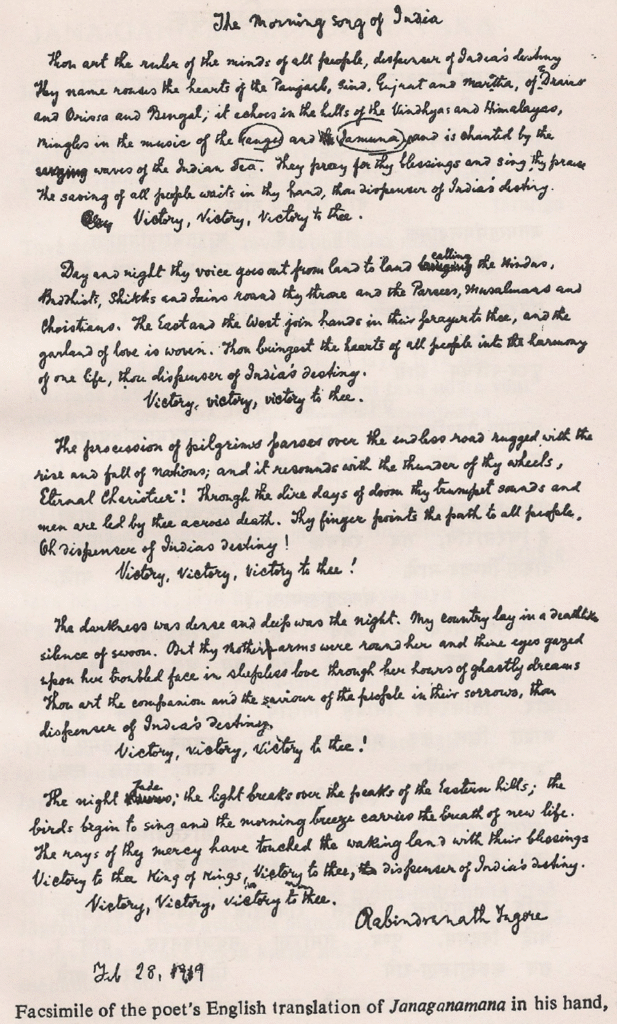
meaning of national anthem

Adoption as the National Anthem of India

Following India’s independence in 1947, the leaders of the new nation had to formally adopt national symbols that represented the country’s identity.

On 24 January 1950, the Constituent Assembly of India officially adopted the first stanza of Jana Gana Mana as the national anthem of India.

Two days later, on 26 January 1950, India became a republic.

During the same session, the Assembly also recognised the historical importance of Vande Mataram lyrics, written by Bankim Chandra Chattopadhyay. Because of its powerful role in inspiring the freedom movement, Vande Mataram was honoured as the national song of India.

Thus, both songs continue to hold a special place in India’s cultural and national heritage.

Clarifying Misinterpretations

Over time, some misconceptions arose regarding the anthem’s meaning. Certain early reports suggested that the composition might have been written to praise the British monarch during his visit to India in 1911.

Rabindranath Tagore later clarified that this interpretation was incorrect. In a letter written in 1937, he explained that the hymn referred to the divine guiding spirit of India rather than to any earthly ruler. To dedicate a prayer for his beloved country to any other was, in his opinion, ‘absurd’.

The meaning of the national anthem, according to Tagore, was a tribute to the enduring universal spirit that guides the destiny of the Indian people.

Significance of the Indian National Anthem Today

Today, the Indian national anthem remains one of the most respected symbols of the nation. Whenever the national anthem of India is played, citizens stand in respect, acknowledging the shared history and collective identity that bind the country together.

In schools, the anthem serves as a daily reminder of national unity. At sporting events, it inspires athletes and spectators alike. During national celebrations such as Independence Day and Republic Day, it evokes a powerful sense of pride and belonging.

More than a ceremonial tradition, the Jan Gan Man national anthem continues to represent India’s values of unity, diversity, and democratic spirit.

Conclusion

The journey of Jana Gana Mana from a poetic hymn composed in 1911 to the official national anthem of India in 1950 reflects the evolution of the Indian nation itself.

Written by Rabindranath Tagore during a period of national awakening, the anthem celebrates the collective spirit and unity of the Indian people. Its lyrics acknowledge the country’s cultural diversity while affirming a shared national destiny.

Today, the Indian national anthem stands as a timeless reminder that India’s strength lies in the harmony of its many voices. Each time the anthem is sung, it renews the nation’s commitment to the ideals of unity, dignity, and hope for the future. Let us all take an inspiration from this to preserve and glorify the true ethos of our nation: We are One, despite having diverse identities and voices.

(Explore More About Nation Related Blogs)

(Know More About Chrysalis High School)

Written By – Amrita Paul,

School Coordinator – Chrysalis High

Frequently Asked Questions

1. Who wrote the Indian national anthem Jana Gana Mana?

The Indian national anthem, Jana Gana Mana, was written by Rabindranath Tagore in 1911. He originally composed it in Sanskritised Bengali under the title Bharoto Bhagyo Bidhata.

2. What is the meaning of the national anthem of India?

The meaning of the national anthem reflects unity, diversity, and the collective spirit of India. It praises the divine force guiding the nation and highlights harmony among different regions and cultures.

3. What are the lyrics of India’s national anthem?

India’s national anthem lyrics begin with “Jana Gana Mana Adhinayaka Jaya He”. The song mentions various regions of India and emphasizes unity in diversity. The official version includes only the first stanza of the original composition.

4. Is the national anthem available in Hindi?

Yes, the national anthem in Hindi is widely used in schools and public events. Although originally written in Bengali, its Sanskrit-based words make it easily understandable across many Indian languages.

5. How long does it take to sing the Jan Gan Man national anthem?

The official full version of the Jan Gan Man national anthem takes approximately 52 seconds to perform. There is also a shorter version consisting of the first and last lines which takes about 20 seconds for specific military or ceremonial occasions.

6. What is the difference between Jana Gana Mana and Vande Mataram lyrics?

Jana Gana Mana is the national anthem of India, while Vande Mataram is the national song. Both played significant roles in India’s freedom movement, but only Jana Gana Mana is officially recognized as the anthem.

7. Why is learning the Indian national anthem important for students?

Learning the Indian national anthem helps students develop patriotism, discipline, and respect for national values. At institutions like Chrysalis High, one of the top CBSE & ICSE schools in Bangalore, the anthem is an essential part of daily assemblies, reinforcing unity and cultural awareness among students.

Latest Posts

Chrysalis School is a hidden gem that is absolutely amazing. The experience started when we were driving through in search of school for our kids and saw this attractive newly built school.

Our interaction with school alumni assured us that our child will be in the best hands with the teachers and staff. The faculty and staff truly care about the students and are available around the clock to help with student needs.

Cheers!
Yaduveer Singh & Tanu Chaudhary

Chrysalis High, is a great school which develops a good foundation for kids both academically and also in character building. Both the pre primary and now the primary school years for Samay, have been socially nurturing and academically challenging. Our son loves his school, he has come a long way from his nursery days till today, the 3rd grade.

Everyone at school, be it the Principal, Coordinators, teachers or the administrative staff, all have been really cooperative and supportive. Chrysalis also has one of the best parent – teacher relationship!

Overall, Chrysalis High, has been a wonderful experience for both Samay and us till date. We appreciate the great work and looking forward for more!

Regard,
Kavita

I have been a student at Chrysalis High Marq for two school years and from what I have experienced, I can tell you it is a great school. The staff is excellent and the rules help keep the school safe and in order.

There is an equal balance of learning and reviewing the information. There are enrichment activity classes as well to where we have life skill and ink well sessions that help in the refinement and polishing of the mind. Chrysalis has initiated many activities for students. We have engrossing and fun-filled Indoor Champs, Performing Arts classes, Buddy interaction time etc. The teachers in Chrysalis are hardworking and determined . I am so proud and lucky to go to Chrysalis!

Sean Lennon
Grade VIII

In the field of Construction, they say- “ A well-designed and strong foundation keeps the building standing while the forces of nature wreak havoc.” The same purpose that a foundation serves for a building, schooling does for our children- ensures they are wholly prepared for the journey called Life!

Having worked for a few schools in the past, I was aware of the paramount role a school plays in the initial nurturing of a child. While joining Chrysalis, I expected a similar school environment as in my past, but to my astonishment, things were incredibly better. While the academics here are indeed exceptional, even better is the focus on the character development of each child. Teachers know their Children really well, beyond just recalling the child’s name; all thanks to initiatives like PUPA. The teachers nurture children in a way that is not just caring and loving but also instills in them qualities like compassion, collaboration, empathy and many more from an early age. Children are also encouraged in a way that they constantly thrive to develop confidence in their own unique abilities.

Well, what we reap is what we sow; and not just the teachers but the whole team in Chrysalis believes in this fact. We work together tirelessly because we know we are nurturing kids to form a responsible and noble generation for the future!

Anjali E
Faculty, Chrysalis High Marq

Chrysalis High Marq has paved new roads of possibilities of learning and fruitful experiences for both teachers such as myself and the students.

The things that are most satisfying for me are the never ending opportunities to learn, perform out of the comfort zone and most importantly the endless love that I receive from the children. Life is a continuous learning process and Chrysalis High Marq has made it possible by giving me many opportunities to be creative in the way I work. The whole team works as a family by supporting and helping each other at any given point of time .

The motivation, appreciation, support and positivity received by us is in turn passed on to our students. The school believes in the holistic development of all its children and takes all the necessary measures to nurture the young minds in a fruitful way. I am extremely proud to be a part of the Chrysalis High Marq family.

Shivani
Educator, Chrysalis High Marq

I enjoy working at Chrysalis High because this is a place where high energy meets absolute dedication.As a teacher, each day is a new day for me and I fully value the myriad opportunities that enhance my experience.

I also appreciate the unique working atmosphere and  the collaborative culture  that allows me to grow not only as a professional, but also as a person.

The school provides me with a lot of scope to interact with children and their parents, and this gives me an opportunity  to gain deeper insights into ways to help each of them achieve their academic goals.

The school’s vision for children is a guiding principle for all of us. It is indeed a pleasure to work with my immediate superiors who are both-understanding and supportive in all aspects. Together, I am certain that we will have a mutually enriching and exciting academic year ahead.

Anuradha Shankar Venkataraman,
Employee, Chrysalis High Marq

My Voyage at Chrysalis High Marq has been spectacular and overwhelming. The school has positive vibes that makes it a beautiful shelter for not only students but also for the teachers. Here at Chrysalis we are motivated to nurture the young minds in the best possible way.

I learnt number of years of work experience is not that counts, what is more important is the quality one possesses through their learning experience. I thoroughly enjoy teaching and unfaltering curiosity.

Chrysalis High is an impressive organization that makes educators feel supported and equipped. I ’am proud to be a part of this institution that strive to take eloquent steps to transform our care philosophy and values into effective action.

I feel privileged to be an integral part of such a proficient and progressive workforce. Chrysalis oozes integrity and excellence that is t=refreshing and essential in our daily duties.

Chrysalis exemplifies what it means to be an organization that is “To help our children excel by understanding them, guiding them on the right path and strengthening their self belief.”

I have been in Chrysalis High BG Road since 2018. The teachers have laid a strong foundation, helped me improve on my basics in all subjects and played a major role in me evolving into the best version of myself. My school has given me many opportunities to develop my leadership skills and I will always feel grateful about that. I have made many friends in the last couple of years, thanks to the warm atmosphere at Chrysalis High. During online classes our school left no stone unturned and even though our classes were online, they ensured we learnt with the same enthusiasm.

I am very happy studying at Chrysalis High Bannerghatta Road. I got admission during the lockdown period. The online classes were well organized and very interactive.

I gained a lot of knowledge during online classes, and the teachers understood us quickly and were there for us at all times. Even though we didn’t meet personally, the atmosphere at Chrysalis was always very warm and supportive. Even though online classes were new to everyone, our teachers were able to identify where we were lagging, and they provided Individual Support Classes (ISP).

The teachers are very interactive, friendly with us, and support us to come up with our own ideas. Practical explanation of the subject through STEaM is also one of the most exciting sessions in our school. The teachers also covered extracurricular activities and enrichment activities during the online classes. The warm welcome by the teachers to the offline classes made us more excited to attend school and a day at Chrysalis High with my friends and teachers is something that I eagerly look forward to every day.

I started my journey at Chrysalis High in the third grade, and have been studying in the same till now and from all these years, I can say that Chrysalis High has the best staff and curriculum.

PUPA (Prior Understanding of Pupil Attributes) is a unique method used in Chrysalis High to understand a student’s learning ability, skills and emotions. They gain this knowledge from the parents and us in an effort to understand us better. The extracurricular activities, inter-school competitions, sports and cultural days organised help incorporate fun and games along with academics.

The student council and the elections for its positions familiarise a student with a sense of responsibility and teamwork. Studying at Chrysalis High has helped me grow to my full potential and has indeed trained me for the exam called life.

I would like to thank all the teachers and staff at Chrysalis High for making my learning experience the best.

Chrysalis High team integrates compassion into their teaching standards, emphasizes the importance of values and builds leaders through each of their classes and lessons. It allows for a lower student to teacher ratio. Online teaching during difficult times of Covid – 19 was indeed a huge challenge for all schools but the support provided by the school to transcend the challenge of teaching students by providing apt and timely training to teachers in online teaching methodology is commendable. This has been very useful to students as well as their parents. The teachers had worked hard in coming up with innovative methods of teaching to keep the students up breast with subjects with their enthusiasm intact.  It’s been a wonderful journey for me at Chrysalis High so far.  The entire team works in unison with one thought in mind – the betterment of the children.

My sincere thanks to Principal ma’am, Coordinators and last but not least my colleagues for the constant support and love.

Upasana Banerjee –
Primary Teacher

Working at Chrysalis High has been a wholesome experience for me. What stands out for me is the support I receive from the school management in standing by my vision and passion as a teacher.

It would not be an exaggeration in the slightest, if I said that I feel always supported by the principal, coordinator and staff in performing my duties to the best of my abilities. This makes me confident that I would be given room to grow as an educator. It feels great to be part of a group that takes meaningful steps towards turning our philosophy and values into action!

The values we would love to instill in our students at Chrysalis High are strongly rooted in our hearts by our compassionate and efficient school heads and mentors and model them to our students.

The induction programme has been nothing short of immense learning and much-needed guidance to face all our challenges head-on and it has helped prepare ourselves for the year ahead.

At Chrysalis High, I find myself doing what I love to do, staying true to what I strongly believe in and above all I can see myself as a passionate learner with new opportunities to learn each and every day. To top it all, the love and support my students shower on me is an additional perk without which I cannot be the happy teacher that I am today.

Suhasini. S
Secondary Teacher

Student Safety and School Security

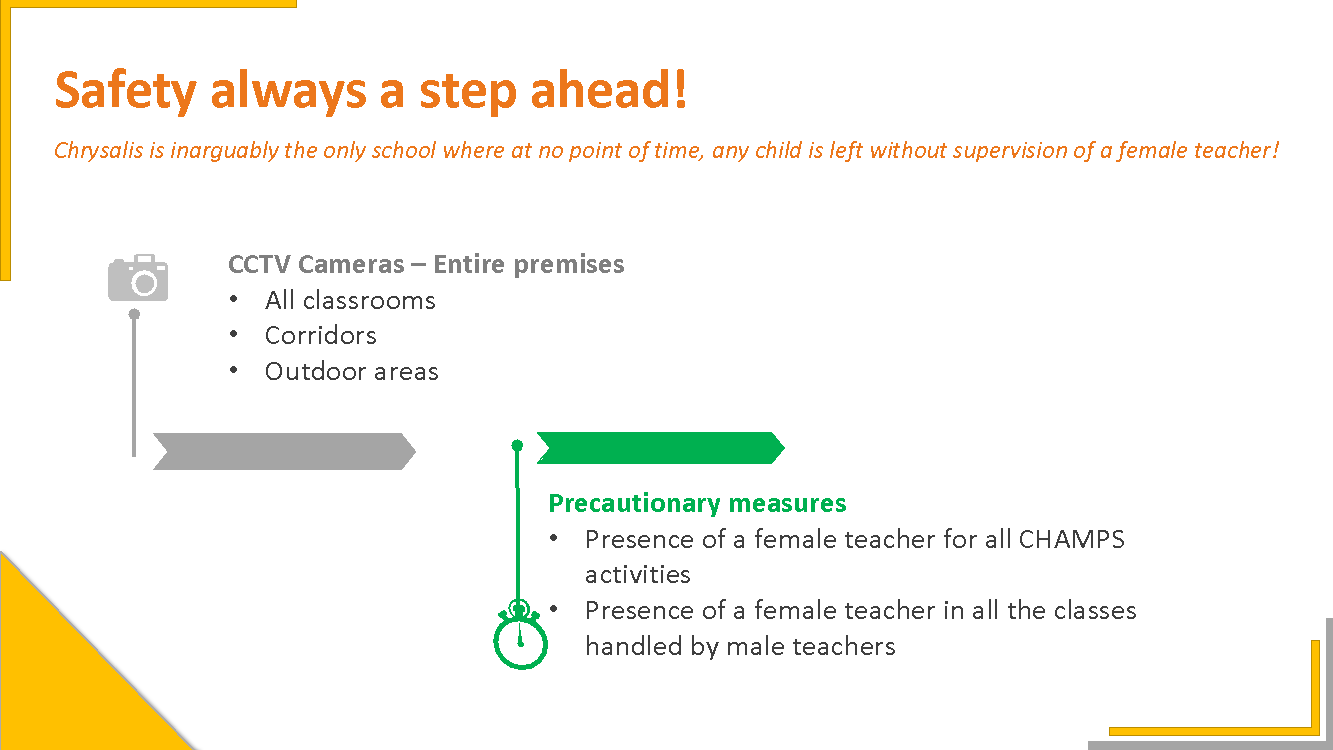
Safety Always a step ahead!

Chrysalis is inarguably the only school where at no point of time, any child is left without supervision of a female teacher!

CCTV Cameras- Entire premises

Precautionary measures

Nutrition

The School serves balanced and nutritious vegetarian snacks and lunch to students who have opted for the facility.

To supervise students during lunchtime, a teacher is appointed for monitoring each table. Children are trained to keep themselves clean and display correct dining manners.

Reverse Osmosis systems for purifying drinking water are available across the campus throughout the day.

Transport

We provide a fleet of well-maintained buses with trained drivers and lady attendants. Special care is taken while appointing the drivers, to ensure that only the experienced and qualified drivers are appointed after undergoing a driving test. The buses are equipped with safety equipment and a first-aid kit in case of an emergency.

Being GPS enabled, the school can locate the position of a bus at any time during commute and in case of a breakdown, can send a replacement bus instantly. To avoid rash driving and speeding, speed governors are installed in all the buses.

Salient Features

Indrani-Singh

Ms. Indrani Singh

Chief Vision Officer, Principal, Chrysalis High Marq & Head - Chrysalis Kids

Ms. Indrani Singh possesses a MSc and B.Ed degree to her credit. She has over 10 years of experience in the field of education and has climbed the rungs of leadership with her sheer dedication, hard work and love for her profession. She joined as the Head of Chrysalis Kids in 2013, which is a pre primary school of Chrysalis. Her out of box thinking and her ideology of doing the right thing for the children have helped her to pioneer new processes to make learning an enriching experience for the children. Across a period of seven years, Ms. Indrani Singh has become a flag bearer of Chrysalis vision, especially the PUPA (Prior Understanding of Pupil Attributes) Program. Indrani brought in the idea of Pre-CHAMPS to all Chrysalis schools. Known for her ideation & focus on quality, Indrani leaves no stone unturned to ensure children have a wonderful learning experience at Chrysalis. In 2017, she was made Associate Academic Director – Pre Primary & again promoted to Academic Director – Pre Primary, a role she handles along with the responsibilities of Chrysalis High, Marq. Under her supervision and guidance, many initiatives like Pre-CHAMPS, AwSTEM, Festival of learning were initiated and appreciated by all. Today she handles multitude of responsibilities from heading two schools to overseeing the Pre-Primary Curriculum Team of Chrysalis as the Academic Director. In addition to these profiles, she was recently promoted as Chief Vision Officer to propel PUPA, an initiative of Chrysalis, to greater heights. To this day, her ideas and her sheer determination to always try something different and new makes her a formidable and integral part of Chrysalis. With an unending pandemic looming over us, the future for education looked uncertain. But Ms. Indrani with her belief that learning should not stop for the children, ideated on the perfect balance of online and live class model to suit the learning styles of the children. The plan started with what best would suit the children and also help the working parents who were facing their own challenges and obstacles. The online model started with curriculum videos which the Chrysalis teachers recorded with the right guidance and methodology which was well defined by her. The live classes began with once a week class to slowly introduce the children to digital learning. With children adapting to live class, the sessions increased to add more to their knowledge. Teachers were sensitized about the challenges of live class and how to ensure that they do the right thing for the children and be an integral part in their learning given the circumstances. Providing the right support to parents and the challenges they faced, were also key elements of the whole digital teaching process. Providing individual support to the children was one way to ensure we partnered with parents to provide the right support to the children and ensure that the learning did not stop.