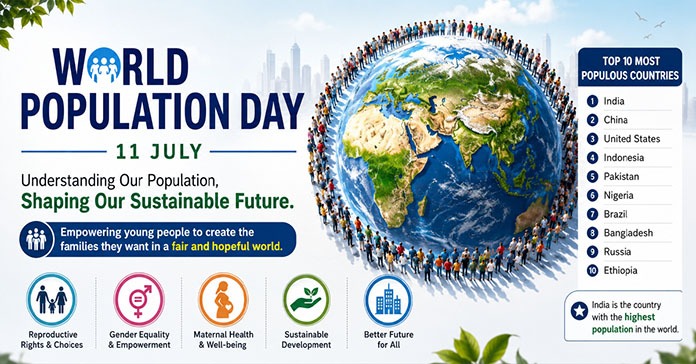
Population explosion is a phrase we are all familiar with. It was on July 11 1987 that this phrase gained traction when the world population hit the five billion mark. This was the tipping point that caused the alarms to resound on the looming crisis of rising population, thus leading to the institution of World Population Day, also known as International Population Day, which is observed on July 11 every year. It was a senior demographer at the World Bank, Dr. Zachariah, who suggested that July 11 be observed as World Population Day. It was established in 1989 by the Governing Council of the United Nations Development Programme (UNDP) in an effort to underscore the pressing issues that the rise in population brought with it, especially in relation to development planning, environmental sustainability, and human well-being.
The essence of 11th July – World Population Day
The mission of observing World Population Day is to foster reproductive rights, endorse gender equality, enhance maternal health and ensure availability of resources required for planning families. It also aims at mitigating poverty and conservation of resources.
- By fostering reproductive rights it helps people make well informed decisions with respect to their reproductive health and family planning. It is interesting to note that India was the first country to champion the cause of family planning by launching the National Family Planning Programme in 1952.
- By endorsing gender equality it empowers women to break the stereotypical moulds, thus unraveling a myriad of opportunities for women and girls.
- By enhancing maternal health it reduces maternal and infant mortality by encouraging healthy timing and spacing of pregnancies.
- By creating awareness about the impact of the population shift on economic development and sustainability it helps mitigate poverty and conserve resources.
World Population Day or international population day also integrates with a number of targets under the United Nations 2030 Agenda for Sustainable Development such as; ensuring healthy lives and promoting well-being for all at all ages, achieving gender equality and empowering all women and girls, making cities inclusive, safe, resilient and sustainable and taking urgent action to combat climate change and its impacts.
World Population Day is celebrated on 11th July and is marked by educational seminars, community outreach and health camps focused on family planning, maternal health, gender equality and sustainable living in an effort to raise awareness among the population. Taking advantage of social media and its ability to reach a larger and wider audience, the United Nations Population Fund spearheads global social media campaigns showcasing yearly themes, advocating human rights and urging sustainable resource consumption.
Theme for World Population Day 2026
In keeping with the global trends and demographic changes the United Nations Population Foundation (UNPF) thoughtfully chooses a theme every year. This year the theme is “Empowering young people to create the families they want in a fair and hopeful world”. With the global population currently facing a decline in the birth rate, this year’s theme focuses on instilling a sense of awareness among young people about reproductive health and educating them about reproductive rights and choices. The earth currently hosts the largest generation of youth, thus it is imperative to equip them with the knowledge and provide them with the facilities to shape a better future.
The dynamics of world population
In the past 200 years the world human population has witnessed a meteoric rise and has grown nearly sevenfold. It took hundreds of thousands of years for the world population to reach the 1 billion mark in the 1800s, however in a little over 200 years thereafter it reached the 7 billion mark in 2011. With a growth rate of 0.85% per year, within the last ten years the population has gone up by 1 billion. Currently the world population stands at 8.3 billion. The top ten most populous countries account for roughly 57% of this total.
Here is a table with the ten most populous countries in the world.
| RANK | COUNTRY | ESTIMATED POPULATION | WORLD SHARE |
| 1 | India | 1,476,829,800 | 17.79% |
| 2 | China | 1,412,898,000 | 17.02% |
| 3 | United States | 349,123,400 | 4.20% |
| 4 | Indonesia | 287,958,200 | 3.47% |
| 5 | Pakistan | 259,207,100 | 3.14% |
| 6 | Nigeria | 242,446,300 | 2.93% |
| 7 | Brazil | 213,624,300 | 2.58% |
| 8 | Bangladesh | 177,824,100 | 2.15% |
| 9 | Russia | 143,184,000 | 1.73% |
| 10 | Ethiopia | 138,950,600 | 1.68% |
Notable demographic changes in recent years with respect to the world human population include
- Decrease in fertility rate which has dropped from 5 births per woman to 2.2 to 2.3 births per woman.
- Increase in life expectancy which rose from 67 to 71 between 2010-2015 and is expected to continue to rise with advancements in medicine.
- Rise in urbanization and migration – in 2007 more people lived in urban areas than rural areas. This trend has been consistently on the rise.
A decline in the fertility rate along with the increased life expectancy poses a number of challenges for the future. This shift leads to a shrinking workforce, strains public pension and healthcare systems and shifts economic focus from rapid expansion to managing a heavier old-age dependency ratio. The rise in urbanization and migration are only fueling these issues further.
Along with the plethora of opportunities that urbanization offers come drawbacks like higher cost of living and work pressure leading to lower fertility rate and smaller families. On the other hand the rural areas are depleted of their working age populations. Urbanization also causes a strain on the resources due to overcrowding. The observance of World Population Day brings these issues to the forefront of public discussion and policy formulation.
Interesting facts about the world population
- While India is the most populous country in the world, the Vatican City is the least populous country with a population of fewer than 1000 residents.
- While Europe is set to become the only region with a smaller population by 2050, Africa’s population is predicted to double by the same timeframe.
- It is projected that by 2050, 66% of the population will be living in cities.
- Millennials comprise about 27% of the world population.
- The median age worldwide is 31 years.
- With a percentage of about 54%, Nepal boasts one of the highest proportions of women in the world.
- While Japan has the oldest population with more than one quarter of the population older than 65 years, the youngest population lives in Niger where 49.8% of the population are younger than 15 years of age..
- Monaco is the most densely populated country where there are more than 19,000 people per square kilometre on the contrary in Australia there are only 3 people per square kilometre.
- Tokyo has a population of 37 million making it the largest populated city in the world. Closely followed by Delhi with a population of 29 million and Shanghai with a population of 26 million.
- The northern hemisphere is home to an estimated 80% of the world population.
Conclusion
With a continuously evolving global population, observing World Population Day is important as it not only emphasises but also ensures that demographic considerations are factored into long-term policy planning. Presently some of the key factors that need to be considered are the economic and health care challenges that are posed by the aging population across Europe, Japan and parts of China, need for increased opportunities for the youthful population of Africa and South Asia and integration of technology and data analytics for real-time population monitoring.
The celebration of world population day brings issues related to the world population to the forefront thereby empowering us with the required knowledge and prodding us to engage meaningfully with the policy makers and the public towards resolving these issues.
(Explore More About Our Blogs)
(Know More About Chrysalis High School)
Written By – Ameeta Bhaskar,
Secondary Teacher – Chrysalis High Horamavu
Frequently Asked Questions
World Population Day is celebrated every year on 11 July to raise awareness about global population issues, including family planning, reproductive health, gender equality, sustainable development, and the responsible use of natural resources. It is also known as International Population Day.
World Population Day is celebrated on 11 July every year. The observance was established by the United Nations Development Programme (UNDP) in 1989 after the world’s population reached five billion in 1987.
As of 2026, India is the country with the highest population in the world, with an estimated population of around 1.48 billion people. It is followed by China and the United States.
The world human population is estimated to be around 8.3 billion people in 2026. Population growth continues to vary across regions due to differences in birth rates, life expectancy, migration, and urbanization.
There is no difference between World Population Day and International Population Day. Both names refer to the same global observance held on 11 July to promote awareness about population trends, reproductive rights, and sustainable development.
Latest Posts:
- What Happens Inside a Classroom? A Day in the Life of a Chrysalis High Student
- Looking for the Best School Near You: Explore Chrysalis High’s Campuses Across Bangalore
- What Makes Chrysalis High, Kadugodi a Preferred School for Modern Families
- The AI Homework Dilemma: Where Should Parents Draw the Line?