
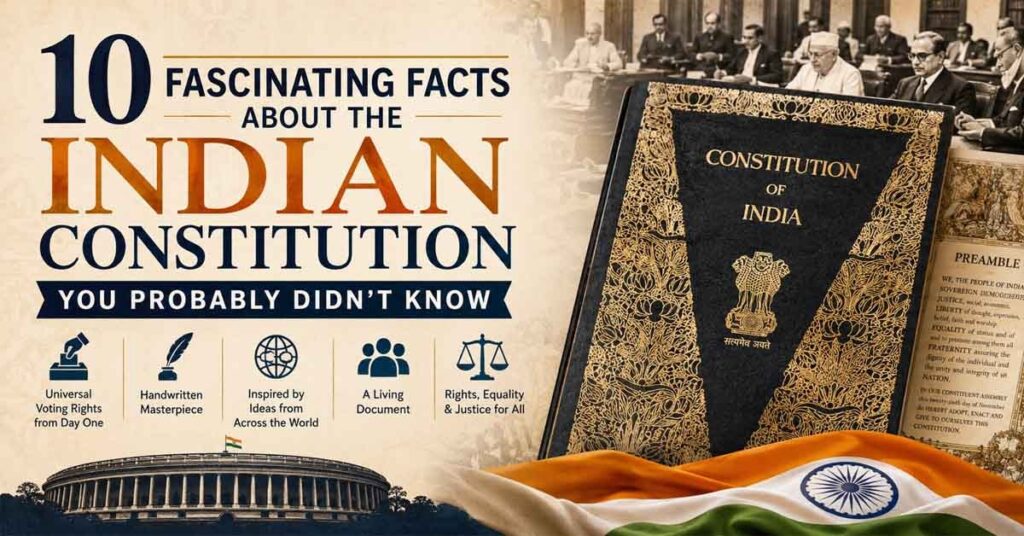
Indian Constitution

What you didn’t learn in Civics class!

The Indian Constitution is the longest written constitution in the world. When adopted in 1950, the Constitution contained 395 Articles, 8 Schedules and 22 parts. It has 25 parts as of now, although the last part is still numbered as XXII, because several new parts were inserted (such as Parts IVA, IXA, IXB, and XIVA), while Part VII was deleted. 

This makes it the longest written constitution of any sovereign democratic nation.

The Constitution of India is not merely a legal document—it has several interesting aspects to it, most of which we do not learn about in our classes at school, but which form a significant part of the history of modern India. Framed after independence and adopted on 26 November 1949, it governs the world’s largest democracy and reflects centuries of political thought, anti-colonial struggle, and social reform. 

Beyond the familiar lessons from civics textbooks, there are extraordinary stories, strange debates, artistic achievements, and constitutional innovations that many Indians have never heard about.  At Chrysalis High we believe in extending knowledge gained through textbooks, into exploring further about any topic. Let us attempt to do so now as well. 

Scholars of constitutional law, political science, and modern Indian history describe the Indian Constitution as both deeply idealistic and astonishingly practical.

Here are some bizarre, brilliant, and little-known facts about the Indian Constitution, which you probably were not familiar with.

1. India Granted Universal Voting Rights Immediately

India adopted a universal adult franchise from the very beginning.

At a time when literacy was low and poverty widespread, every adult citizen—regardless of caste, gender, religion, education, or wealth—received the right to vote. Despite having an illiteracy rate exceeding 80 percent and enormous social inequalities, the Constitution granted voting rights to every adult citizen.  In 1950, most newly independent nations restricted voting based on literacy, property ownership, education, or gender. India did not.

Even in older European countries, including England, our colonisers, voting rights were not universal at all: many were monarchies, who did not have the right for long, and did not grant them to women when voting was institutionalised. 

That is the reason why political scientists describe this as one of the greatest democratic milestones in history. Around 173 million people became eligible voters in 1951–52. Scholars such as Ornit Shani argue that India chose democracy before economic development, not after it. Whether that was the ideal path or not, may be debated, but for a freedom movement that sought to place the reins of power in the hands of the people, this was a non negotiable matter. 

2. The Constitution Was Handwritten, Not Typed

The original Constitution was handwritten in elegant calligraphy by Prem Behari Narain Raizada.Remarkably, he charged no fee for his work. Instead, he requested permission to sign every page and include his grandfather’s name on the final page. The copperplate calligraphy in itself is a testament of great artistic presentation, but the presence of such consistent and even beauty across one of the longest documents is also a feat of great skill and artistry.
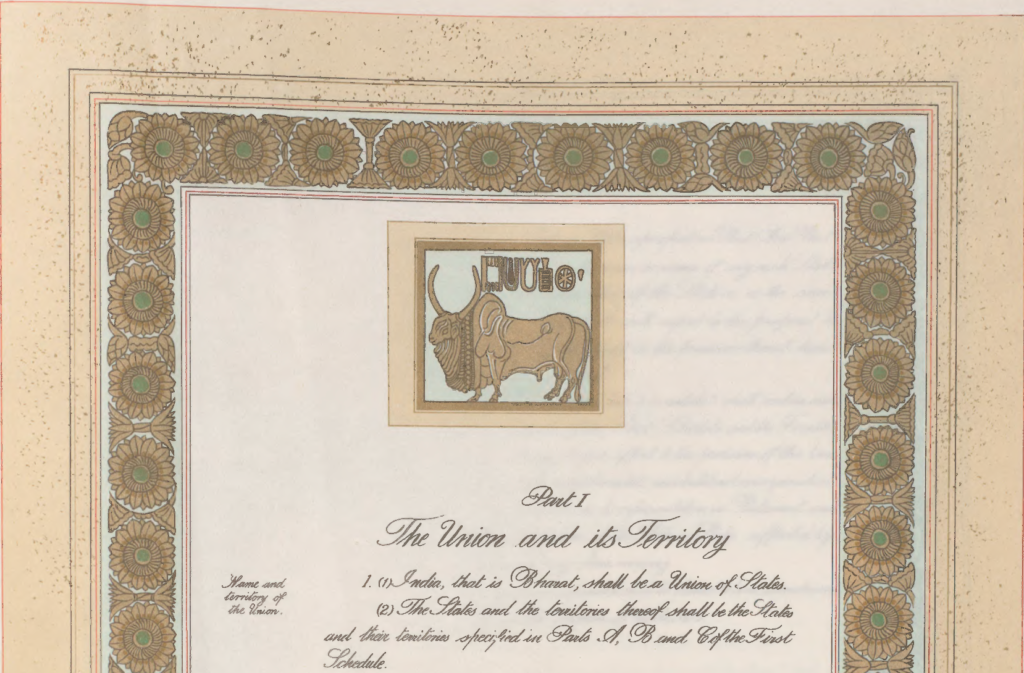
Prem Behari Narain Raizada

The pages of the Indian Constitution are not just beautifully written, every single page of the original document is visually designed artistically and  illustrated under the supervision of artist Nandalal Bose from Tagore’s Vishwa Bharati University, Shantiniketan. The execution was done by his apprentices from the Kala Bhavan.
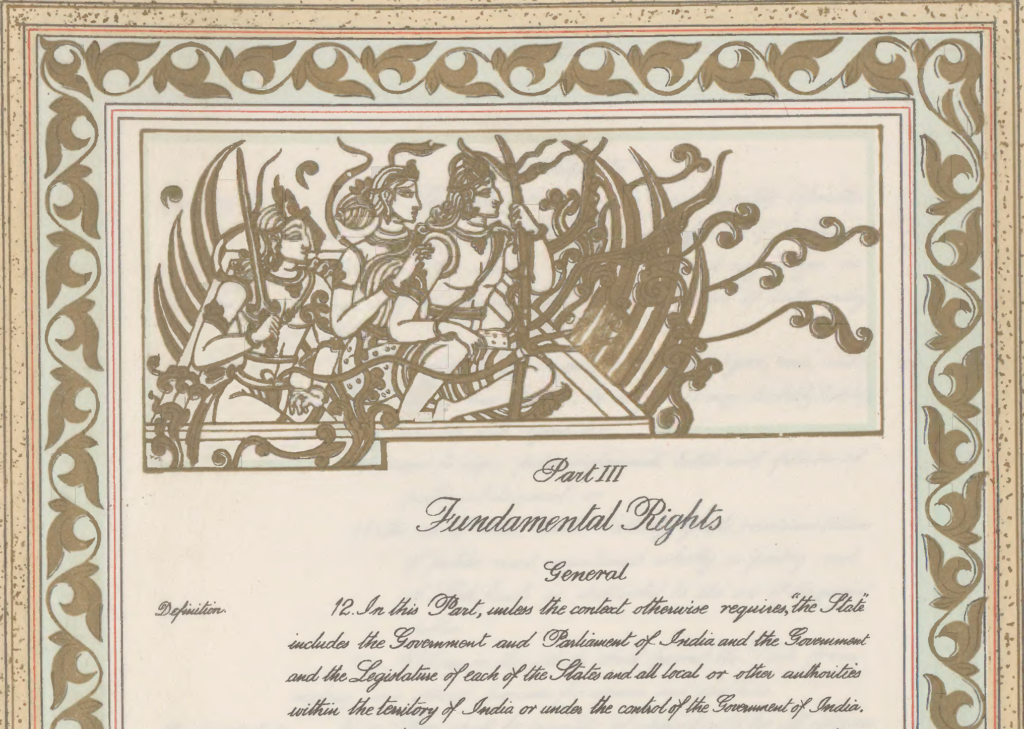
Prem Behari

The illustrations draw from the different styles of art across India’s civilisational journey from the Indus Valley Civilisation to the freedom struggle itself. 

Historians often describe the Constitution as both a legal manuscript and a national artistic archive. Also, few constitutions in the world are simultaneously legal texts and works of fine art.

3. It is preserved using the best of Archival preservation techniques

The original handwritten copies of the Indian Constitution (in both English and Hindi) are permanently housed in special, hermetically sealed, helium-filled glass cases. These are kept in a climate-controlled strong room at the Parliament Library Building in New Delhi.

How it is Preserved

To prevent the aging, yellowing, or decay of the 1950 documents, meticulous scientific measures are in place: 

  • Helium-Filled Receptacles: The manuscripts are enclosed in cases filled with helium to prevent oxidation and protect the delicate parchment and calligraphy from moisture, pollutants, and insects.
  • Micro-Environment: The cases maintain a strictly monitored environment with less than 1% oxygen and 45% relative humidity.
  • Protective Vault: The cases are secured inside a massive, climate-controlled vault (20°C and 30% relative humidity) designed by the CSIR-National Physical Laboratory and the Getty Conservation Institute.
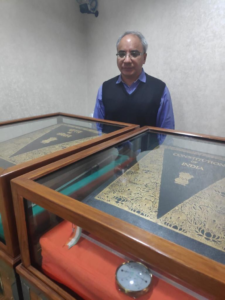
Image 4

4. The Original document is signed in both English and Hindi

There was significant debate about the language in which the Indian Constitution was drafted in, as well as the languages it would be signed in. English was initially adopted as a temporary language for deliberations, but it still functions as an official language as it is more universally accepted all across the country.

Finally, the Constitution of India was signed in both English and Hindi and the original documents also exist in these two languages.

5. It is one of the most ‘inclusive’ documents ever written: its creation was also a beacon of its democratic spirit

Inspired by several Constitutions

The Constitution of India as framed by the Constituent Assembly under the Chairmanship of Dr. B.R. Ambedkar drew inspiration from several global constitutions. The collective wisdom from several other constitutions have informed the Constituent Assembly’s choice of the following features. :

FeatureBorrowed From
Fundamental RightsUnited States
Parliamentary SystemUnited Kingdom
Directive PrinciplesIreland
FederalismCanada
Emergency ProvisionsGermany
Concurrent ListAustralia

Scholars emphasize that these features were adapted creatively for Indian realities rather than copied mechanically. For instance the guarantee of Fundamental rights as per the principles of the United States Constitution was a necessity in the multi-cultural and multi- faceted society as India is. At the same time, it did not adopt the Federal system of government or the presidential system from that constitution because dual citizenship would serve to be divisive, rather than unifying for our diverse nation. 

The Emergency provisions were inspired by the German constitution, and these provisions were proved their worth during the days of the Emergency in 1970’s where it showed up as both the strength of our constitution as well as its greatest vulnerability as well.

Ordinary citizens have sent in their suggestions to the Constituent Assembly

Recent research shows thousands of letters and petitions were sent by ordinary Indians to the Constituent Assembly. People wrote about

  • Minority protections
  • Women’s rights
  • Language
  • Electoral systems
  • Education

Hence, our Constitution of India,  was partially ‘crowdsourced’ decades before the internet existed, or this was a practice. Visionary, wasn’t it?

The Constituent Assembly Included Extraordinary Diversity

The Constituent Assembly led by Dr. B.R. Ambedkar, included lawyers, scholars, social reformers, administrators, freedom fighters, women leaders, and minority representatives.

Women such as Hansa Mehta, Dakshayani Velayudhan, Rajkumari Amrit Kaur played major roles in debates on equality and rights.

6. The Indian Constitution is a ‘Living Document’ 

The Preamble to the Bharatiya Samvidhan originally did not contain the words:

  • Socialist
  • Secular
  • Integrity

These were added later through the 42nd Constitutional Amendment during the Emergency (1976).

The Constitution itself evolved along with political developments.

Also, the Constitution of India aimed at social revolution and not on limiting government power.

Granville Austin famously called it “the cornerstone of a nation committed to social transformation.”

It sought to:

  • End caste discrimination
  • Promote equality
  • Expand education
  • Build a welfare state
  • Protect minorities

The aim was to dismantle centuries of caste discrimination, promote equality, expand education, and improve socio-economic conditions. The Directive Principles of State Policy were included specifically to guide future governments toward building a welfare state.

It is also relatively easier to make amendments to India’s Constitution, which is why it  is referred to as partly rigid and partly flexible.

Some amendments require a simple majority in Parliament, while others require a special majority, including ratification by states. 

This balance was also designed deliberately. It was felt that keeping the route of reform open at the constitutional level was extremely important for it to be relevant to the citizens of the Indian republic in the future. 

Between 1975 and 1977, India experienced a National Emergency where several  restrictions on civil liberties were instituted and executive power was disproportionately expanded. Constitutional amendments during this period significantly altered the balance among institutions. Scholars often cite the Emergency as a critical test of constitutional resilience.  Following the Emergency, several safeguards were strengthened to prevent future misuse of constitutional provisions.

So we see how the Constitution evolved through experience and correction, demonstrating its adaptability.

7. Emergency Powers granted by the Indian Constitution Were Influenced by Fear of National Collapse

The framers of the Constitution of India had witnessed:

  • Partition violence
  • Communal riots
  • Refugee crises
  • Princely state integration challenges

These experiences influenced strong emergency provisions. Ironically, the Emergency of 1975 later exposed how dangerous such powers could become. This has been discussed in the previous point. 

8. There Was Serious Debate About Which Language It Should Be Written In

One of the most heated debates in the Constituent Assembly concerned language. Some members argued that the Constitution should be written only in Hindi or Hindustani. Others believed English was necessary for precision and administrative continuity. Assembly debates reveal passionate arguments on both sides.  There were concerns about the risk of regional dominance as a result of the selection of language, and as we can see by the recent language debates that rage even today, we have not settled this to the satisfaction of the polity. The compromise ultimately allowed English to remain while promoting Hindi.

Language debates reflected deeper questions about identity, culture, and nationhood. Nearly 8 decades into our nationhood, we still have the language debate rage on, and await a democratic and ‘inclusive’ resolution of the same. Shall our visionary Constituent Assembly thought leaders influence today’s thought? Perhaps you could read the assembly debates and form that opinion!

9. The Indian Constitution Protects Both Individual Rights and Community Rights

India’s constitutional framework protects:

  • Individual liberty
  • Minority educational institutions
  • Religious freedom
  • Reservation policies
  • Cultural rights
  • Tribal and indigenous cultures

and many more. The possibility of conflict prompted the Assembly to remove the Right to Property from its list of Fundamental Rights, as there was a tremendous potential for it to cause conflict between individual rights and community welfare.

This balancing act remains one of its most debated features.

10. “We, the People” Was More Than a Phrase

The opening words of the Preamble—“We, the People of India”—are among the most powerful in constitutional history. It reflects the genuine will of the Assembly in granting to the people their right to self governance, for which the freedom struggle was fought. 

In the colonial times, laws were imposed from our colonisers, but the Constitution derives its authority from the people themselves. The Constituent Assembly adopted the Constitution on 26 November 1949, and it came into force on 26 January 1950, marking the birth of the Republic of India. This date commemorated the 1930 declaration of Purna Swaraj (complete independence) by the Indian National Congress.

The Indian Constitution’s legitimacy rests not on a monarch, parliament, or colonial authority, but on the sovereignty of Indian citizens.

Conclusion

The Indian Constitution is far more than a legal handbook. It is a remarkable blend of idealism and pragmatism, tradition and modernity, global influences and Indian realities. It enfranchised millions before many developed nations had done the same, sought to transform society through law, and created institutions capable of governing one of the most diverse populations in human history. The endurance of our democracy is the greatest testament to its relevance and fluid adaptability to the needs of the current society. It placed its faith in its ordinary people, and that is at the heart of this great Pole Star of our democratic will. 

Perhaps the most astonishing fact is that a document drafted nearly eight decades ago continues to guide over 1.4 billion people while adapting to changing times. Few constitutions in the world have attempted so much—and fewer still have endured so successfully. 

At Chrysalis High, it is our commitment to create future citizens who understand their roots and take pride in it. Knowing such enriched facts about the Pole Star of our democratic system is but one aspect of creating community-minded and nation-focussed citizens.

(Explore More About Nation Related Blogs)

(Know More About Chrysalis High School)

Written By – Amrita Paul,

School Coordinator – Chrysalis High

Frequently Asked Questions:

1. Why is the Indian Constitution considered the longest written constitution in the world?

The Constitution of India originally contained 395 Articles, 22 Parts, and 8 Schedules. Today, it has grown through amendments, making it the world’s longest written constitution of any sovereign democratic nation.

2. Who wrote the original Indian Constitution by hand?

The original Constitution was beautifully handwritten by Prem Behari Narain Raizada, who declined payment and instead requested permission to sign every page of his work.

3. Why is the Indian Constitution called a living document?

The Constitution evolves through constitutional amendments, allowing it to address changing social, political, and economic needs while preserving democratic values.

4. What is the importance of the Preamble in the Indian Constitution?

The Preamble reflects the core values of justice, liberty, equality, and fraternity, expressing the aspirations of the people of India and serving as the guiding philosophy of the Constitution.

5. How do top schools teach practical civic concepts like the Indian Constitution?

The best CBSE & ICSE schools in Bangalore, such as Chrysalis High, focus on expanding education beyond standard textbooks. Instead of just memorizing articles, students engage in interactive learning—like analyzing the Constituent Assembly debates, studying Nandalal Bose’s original artwork, and participating in mock parliaments. This experimental approach helps nurture community-minded, nation-focused future citizens across their multiple campuses in Bengaluru.

Latest Posts:

Chrysalis School is a hidden gem that is absolutely amazing. The experience started when we were driving through in search of school for our kids and saw this attractive newly built school.

Our interaction with school alumni assured us that our child will be in the best hands with the teachers and staff. The faculty and staff truly care about the students and are available around the clock to help with student needs.

Cheers!
Yaduveer Singh & Tanu Chaudhary

Chrysalis High, is a great school which develops a good foundation for kids both academically and also in character building. Both the pre primary and now the primary school years for Samay, have been socially nurturing and academically challenging. Our son loves his school, he has come a long way from his nursery days till today, the 3rd grade.

Everyone at school, be it the Principal, Coordinators, teachers or the administrative staff, all have been really cooperative and supportive. Chrysalis also has one of the best parent – teacher relationship!

Overall, Chrysalis High, has been a wonderful experience for both Samay and us till date. We appreciate the great work and looking forward for more!

Regard,
Kavita

I have been a student at Chrysalis High Marq for two school years and from what I have experienced, I can tell you it is a great school. The staff is excellent and the rules help keep the school safe and in order.

There is an equal balance of learning and reviewing the information. There are enrichment activity classes as well to where we have life skill and ink well sessions that help in the refinement and polishing of the mind. Chrysalis has initiated many activities for students. We have engrossing and fun-filled Indoor Champs, Performing Arts classes, Buddy interaction time etc. The teachers in Chrysalis are hardworking and determined . I am so proud and lucky to go to Chrysalis!

Sean Lennon
Grade VIII

In the field of Construction, they say- “ A well-designed and strong foundation keeps the building standing while the forces of nature wreak havoc.” The same purpose that a foundation serves for a building, schooling does for our children- ensures they are wholly prepared for the journey called Life!

Having worked for a few schools in the past, I was aware of the paramount role a school plays in the initial nurturing of a child. While joining Chrysalis, I expected a similar school environment as in my past, but to my astonishment, things were incredibly better. While the academics here are indeed exceptional, even better is the focus on the character development of each child. Teachers know their Children really well, beyond just recalling the child’s name; all thanks to initiatives like PUPA. The teachers nurture children in a way that is not just caring and loving but also instills in them qualities like compassion, collaboration, empathy and many more from an early age. Children are also encouraged in a way that they constantly thrive to develop confidence in their own unique abilities.

Well, what we reap is what we sow; and not just the teachers but the whole team in Chrysalis believes in this fact. We work together tirelessly because we know we are nurturing kids to form a responsible and noble generation for the future!

Anjali E
Faculty, Chrysalis High Marq

Chrysalis High Marq has paved new roads of possibilities of learning and fruitful experiences for both teachers such as myself and the students.

The things that are most satisfying for me are the never ending opportunities to learn, perform out of the comfort zone and most importantly the endless love that I receive from the children. Life is a continuous learning process and Chrysalis High Marq has made it possible by giving me many opportunities to be creative in the way I work. The whole team works as a family by supporting and helping each other at any given point of time .

The motivation, appreciation, support and positivity received by us is in turn passed on to our students. The school believes in the holistic development of all its children and takes all the necessary measures to nurture the young minds in a fruitful way. I am extremely proud to be a part of the Chrysalis High Marq family.

Shivani
Educator, Chrysalis High Marq

I enjoy working at Chrysalis High because this is a place where high energy meets absolute dedication.As a teacher, each day is a new day for me and I fully value the myriad opportunities that enhance my experience.

I also appreciate the unique working atmosphere and  the collaborative culture  that allows me to grow not only as a professional, but also as a person.

The school provides me with a lot of scope to interact with children and their parents, and this gives me an opportunity  to gain deeper insights into ways to help each of them achieve their academic goals.

The school’s vision for children is a guiding principle for all of us. It is indeed a pleasure to work with my immediate superiors who are both-understanding and supportive in all aspects. Together, I am certain that we will have a mutually enriching and exciting academic year ahead.

Anuradha Shankar Venkataraman,
Employee, Chrysalis High Marq

My Voyage at Chrysalis High Marq has been spectacular and overwhelming. The school has positive vibes that makes it a beautiful shelter for not only students but also for the teachers. Here at Chrysalis we are motivated to nurture the young minds in the best possible way.

I learnt number of years of work experience is not that counts, what is more important is the quality one possesses through their learning experience. I thoroughly enjoy teaching and unfaltering curiosity.

Chrysalis High is an impressive organization that makes educators feel supported and equipped. I ’am proud to be a part of this institution that strive to take eloquent steps to transform our care philosophy and values into effective action.

I feel privileged to be an integral part of such a proficient and progressive workforce. Chrysalis oozes integrity and excellence that is t=refreshing and essential in our daily duties.

Chrysalis exemplifies what it means to be an organization that is “To help our children excel by understanding them, guiding them on the right path and strengthening their self belief.”

I have been in Chrysalis High BG Road since 2018. The teachers have laid a strong foundation, helped me improve on my basics in all subjects and played a major role in me evolving into the best version of myself. My school has given me many opportunities to develop my leadership skills and I will always feel grateful about that. I have made many friends in the last couple of years, thanks to the warm atmosphere at Chrysalis High. During online classes our school left no stone unturned and even though our classes were online, they ensured we learnt with the same enthusiasm.

I am very happy studying at Chrysalis High Bannerghatta Road. I got admission during the lockdown period. The online classes were well organized and very interactive.

I gained a lot of knowledge during online classes, and the teachers understood us quickly and were there for us at all times. Even though we didn’t meet personally, the atmosphere at Chrysalis was always very warm and supportive. Even though online classes were new to everyone, our teachers were able to identify where we were lagging, and they provided Individual Support Classes (ISP).

The teachers are very interactive, friendly with us, and support us to come up with our own ideas. Practical explanation of the subject through STEaM is also one of the most exciting sessions in our school. The teachers also covered extracurricular activities and enrichment activities during the online classes. The warm welcome by the teachers to the offline classes made us more excited to attend school and a day at Chrysalis High with my friends and teachers is something that I eagerly look forward to every day.

I started my journey at Chrysalis High in the third grade, and have been studying in the same till now and from all these years, I can say that Chrysalis High has the best staff and curriculum.

PUPA (Prior Understanding of Pupil Attributes) is a unique method used in Chrysalis High to understand a student’s learning ability, skills and emotions. They gain this knowledge from the parents and us in an effort to understand us better. The extracurricular activities, inter-school competitions, sports and cultural days organised help incorporate fun and games along with academics.

The student council and the elections for its positions familiarise a student with a sense of responsibility and teamwork. Studying at Chrysalis High has helped me grow to my full potential and has indeed trained me for the exam called life.

I would like to thank all the teachers and staff at Chrysalis High for making my learning experience the best.

Chrysalis High team integrates compassion into their teaching standards, emphasizes the importance of values and builds leaders through each of their classes and lessons. It allows for a lower student to teacher ratio. Online teaching during difficult times of Covid – 19 was indeed a huge challenge for all schools but the support provided by the school to transcend the challenge of teaching students by providing apt and timely training to teachers in online teaching methodology is commendable. This has been very useful to students as well as their parents. The teachers had worked hard in coming up with innovative methods of teaching to keep the students up breast with subjects with their enthusiasm intact.  It’s been a wonderful journey for me at Chrysalis High so far.  The entire team works in unison with one thought in mind – the betterment of the children.

My sincere thanks to Principal ma’am, Coordinators and last but not least my colleagues for the constant support and love.

Upasana Banerjee –
Primary Teacher

Working at Chrysalis High has been a wholesome experience for me. What stands out for me is the support I receive from the school management in standing by my vision and passion as a teacher.

It would not be an exaggeration in the slightest, if I said that I feel always supported by the principal, coordinator and staff in performing my duties to the best of my abilities. This makes me confident that I would be given room to grow as an educator. It feels great to be part of a group that takes meaningful steps towards turning our philosophy and values into action!

The values we would love to instill in our students at Chrysalis High are strongly rooted in our hearts by our compassionate and efficient school heads and mentors and model them to our students.

The induction programme has been nothing short of immense learning and much-needed guidance to face all our challenges head-on and it has helped prepare ourselves for the year ahead.

At Chrysalis High, I find myself doing what I love to do, staying true to what I strongly believe in and above all I can see myself as a passionate learner with new opportunities to learn each and every day. To top it all, the love and support my students shower on me is an additional perk without which I cannot be the happy teacher that I am today.

Suhasini. S
Secondary Teacher

Student Safety and School Security

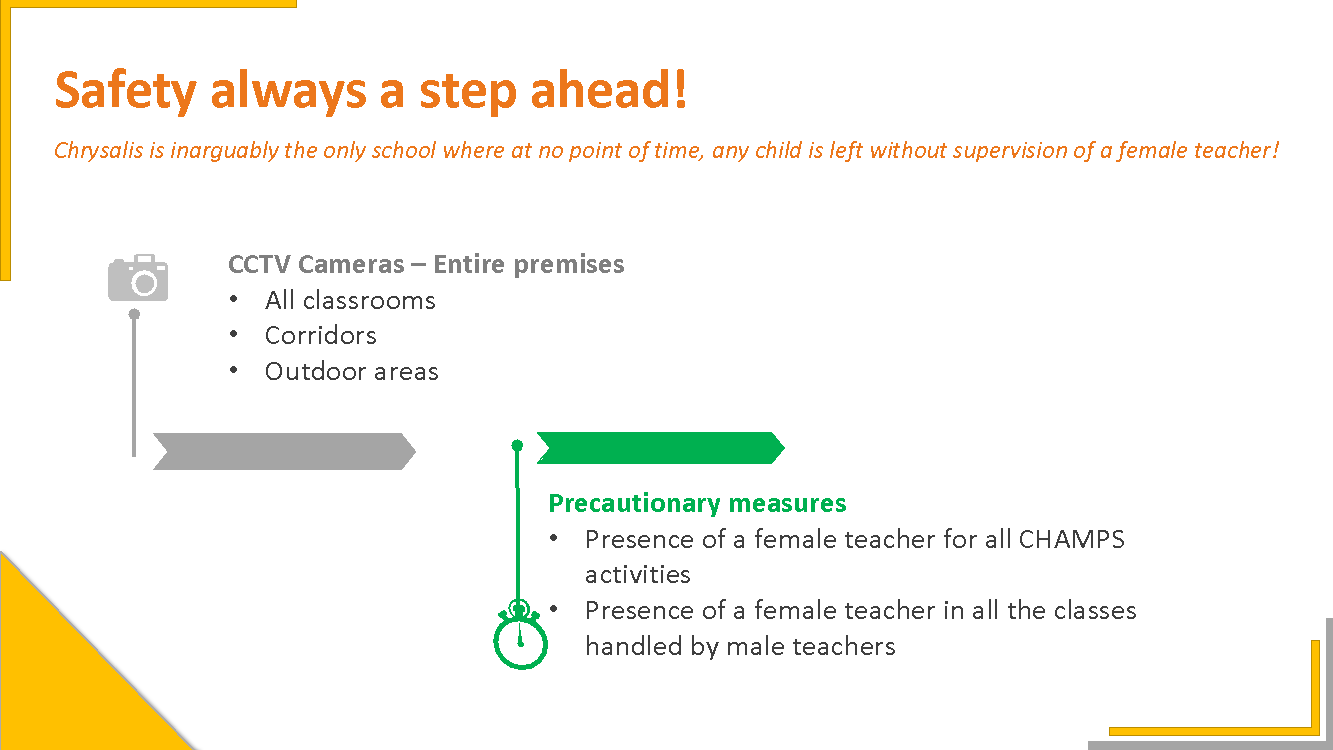
Safety Always a step ahead!

Chrysalis is inarguably the only school where at no point of time, any child is left without supervision of a female teacher!

CCTV Cameras- Entire premises

Precautionary measures

Nutrition

The School serves balanced and nutritious vegetarian snacks and lunch to students who have opted for the facility.

To supervise students during lunchtime, a teacher is appointed for monitoring each table. Children are trained to keep themselves clean and display correct dining manners.

Reverse Osmosis systems for purifying drinking water are available across the campus throughout the day.

Transport

We provide a fleet of well-maintained buses with trained drivers and lady attendants. Special care is taken while appointing the drivers, to ensure that only the experienced and qualified drivers are appointed after undergoing a driving test. The buses are equipped with safety equipment and a first-aid kit in case of an emergency.

Being GPS enabled, the school can locate the position of a bus at any time during commute and in case of a breakdown, can send a replacement bus instantly. To avoid rash driving and speeding, speed governors are installed in all the buses.

Salient Features

Indrani-Singh

Ms. Indrani Singh

Chief Vision Officer, Principal, Chrysalis High Marq & Head - Chrysalis Kids

Ms. Indrani Singh possesses a MSc and B.Ed degree to her credit. She has over 10 years of experience in the field of education and has climbed the rungs of leadership with her sheer dedication, hard work and love for her profession. She joined as the Head of Chrysalis Kids in 2013, which is a pre primary school of Chrysalis. Her out of box thinking and her ideology of doing the right thing for the children have helped her to pioneer new processes to make learning an enriching experience for the children. Across a period of seven years, Ms. Indrani Singh has become a flag bearer of Chrysalis vision, especially the PUPA (Prior Understanding of Pupil Attributes) Program. Indrani brought in the idea of Pre-CHAMPS to all Chrysalis schools. Known for her ideation & focus on quality, Indrani leaves no stone unturned to ensure children have a wonderful learning experience at Chrysalis. In 2017, she was made Associate Academic Director – Pre Primary & again promoted to Academic Director – Pre Primary, a role she handles along with the responsibilities of Chrysalis High, Marq. Under her supervision and guidance, many initiatives like Pre-CHAMPS, AwSTEM, Festival of learning were initiated and appreciated by all. Today she handles multitude of responsibilities from heading two schools to overseeing the Pre-Primary Curriculum Team of Chrysalis as the Academic Director. In addition to these profiles, she was recently promoted as Chief Vision Officer to propel PUPA, an initiative of Chrysalis, to greater heights. To this day, her ideas and her sheer determination to always try something different and new makes her a formidable and integral part of Chrysalis. With an unending pandemic looming over us, the future for education looked uncertain. But Ms. Indrani with her belief that learning should not stop for the children, ideated on the perfect balance of online and live class model to suit the learning styles of the children. The plan started with what best would suit the children and also help the working parents who were facing their own challenges and obstacles. The online model started with curriculum videos which the Chrysalis teachers recorded with the right guidance and methodology which was well defined by her. The live classes began with once a week class to slowly introduce the children to digital learning. With children adapting to live class, the sessions increased to add more to their knowledge. Teachers were sensitized about the challenges of live class and how to ensure that they do the right thing for the children and be an integral part in their learning given the circumstances. Providing the right support to parents and the challenges they faced, were also key elements of the whole digital teaching process. Providing individual support to the children was one way to ensure we partnered with parents to provide the right support to the children and ensure that the learning did not stop.