Evolution of technology through the generations:
It is rightly said that change is the only constant. In an ever evolving world every generation has not only witnessed but also adapted to its fair share of changes. In recent years we have made great strides in technology. The technological evolution has been phenomenal. While the Baby Boomer (1946-1964) successfully transverse the gap between early mechanical systems and modern digital interfaces, Gen X (1965-1980) were the first to integrate desktop computers and early mobile tools into daily professional life. They were followed by the Millennials (1981-1996) also known as the true Digital Natives, they are the harbingers of smart phones, cloud computing and digital streaming. Born into a fully connected, digital first world are Gen Z (1997-2012) for whom the rotary phone is a part of the stoneage!! Experiencing first hand what the science fiction writer Isaac Asimov wrote in his book I, Robot in the 1950s are Gen Alpha (2013-present), they are also referred to as the first ‘AI Native’ generation.
We are currently witnessing a meteoric advancement in technology. Keeping abreast with technological advancements and understanding how to navigate this vast technological ocean has become the need of the hour. It has become imperative for Gen Z and Gen Alpha that they become AI literate. It is a new ‘must-have’ skill for these generations, without which survival would be a challenge. In order to understand AI literacy, let us first answer the question ‘What is AI and how does it work?’
AI and its modus operandi:
While the human brain possesses finite capabilities for learning, reasoning, analysis and problem-solving, Artificial Intelligence aims to develop machines that can perform these functions on a much larger scale and at unprecedented speed. The AI systems are fed with enormous amounts of data which is analysed by various algorithms. These algorithms sift through data to identify connections. The systems adjust their parameters depending on their accuracy. AI tools are thus created by combining mathematical algorithms, enormous datasets and programming logic and then presenting it in user-friendly software.
The present generations are using AI as a means to the end, instead of using AI as a tool to achieve the goal. They blindly accept AI generated content without reviewing or evaluating it, without even realising that output that is generated can be flawed. We often talk about AI takeover but never realise that with our reliance and dependence on AI, we are actually paving the way for AI handover. Tools are created to make life convenient. However overuse or misuse of these tools can lead to adverse effects. The same holds true for AI as well. AI being a new technology, its uncensored, fatuous use can lead to unforeseen issues we don’t have solutions to yet. Hence AI literacy is no longer optional.
AI Literacy: Gen Z’s passport to the Future:
AI literacy encompasses critical understanding, evaluation and mindful usage of AI tools. While the current generations are adept at using various AI tools, they need to realise that AI literacy is not just about learning how to use them but more importantly use it judiciously. In today’s technologically driven world we interact with AI day in and day out without even realising it. The line between the real and the artificial is often so blurred that it is hard to differentiate between the two.
AI literacy is crucial to identify when one is interacting with AI and critically evaluate the responses. It is important to understand that unlike the human brain that has the capacity to think on its own, an AI tool functions by identifying patterns in enormous databases therefore its output is based on probability. This can often lead to AI hallucination, wherein the AI tool generates an incorrect answer and presents it conclusively. An unsuspecting mind can be easily convinced about this response. Additionally data is fed into AI machines by humans, but more often than not along with data human prejudices and predilections are also fed into the machines. This can lead to lopsided responses often misguiding young minds. It is thus vital that all responses generated by AI are thoroughly read and fact checked.
AI primarily functions on identifying patterns in enormous databases which means that any information fed into an AI tool is likely to be saved in the systems database and can be used by the system at any given point of time. This can give rise to serious privacy concerns. One must be aware about what information can be input and what information should not be. It is best to avoid confidential, personal or copyrighted information.
AI literacy also entails ensuring originality and authenticity. In a world where plagiarism and heavy dependence on AI generated outputs abound it is easy to lose sight of the ingenuity of the human mind. AI tools should be used to help with the simplification of the task rather than the completion of the task.
While AI use has surged dramatically, the level of understanding about AI has not kept pace. AI literacy attempts to bridge this gap and advocate the mindful use of AI.
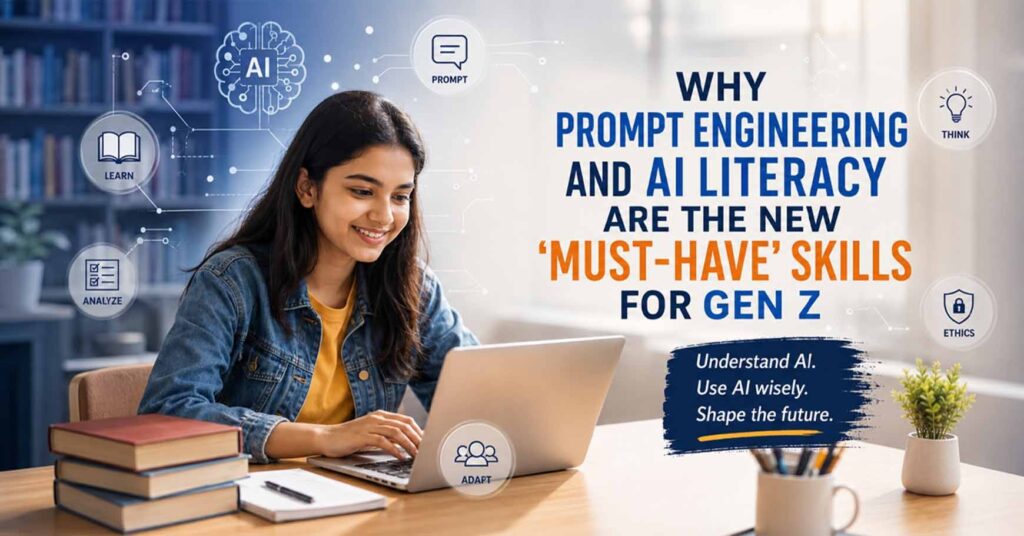
Prompt engineering: The key to Gen Z’s success in an AI-driven world
While on one hand AI literacy teaches us to exercise caution while using AI tools, on the other hand AI literacy teaches us how to use these tools effectively. The art of generating high quality outputs depends on the prompts that are input into AI tools. Thus prompt engineering plays a pivotal role in AI literacy. Prompt engineering deals with the technique of creating highly specialized and specific instructions to steer AI tools towards producing the most precise, pertinent and valuable outputs. In order to make the most of AI tools it is essential to master the art of prompt engineering. Prompt engineering involves the utilization of the CERF framework to define the details and structure of the final answer. CERF is an acronym where
- C stands for Context wherein the the prompt details out the context of the information
- E stands for Expectation wherein clear, specific prompts are provided for the completion of the task.
- R stands for Role, here a persona or profession is assigned to the AI. The answer that is generated will be from this persona or profession’s point of view.
- F stands for Formatting which deals with the specification of the output.
One can also upload information on to AI tools in various formats such as images, documents, spreadsheets. An understanding of which format of information would yield the best results is also essential. In addition to this the knowledge of specialized tools for varied tasks can further enhance and streamline the output.
The future will be shaped by those who not only use AI but master it; success in this AI-driven era depends on unlocking the full potential of these powerful tools.
The Inference:
Every generation has had to embrace and adapt to new technological innovations. Gen Z are confronted with challenges unlike any other generations before them. No other technological development thus far has had the cognitive ability that AI possesses, thus posing a threat to the very ability the human race has prided itself in – cognition. The only way to move forward and stay ahead is to ensure that the reins are in our hands. This is possible with proper AI literacy.
AI literacy and prompt engineering have become a prerequisite for Gen Z, whether they are trying to navigate their career or educational paths or protect themselves from all the risks and perils that AI brings along with it. As a generation born in a fully connected, digital first world, technology has always been a part and parcel of their lives. However the time has come now for them to embrace the change that accompany the shift sands of AI and rise to the challenge by exercising insight and discernment while using AI in their day to day life.
(Explore More About AI Blogs)
(Know More About Chrysalis High School)
Written By – Ameeta Bhaskar,
Secondary Teacher – Chrysalis High Horamavu
Frequently Asked Questions:
AI literacy is the ability to understand, evaluate, and use artificial intelligence responsibly and effectively. It helps Gen Z identify reliable AI-generated information, protect their privacy, think critically, and make informed decisions in an increasingly AI-driven world.
Prompt engineering is the skill of writing clear, detailed, and structured instructions for AI tools. Well-crafted prompts provide context, define expectations, specify the AI’s role, and describe the desired output format, resulting in more accurate, relevant, and useful responses.
No. AI can assist with research, brainstorming, and problem-solving, but it cannot replace human creativity, critical thinking, emotional intelligence, ethical judgment, or decision-making. These uniquely human skills remain essential for academic and professional success.
Using AI without understanding its limitations can lead to misinformation, AI hallucinations, biased outputs, plagiarism, and privacy risks. Developing AI literacy helps users verify information, use AI ethically, and avoid sharing sensitive or confidential data.
Students can build AI literacy by learning how AI works, fact-checking AI-generated content, practicing responsible AI usage, writing effective prompts, and using AI as a learning assistant rather than relying on it to complete tasks independently.
Being tech-savvy means you know how to navigate digital interfaces, use apps, and adapt to new software quickly—skills Gen Z already excels at. AI literacy goes deeper; it is the ability to critically evaluate AI-generated outputs, understand the data privacy risks involved, and identify machine biases and hallucinations rather than blindly accepting the results.