“Can you just ask ChatGPT?”
A question that once sounded strange now slips into daily family chatter. Whether it’s a Grade IV science project, a Grade IX essay, or a tricky math problem, AI has become the go-to homework buddy for millions of kids.
And for parents, this shift brings a whole new kind of headache.
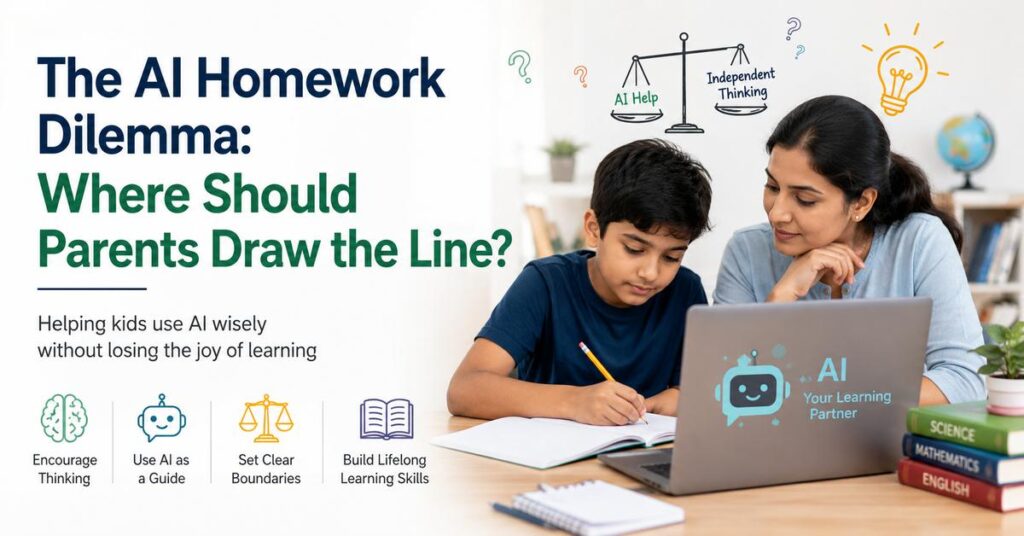
Should kids use AI for homework?
If so, how much is too much?
And really, where do you draw the line?
It’s not just about banning AI or letting it run wild. Think about calculators, the Internet, search engines; AI isn’t evil or magic. It’s a tool, plain and simple. Everything depends on how you use it.
The truth is, keeping AI away from kids? That ship sailed a while ago. Now, the challenge is helping them use it wisely, responsibly, and honestly.
Homework Has Changed A Lot
Ten years ago, homework meant flipping through encyclopaedias, scribbling notes, and digging around in library stacks. Then came Google, endless articles, YouTube tutorials, and virtual classrooms.
Now, AI can easily draft an essay, break down a science concept, solve an equation, summarize an entire novel, create a presentation, and even write out computer code in just seconds.
For kids these days, it’s just normal.
Why spend forever slogging through a writing assignment when AI can crank it out in a minute?
It’s a fair question. We’ve always made tech to save time and make things easier.
But learning isn’t about finishing the worksheet.
It’s about building the mind that figures out the answer.
That difference matters.
Is It Helping… or Hurting?
Picture a kid learning to ride a bike.
If a parent never lets go, the kid might never crash but also never learns to balance.
AI’s kind of like that.
As a backup, it can boost confidence.
As a substitute, it can block growth.
Plenty of parents cheer for polished homework, not realizing their kid doesn’t really get it at all. A shiny essay hides shaky understanding.
Homework isn’t for neat handwriting or fancy vocabulary or perfect formatting, It’s for practicing thinking. Homework teaches patience, strengthens memory, encourages problem-solving, and makes room for mistakes and for bouncing back.
If AI wipes away every struggle, it wipes out the growth, too.
AI Makes a Great Coach But a Bad Stand-In
People argue that AI either helps kids cheat or helps them learn, but honestly, it does both.
Used right, AI’s an amazing tutor.
Kids stuck on photosynthesis? Ask AI to explain in plain English.
Confused by Shakespeare? Get a simple translation.
Preparing for a test? Ask AI to generate practice questions, more examples, whatever they need.
That’s helpful because the kid is still thinking, still active.
Trouble starts when AI begins doing the thinking.
Copying full essays without reading, handing in answers without understanding and relying on AI for every assignment means losing their own voice.
Kids start learning less, thinking less and breaking that habit isn’t easy.
The Price of Instant Answers
Kids today are raised on speed.
Texting is instant. Shopping →instant. Entertainment →instant.
Information?? also Instant.
Now, homework? Instant, thanks to AI.
But deep learning never happened in an instant.
Great writers rewrite. Scientists keep testing. Artists sketch and sketch again. Athletes train through mistakes. The magic’s in the effort.
When answers always show up instantly, kids start believing every problem should have a quick solution but interestingly life isn’t like that.
Tests don’t hand out AI. Job interviews don’t, either and big life decisions definitely won’t.
Parents Aren’t Just Teachers but Role Models
Kids watch what grown-ups do. That matters way more than what they say.
If parents count on AI for every grocery list, email, social media post, or work task, kids think outsourcing thinking is normal.
Instead, parents can start showing balance. Using AI to spark ideas, clarify stuff, learn new things but at the same time also let your kids see you work – read books, talk through ideas, solve puzzles, ask wild questions.
Curiosity grows when you nurture it. No chatbot can do that.
Setting Boundaries Without Banning
No need to outlaw AI completely. Clear rules help.
Some families try this:
Think first. Ask AI later.
Let kids tackle homework on their own. If they get stuck after really trying, AI can give hints or explanations but not the full answer.
Ask kids to explain AI-generated answers in their own words. If they can’t explain it, they haven’t learned it. And here’s another trick: Separate learning tasks from presentation tasks.
Let AI tidy grammar, organize ideas, or suggest stronger vocabulary after the homework’s done. Never let it do the actual thinking. Thinking always should belong to the student.
Change the Conversation
Instead of “Did you finish your homework?” ask,
“What did you learn?”
“What part was tough?”
“How did you figure that out?”
It’s about understanding, not just completing.
If AI played a part, ask,
“What did AI help you learn?”
Not, “Did AI do it for you?”
You’re building a conversation about learning, not policing.
Kids respond better when they know they’re trusted, not just watched.
Schools and Parents Have to Work Together
AI isn’t going away, and schools alone can’t handle the changes.
This takes teamwork.
Teachers need to design assignments that focus on thinking, reflection, discussion, creativity, and real-world learning. We should remember that things can’t just be outsourced.
Parents can reinforce honesty, perseverance, and independence at home.
Together, they show students:
Technology’s here to boost human intelligence not replace it.
Preparing Kids for More Than Just Homework
Lots of parents worry about holding their kids back if they limit AI.
But honestly, it’s the opposite.
Yes, employers will want people who know how to use AI.
But they’ll value something even more like people who can think for themselves.
The future’s for those who know how to ask good questions, which answers to trust, and when to challenge them.
Original ideas, ethical judgement, emotionally smart, creativity, leadership, and teamwork- AI just can’t match those.
Raise kids who can use AI confidently, but never depend on it.
It’s Not a Simple Line
So where’s the line?
It’s not between tech and tradition.
It’s not screens versus books.
It’s not AI versus homework.
It’s between assistance and dependence.
If AI helps kids understand, think deeper, and get curious, that’s good for learning.
If it replaces effort, curiosity, and independent thought, it’s undermining education.
Kids don’t need to fear AI but they need to master it, without letting it master them.
Homework’s not really about finishing an assignment.
It’s about developing habits of thinking, asking questions, sticking with problems, and learning.
AI can write an essay, solve a math equation, or summarize a chapter but it can’t replace the confidence a kid gets from solving something hard through their own effort.
Conclusion
AI isn’t going anywhere, and fighting it doesn’t help. Instead of seeing it as an enemy, parents can treat it as a chance to teach discernment.
Kids need to know when to ask for help, when to keep struggling, and when to challenge what’s in front of them. The goal isn’t raising students who just use the latest tech but building people who are wise, honest, and gutsy enough to use it well.
Education was never just about collecting answers. It’s about growing minds. Homework is just a tiny part of that. If parents help kids see AI as a guide, not a crutch, they’ll do better in school and grow into thoughtful, resilient, capable adults because really, in a world fueled by AI, the biggest advantage goes to those who still value human intelligence, curiosity, and character above everything else.
(Explore More About AI Blogs)
(Know More About Chrysalis High School)
Written By – Sharmila Yellapu
Secondary Teacher – Chrysalis High, Bannerghatta Road
Frequently Asked Questions
Yes, children can use AI as a learning support tool, but it should not complete their homework for them. AI can explain difficult concepts, provide examples, generate practice questions, and offer hints while allowing students to do the actual thinking and problem-solving.
Parents can set clear boundaries such as asking children to attempt the work independently first, use AI only when genuinely stuck, verify AI-generated information, and explain answers in their own words. This encourages responsible AI use without discouraging curiosity.
Using ChatGPT is not necessarily cheating if it is used appropriately for learning, brainstorming, explanations, or practice. However, submitting AI-generated work as the student’s own without understanding or disclosing its use can conflict with academic honesty policies.
AI does not automatically reduce critical thinking, but excessive dependence on it can limit opportunities for children to solve problems independently. When students use AI to explore ideas, question answers, compare information, and deepen understanding, it can instead support critical thinking.
Parents should look for schools that balance technology with independent thinking, creativity, problem-solving, life skills, and hands-on learning. Chrysalis High, for example, highlights initiatives such as STEaM, Life Skills, Dream Period, and ISP as part of its broader learning approach. It offers CBSE and ICSE schools across Bangalore.
Schools and parents can establish consistent expectations around AI use, academic honesty, fact-checking, and independent work. Teachers can design assignments that encourage reflection and creativity, while parents can reinforce these habits at home and discuss how AI was used rather than simply asking whether it was used.