The Silent Architects of an Emerging Power
Leadership is the bridge between a nation’s potential and its progress.” India’s journey as the world’s largest democracy reflects this truth. Since independence in 1947, the country has evolved from a newly independent nation facing poverty and instability into one of the world’s fastest-growing major economies and an influential global power.
This transformation has been shaped by all the Prime Ministers of India, whose leadership guided India through nation-building, economic reforms, technological advancement and global diplomacy. From strengthening democratic foundations to emerging as a leader in IT, space research and international forums, India’s rising global stature stands as a testament to the power of visionary leadership. The story of the Prime Ministers of India is therefore not just a political narrative, but a chronicle of how visionary leadership can transform a nation’s immense potential into sustained progress and global prominence.
Forgers of Destiny: The Titans of a Rising Nation
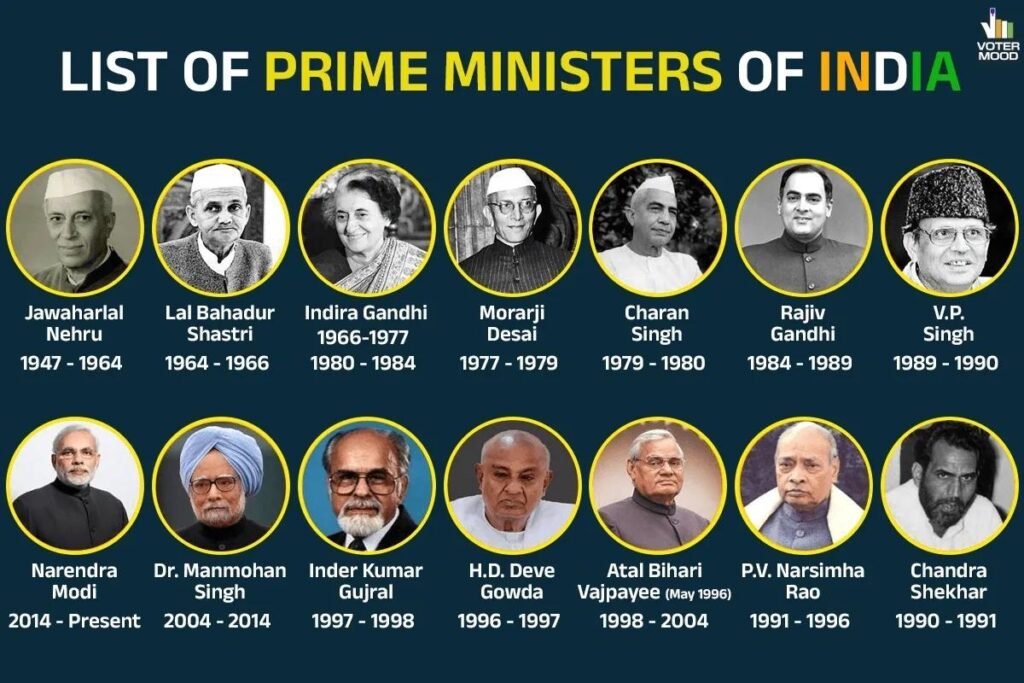
Jawaharlal Nehru (1947–1964)
As India’s first and longest-serving Prime Minister, Jawaharlal Nehru laid the strong foundations of modern India. A visionary and progressive statesman, he championed democracy, secularism, and scientific temper as guiding principles for the new nation. He established premier institutions such as the IITs and promoted planned industrial development to build a self-reliant economy. Through his policy of Non-Alignment, India emerged as an independent voice during the Cold War. Despite challenges, including the 1962 war with China, Nehru’s enduring legacy lies in the robust democratic institutions and forward-looking vision that continue to shape India’s identity.
Lal Bahadur Shastri (1964–1966)
Lal Bahadur Shastri is fondly remembered for his humility, simplicity and unwavering integrity. Despite his soft-spoken demeanor, he displayed remarkable courage and determination during a critical phase in India’s history. He steered the nation with resilience during the 1965 war with Pakistan, inspiring confidence and unity among citizens. His powerful slogan, “Jai Jawan, Jai Kisan,” highlighted the vital role of soldiers in safeguarding the nation and farmers in sustaining it. By strongly supporting agricultural reforms and self-sufficiency, he laid the groundwork for the Green Revolution, which significantly strengthened India’s food security and reduced dependence on imports. His leadership remains a shining example of dedication, patriotism and moral strength.
Indira Gandhi (1966–1977, 1980–1984)
India’s first and only woman Prime Minister, Indira Gandhi was a strong and resolute leader who left an indelible mark on the nation’s history. Known for her decisive style of governance, she undertook bold measures such as the nationalization of banks to strengthen the public sector and promote economic equity. Her leadership during the 1971 war demonstrated strategic acumen and resulted in the creation of Bangladesh, significantly enhancing India’s regional influence.Indira Gandhi’s assertive leadership profoundly reshaped India’s political landscape and consolidated central authority, making her one of the most influential figures in modern Indian history.
Morarji Desai (1977–1979)
Morarji Desai became the first non-Congress Prime Minister of India, marking a historic turning point in the nation’s political landscape and signaling the strength of its democratic framework. His leadership emerged at a crucial time following the Emergency, when the country sought stability and the restoration of democratic values. Under his government, civil liberties were reinstated, press freedom was revived and constitutional processes were strengthened, reaffirming the supremacy of democratic institutions. His tenure underscored the resilience of India’s democracy and demonstrated that the will of the people remains central to the nation’s governance.
Rajiv Gandhi (1984–1989)
Rajiv Gandhi infused Indian politics with youthful energy and a forward-looking vision. Recognizing the transformative power of technology, he championed modernization and ushered India into the era of computers and telecommunications. His emphasis on expanding digital infrastructure, improving connectivity and encouraging technological innovation laid the foundation for India’s IT revolution. By promoting computerization and reforming communication systems, he set the stage for India’s emergence as a global technology hub. His progressive outlook not only modernized governance but also opened new opportunities for economic growth and global integration.
P. V. Narasimha Rao (1991–1996)
P. V. Narasimha Rao is widely regarded as the architect of India’s economic liberalization. At a time when the nation was grappling with a severe balance-of-payments crisis, his calm and decisive leadership steered India toward bold structural reforms. Under his government, sweeping policy changes dismantled the License Raj, reduced trade barriers, and opened the doors to globalization. These landmark reforms revitalized the Indian economy, encouraged private enterprise, attracted foreign investment and integrated India into the global marketplace. His visionary economic direction not only stabilized the country during a period of uncertainty but also laid the foundation for India’s emergence as one of the world’s fastest-growing economies.
Atal Bihari Vajpayee (1998–2004)
Atal Bihari Vajpayee was widely admired for his eloquence, statesmanship, and balanced approach to leadership. A leader of conviction and vision, he guided India through significant strategic and developmental milestones. In 1998, his government conducted the Pokhran-II nuclear tests, firmly establishing India as a nuclear power and asserting its strategic autonomy on the global stage. He also prioritized infrastructure development, launching the ambitious Golden Quadrilateral highway project, which transformed connectivity and boosted economic growth across the country. At the same time, Vajpayee extended sincere efforts toward peace and dialogue with neighboring nations, reflecting his belief in diplomacy alongside strength. His tenure is remembered for blending firmness with foresight and development with dialogue.
Manmohan Singh (2004–2014)
An economist of global repute, Manmohan Singh brought intellectual depth and steady leadership to the office of Prime Minister. His tenure was marked by sustained economic growth, financial stability, and policies aimed at inclusive development. Under his leadership, India witnessed significant expansion in GDP and deeper integration into the global economy. His government introduced landmark initiatives such as the Right to Information Act, which strengthened transparency and accountability and major rural employment programmes that enhanced social security for millions. On the international front, he played a pivotal role in strengthening strategic partnerships, most notably through the historic Indo-U.S. civil nuclear agreement, which elevated India’s standing in the global arena. His leadership combined economic expertise with a commitment to social equity and global engagement.
Narendra Modi (2014–present)
Narendra Modi’s leadership has been characterized by a strong focus on economic reform, digital transformation and proactive global engagement. With an emphasis on modernization and efficiency, his government has launched flagship initiatives such as Digital India to expand technological access, Make in India to boost manufacturing and entrepreneurship, and Swachh Bharat to promote nationwide cleanliness and sanitation. His tenure has also witnessed major structural reforms, including the implementation of the Goods and Services Tax (GST), aimed at creating a unified national market. The vision of “Atmanirbhar Bharat” underscores a drive toward self-reliance, innovation and economic resilience. On the global stage, India has expanded its diplomatic outreach, strengthened strategic partnerships and enhanced its role in international forums, reflecting a more assertive and confident global presence.
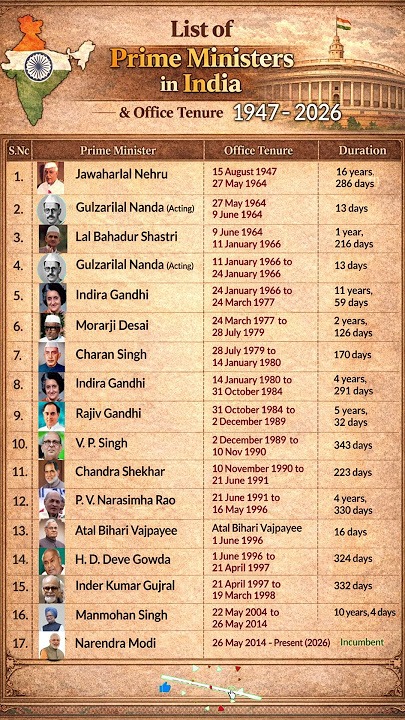
Leadership Through the Years: A List of the Prime Ministers of India (1947–2026)
| Name | Tenure as PM | Interesting fact |
|---|---|---|
| Jawaharlal Nehru | 15 Aug 1947 – 27 May 1964 | First PM of independent India and its longest-serving PM. |
| Gulzarilal Nanda (Acting) | 27 May – 9 Jun 1964, 11–24 Jan 1966 | Served twice as acting PM after deaths of sitting PMs. |
| Lal Bahadur Shastri | 9 Jun 1964 – 11 Jan 1966 | Coined “Jai Jawan Jai Kisan” during the 1965 war. |
| Indira Gandhi | 24 Jan 1966 – 24 Mar 1977; 14 Jan 1980 – 31 Oct 1984 | First and only woman PM of India. |
| Morarji Desai | 24 Mar 1977 – 28 Jul 1979 | First non-Congress PM. |
| Charan Singh | 28 Jul 1979 – 14 Jan 1980 | Only PM who never faced Parliament in a session. |
| Rajiv Gandhi | 31 Oct 1984 – 2 Dec 1989 | Youngest PM at age 40 when sworn in. |
| V. P. Singh | 2 Dec 1989 – 10 Nov 1990 | First PM to lose power after a no-confidence vote. |
| Chandra Shekhar | 10 Nov 1990 – 21 Jun 1991 | Known as “Babuji”; led a short minority government. |
| P. V. Narasimha Rao | 21 Jun 1991 – 16 May 1996 | Oversaw major economic reforms liberalising India’s economy. |
| Atal Bihari Vajpayee | 16 May–1 Jun 1996; 19 Mar 1998 – 22 May 2004 | First non-Congress PM to complete a full term; also a noted poet. |
| H. D. Deve Gowda | 1 Jun 1996 – 21 Apr 1997 | Second PM from South India. |
| I. K. Gujral | 21 Apr 1997 – 19 Mar 1998 | Served as PM while a Rajya Sabha member. |
| Manmohan Singh | 22 May 2004 – 26 May 2014 | First PM from the minority community |
| Narendra Modi | 26 May 2014 – present | First PM born after Independence and (as of 2025) second-longest serving. |
The Transformative Influence of India’s Leadership
The influence of India’s Prime Ministers extends far beyond policies and programmes; it is deeply woven into the nation’s progress and identity. Collectively, their leadership has shaped the course of India’s development in remarkable ways:
Strengthened Democracy: Despite wars, political transitions, and internal challenges, India has preserved and reinforced a vibrant democratic framework rooted in constitutional values and the will of its people.
Transformed the Economy: From a largely agrarian and resource-constrained nation at independence, India has evolved into one of the world’s fastest-growing major economies, driven by reforms, innovation and enterprise.
Advanced Science and Technology: Through sustained investment in education, research and innovation, India has emerged as a global force in information technology, space exploration, pharmaceuticals and scientific research.
Enhanced Global Standing: Strategic diplomacy and international cooperation have elevated India’s voice on global platforms, positioning it as a key player in regional and global affairs.
Promoted Social Change: Progressive reforms and welfare initiatives have sought to advance equality, expand opportunities and empower marginalized communities.
Each Prime Minister governed in a distinct historical context—navigating wars, economic crises, political shifts and global transformations. Through their varied approaches and visions, they collectively shaped India’s trajectory, reflecting the resilience, diversity and enduring aspirations of the nation itself.
A League of Leaders, A Legacy of Progress
The story of India’s Prime Ministers is, in many ways, the story of India’s remarkable evolution from a newly independent nation to a confident and influential global power. Each leader, shaped by the demands of their time, contributed uniquely to the building of a resilient democracy and a dynamic society. From laying the foundations of strong democratic institutions and safeguarding constitutional values to steering bold economic reforms and championing scientific and technological advancement, their collective leadership has guided the nation through decades of transformation.
They have navigated wars, economic crises, social transitions and shifting global realities with determination and vision. Through their policies and decisions, they expanded access to education, strengthened infrastructure, encouraged industrial growth, empowered rural communities and integrated India more deeply into the global economy. Their efforts helped propel India from an agrarian economy striving for self-sufficiency to a nation recognized for its innovation, entrepreneurial spirit, space exploration and digital advancement.
As India continues to rise and redefine its role in an interconnected and competitive world, the enduring legacy of its Prime Ministers remains intricately woven into the fabric of the nation’s progress. Their leadership reflects not only political stewardship but also the resilience, diversity and aspirations of over a billion people. In tracing their journeys, we trace the unfolding story of India itself—a story of perseverance, transformation, and an unyielding pursuit of progress.
(Explore more about Nation related blogs)
(Know more about Chrysalis High)
Written By – Ameeta Bhaskar,
Secondary Teacher – Chrysalis High Horamavu
Frequently Asked Questions
The first Prime Minister of India was Jawaharlal Nehru. He served from 15 August 1947 to 27 May 1964 and laid the foundation of modern democratic India.
Since Independence in 1947, India has had 15 full-time Prime Ministers, along with acting Prime Ministers. The current Prime Minister is Narendra Modi.
Jawaharlal Nehru remains the longest-serving PM, with a tenure of nearly 17 years. He is followed by Indira Gandhi and Narendra Modi. Since 2014, the current leadership has focused heavily on digital transformation and global economic integration.
As of 2026, Narendra Modi is serving as the Prime Minister of India.
Rajiv Gandhi became the youngest Prime Minister of India at the age of 40 in 1984.
Lal Bahadur Shastri introduced this slogan during the 1965 war, emphasizing soldiers and farmers while advancing the Green Revolution.
Yes, Indira Gandhi was the first and only woman Prime Minister of India. She served two separate terms (1966–1977 and 1980–1984) and is remembered for her decisive leadership, the nationalization of banks, and leading India during the 1971 war.
Understanding the prime ministers of India helps students learn about nation-building, democracy, economic reforms, and leadership evolution. Schools like Chrysalis High, one of the best CBSE & ICSE schools in Bangalore, encourage students to explore Indian political history to build civic awareness and leadership values.