Many people search for topics such as the President of India, the first president of India, the first woman president of India, or the president of India list from 1947 to 2026. These questions reflect curiosity about the leaders who have held the highest constitutional office in the country.
India gained independence in 1947, but the office of the President came into existence only after the Constitution was adopted and India officially became a republic on 26 January 1950, celebrated as Republic Day. Since then, the presidents of India have played a vital role in safeguarding the Constitution and maintaining the stability of the nation’s democratic institutions.
The President of India is the constitutional head of the state and the supreme commander of the armed forces. While the role is largely ceremonial in everyday governance, the President holds significant constitutional authority, especially during political transitions, emergencies, and legislative procedures.
According to Article 52 of the Constitution of India, there shall always be a President of India. Over the decades, distinguished individuals from diverse backgrounds—scholars, freedom fighters, scientists, and political leaders—have served in this prestigious position. Their leadership has helped strengthen India’s democratic framework and national unity.
First President of India
The first president of India was Dr. Rajendra Prasad, a prominent freedom fighter and close associate of Mahatma Gandhi. He assumed office on 26 January 1950 and served until 1962, making him the only President to complete two full terms.
During his presidency, Dr. Rajendra Prasad guided the newly formed republic through its formative years. He played an important role in establishing the dignity, neutrality, and independence of the presidential office. His leadership helped strengthen parliamentary traditions and democratic governance during a crucial period in India’s history.
Dr. Prasad strongly supported education, agricultural reforms, and national development, and he worked closely with the government to stabilize India’s institutions in the early years of independence.
List of Presidents of India in Chronological Order
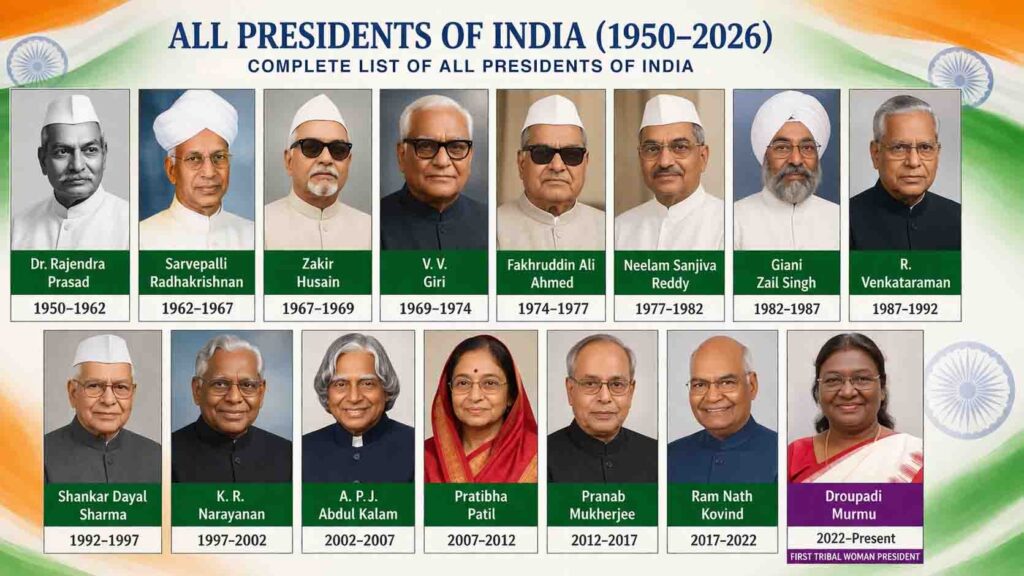
Below is the complete list of presidents of India, including their tenure and key contributions. This list is often searched online as the president of India list from 1947 to 2026, though technically the presidency began in 1950.
1. Rajendra Prasad (1950–1962)
As the first president of India, Rajendra Prasad oversaw the transformation of India into a republic. He supported education, agricultural development, and constitutional stability during the early years of independence.
2. Sarvepalli Radhakrishnan (1962–1967)
A renowned philosopher and scholar, Sarvepalli Radhakrishnan previously served as India’s Vice President. His presidency enhanced India’s intellectual reputation worldwide. His birthday, 5 September, is celebrated as Teachers’ Day in India in recognition of his contribution to education.
3. Zakir Husain (1967–1969)
Dr. Zakir Husain was a distinguished educationist and the first Muslim President of India. He strongly advocated educational reforms and national integration. His tenure ended unexpectedly when he passed away in office, becoming the first President to do so.
4. Varahagiri Venkata Giri (1969–1974)
V. V. Giri initially served as Acting President before being elected to the position. Known for his strong association with the labor movement, he championed workers’ rights and trade union activities in India.
5. Fakhruddin Ali Ahmed (1974–1977)
Fakhruddin Ali Ahmed served during one of the most controversial periods in Indian political history—the Emergency (1975–1977). Acting on the advice of the Prime Minister, he signed the proclamation of Emergency. He later passed away while in office.
6. Neelam Sanjiva Reddy (1977–1982)
Neelam Sanjiva Reddy holds the distinction of being the only President elected unopposed. His presidency came after the Emergency period, and he played a crucial role in restoring democratic values and political stability.
7. Giani Zail Singh (1982–1987)
Giani Zail Singh served during a politically sensitive period, including Operation Blue Star. His tenure also witnessed strained relations between the President and the Prime Minister, highlighting the complexities of constitutional roles.
8. Ramaswamy Venkataraman (1987–1992)
R. Venkataraman guided India during a time of political instability and coalition governments. He ensured that constitutional procedures were followed despite frequent political changes.
9. Shankar Dayal Sharma (1992–1997)
Shankar Dayal Sharma emphasized constitutional discipline and respect for parliamentary traditions. His presidency coincided with coalition politics and minority governments.
10. K. R. Narayanan (1997–2002)
K. R. Narayanan became the first Dalit President of India. Known as a “working President,” he actively used constitutional powers to question government decisions and advocated social justice and equality.
11. A. P. J. Abdul Kalam (2002–2007)
Dr. A. P. J. Abdul Kalam, popularly known as the “Missile Man of India,” was one of the most loved presidents. A distinguished scientist, he inspired millions of young Indians with his vision of India 2020, promoting innovation, education, and scientific progress.
12. Pratibha Patil (2007–2012)
Pratibha Patil made history as the first woman president of India. Her presidency focused on women’s empowerment, rural development, and inclusive growth. She also represented India at numerous international forums.
13. Pranab Mukherjee (2012–2017)
Pranab Mukherjee brought decades of political and parliamentary experience to the presidency. He emphasized the importance of democratic institutions, higher education, and innovation.
14. Ram Nath Kovind (2017–2022)
Ram Nath Kovind advocated social justice, education, and empowerment of marginalized communities. His presidency highlighted inclusive development and constitutional values.
15. Droupadi Murmu (2022–Present)
Draupadi Murmu President of India marks a historic milestone in Indian democracy. She is the first tribal woman and the youngest President of India. Her election symbolizes inclusivity and representation for tribal communities and underrepresented groups.
Role and Importance of the President of India
The President of India performs several important constitutional duties that ensure the proper functioning of the government. Some of the key responsibilities include:
• Appointing the Prime Minister and the Council of Ministers
• Giving assent to bills passed by Parliament before they become law
• Declaring national emergencies under constitutional provisions
• Acting as the Supreme Commander of the Indian Armed Forces
• Representing India in international relations and diplomatic affairs
Although the executive authority is exercised on the advice of the Council of Ministers, the President acts as the guardian of the Constitution. The role becomes particularly important during political uncertainty or constitutional crises.
Evolution of the Presidency in India
The office of the President has evolved significantly since 1950. Early leaders such as Rajendra Prasad and Sarvepalli Radhakrishnan helped establish democratic traditions and constitutional norms in the newly formed republic.
In later decades, Presidents faced challenges such as political instability, coalition governments, and economic transformations. Leaders like K. R. Narayanan and A. P. J. Abdul Kalam redefined the presidency by actively engaging with social issues and inspiring the youth.
More recently, the election of Draupadi Murmu as President of India reflects India’s commitment to diversity and representation. Her presidency symbolizes empowerment for tribal communities and women across the country.
The diversity among the presidents of India—from scholars and philosophers to scientists and social reformers—demonstrates the inclusive spirit of Indian democracy.
Conclusion
The Presidents of India have played an essential role in shaping the nation’s democratic journey. Although the position is often viewed as ceremonial, the President acts as a stabilizing force during political transitions, constitutional challenges, and national crises.
From the visionary leadership of the first president of India, Dr. Rajendra Prasad, to the inspirational legacy of Dr. A. P. J. Abdul Kalam, and the historic leadership of Draupadi Murmu President of India, each leader has contributed uniquely to the nation.
Understanding the list of presidents of India helps us appreciate how the highest constitutional office has evolved over time. As India continues to grow as a global power, the President remains a symbol of unity, constitutional integrity, and democratic strength.
(Explore More About Nation Related Blogs)
(Know More About Chrysalis High)
Written By – Rajeshwari R,
Academic Coordinator – Chrysalis High Varthur
Frequently Asked Questions
Dr. Rajendra Prasad was the first President of India, serving from 1950 to 1962. As a freedom fighter and Gandhi associate, he guided the republic’s early years, promoting education and constitutional stability.
The first woman President of India was Pratibha Patil, who served as the 12th President from 2007 to 2012. Her presidency was a landmark moment for women’s empowerment and gender representation in Indian politics.
The current Droupadi Murmu, President of India, assumed office on July 25, 2022. She is a historic figure in Indian democracy, serving as the first person from a tribal community and the second woman to hold the highest constitutional office.
Yes, under the Constitution of India, there is no legal bar on a President seeking re-election. However, in the history of the list of Presidents of India, Dr. Rajendra Prasad is the only individual to have actually served two terms.
The President of India is the constitutional head of the country. Key responsibilities include appointing the Prime Minister, giving assent to laws, declaring emergencies, and acting as the Supreme Commander of the armed forces.
Leading educational institutions like Chrysalis High, the best ICSE school in Bangalore, integrate the study of the Presidents of India into their comprehensive Civics and History curriculum. By focusing on the lives of leaders like Dr. A.P.J. Abdul Kalam, the school inspires students to understand constitutional values and leadership.