As parents, we all want to provide best education which will help our children to stand confident in todays world. So what comes to mind is AI literacy. It is a known fact that in 21st century the human brain possesses finite capabilities for learning, reasoning, analysis and problem-solving. Artificial Intelligence aims to develop machines that can perform these functions on a much larger scale and at unprecedented speed. The AI systems are fed with enormous amounts of data which is analysed by various algorithms. These algorithms sift through data to identify connections. The systems adjust their parameters depending on their accuracy. AI tools are thus created by combining mathematical algorithms, enormous datasets and programming logic and then presenting it in user-friendly software.
The present generations are using AI as a means to the end, instead of using AI as a tool to achieve the goal. They blindly accept AI generated content without reviewing or evaluating it, without even realising that output that is generated can be flawed. We often talk about AI takeover but never realise that with our reliance and dependence on AI, we are actually paving the way for AI handover. Tools are created to make life convenient. However overuse or misuse of these tools can lead to adverse effects. The same holds true for AI as well. AI being a new technology, its uncensored, fatuous use can lead to unforeseen issues we don’t have solutions to yet. Hence AI literacy is no longer optional.
We are constantly contemplating whether to allow students to use Chat GPT or to prohibit its use of it. But the truth is at some point in time we not only allow but also sit with them to search for things and maybe do the homework or project using this tool.
AI challenging Education but not replacing it
So it’s true that in today’s era, learning has become smarter. We all use various tools to get an upgraded version, but this upskilling happens through various platforms but do you all know what attracts students more which in turn pushes them to use Chat GPT is instant feedback. When we involve any human, we have to wait for an appropriate time to show but Chat GPT does at the spur of the moment. Also, kids nowadays need assistance, and if parents are busy with office work, they fail to give their kids time, so it serves as their companion. Whenever students ask anything, ChatGPT is there to give an appropriate response and also to give company and have a chit chat.
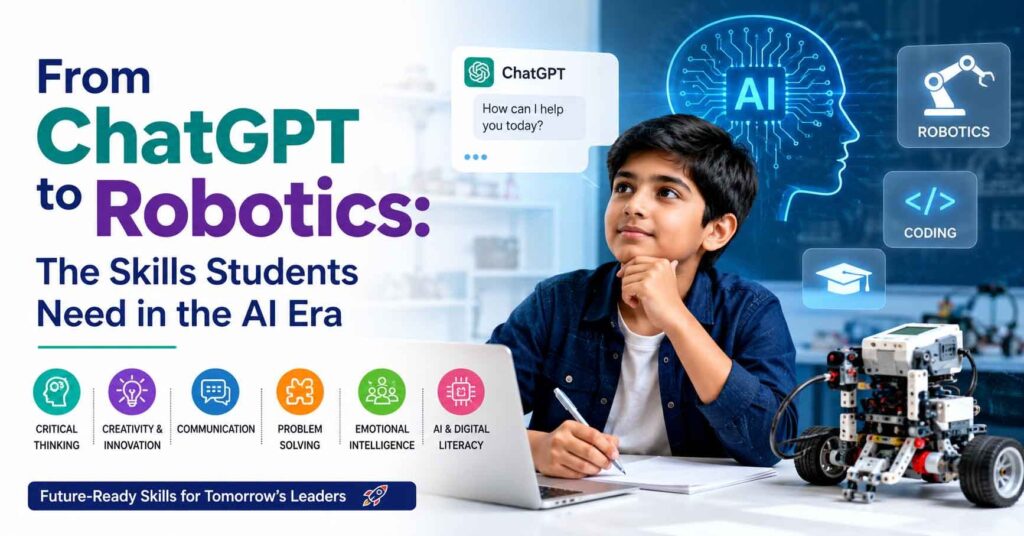
Artificial Intelligence is no longer a glimpse into the future but instead it is already woven into our daily lives. From ChatGPT helping students brainstorm ideas to voice assistants answering questions, personalized learning platforms, and robotics kits in classrooms, AI is transforming the way children learn, explore, and solve problems.
Naturally, many parents wonder whether AI will eventually replace human roles. While AI is reshaping education and the workplace, it is not a substitute for human relationships. Friends, families, teachers, and colleagues provide emotional support, guidance, trust, and shared experiences—qualities that technology cannot replicate.
Rather than viewing AI as a threat, we should see it as a tool that complements human abilities. The relationship between people and AI is best understood as a partnership: AI can process information, automate routine tasks, and enhance learning, while humans contribute creativity, empathy, ethical judgment, and collaboration. These strengths work together, creating a balanced and mutually beneficial relationship.
For today’s students, success will not come from competing with AI but from learning how to use it wisely. Children who combine technological confidence with curiosity, critical thinking, communication, and compassion will be well prepared to thrive in an AI-enabled world. As parents and educators, our role is to help them embrace innovation while staying deeply connected to the human values that no technology can replace.
What skills will matter most?
Now as we have made peace with the presence of AI in our day to day life still there are certain factors which are to considered. Our kids must be taught certain skills so that they can thrive in today’s world. As AI becomes a part of everyday learning, academic knowledge alone will not be enough to prepare students for the future. Children need to develop skills that help them think independently and work effectively alongside technology.
Critical thinking enables students to ask meaningful questions, evaluate AI-generated responses, and verify information rather than accepting it at face value.
Creativity remains a uniquely human strength, allowing children to imagine, innovate, and tell stories that reflect original ideas and personal experiences.
Strong communication skills include speaking confidently, writing clearly, and presenting ideas effectively. These will help students collaborate and share their perspectives. Equally important is problem-solving, where children learn to break complex challenges into manageable steps and explore multiple solutions.
Finally, emotional intelligence, including empathy, teamwork, leadership, and relationship-building, will continue to set humans apart. While AI can process information quickly, it cannot replace kindness, ethical judgment, or the ability to connect meaningfully with others.
What skills will matter most in AI era?
The present generations are using AI as a means to the end, instead of using AI as a tool to achieve the goal. They blindly accept AI generated content without reviewing or evaluating it, without even realising that output that is generated can be flawed. We often talk about AI takeover but never realise that with our reliance and dependence on AI, we are actually paving the way for AI handover.
So now the question is how can we motivate our students to upgrade and upskill themselves. In an AI-driven world, success will depend not only on what students know but also on how they think and interact with others. Critical thinking helps children ask meaningful questions, evaluate AI-generated responses, and fact-check information before accepting it as accurate. Since AI can sometimes provide incomplete or incorrect answers, students must learn to think independently and make informed decisions.
Creativity is another skill that AI cannot truly replicate. While AI can generate content, it cannot replace a child’s imagination, originality, or ability to create stories, ideas, and innovative solutions inspired by personal experiences and emotions.
Strong communication skills are equally important. Whether speaking confidently, writing clearly, or presenting ideas effectively, students who can express themselves well will be better equipped to collaborate, lead, and inspire others.
Effective problem-solving enables children to break complex challenges into smaller, manageable steps, explore different approaches, and adapt when their first solution doesn’t work. These abilities foster resilience and confidence in unfamiliar situations.
Finally, emotional intelligence remains one of the most valuable human strengths. Empathy, teamwork, leadership, and the ability to build meaningful relationships cannot be automated. These qualities help students work collaboratively, resolve conflicts, and become compassionate individuals who can use technology responsibly while making a positive impact on the world.
Conclusion: Helping Children Thrive in the AI Era
The future our children will inherit will be shaped by Artificial Intelligence, automation, and rapid technological innovation. While many of tomorrow’s careers have yet to be imagined, one thing is certain: success will belong to those who are adaptable, curious, and eager to learn throughout their lives. Rather than fearing AI, we should empower children to understand it, use it responsibly, and view it as a tool that enhances their potential.
At the same time, technology can never replace the qualities that make us uniquely human. Empathy, creativity, critical thinking, communication, ethical decision-making, and the ability to build meaningful relationships will remain invaluable in every profession and every stage of life. These are the skills that enable children not only to succeed academically but also to become compassionate leaders and responsible global citizens.
Parents and schools play an equally important role in preparing children for this evolving world. By encouraging curiosity, celebrating creativity, fostering resilience, and promoting responsible use of technology, we can help students develop both technical confidence and strong human values. The goal is not simply to raise children who can use AI, but to nurture future-ready learners who can think independently, collaborate effectively, and shape a future where technology and humanity grow together.
(Explore More About AI Blogs)
(Know More About Chrysalis High School)
Written By – Swapna Paranjpe,
Secondary Teacher – Chrysalis High Budigere
Frequently Asked Questions
Students need a combination of technical and human skills to thrive in the AI era. Critical thinking, creativity, communication, problem-solving, adaptability, digital literacy, and emotional intelligence are essential for using AI responsibly while making informed decisions and collaborating effectively.
Yes, ChatGPT can be a valuable learning tool when used responsibly. It helps students brainstorm ideas, understand concepts, improve writing, and receive instant feedback. However, students should always verify AI-generated information, think critically, and avoid relying on AI for all their learning.
Rather than outright prohibition, parents should encourage co-using ChatGPT. Use it as a brainstorming partner or research aid, but require students to review, verify, and write the final output in their own words.
Robotics bridges theoretical programming with physical problem-solving. It teaches cause-and-effect, debugging, resilience, and hands-on logic, showing children how code controls real-world outcomes.
While AI can generate content and analyze data, it cannot replicate human imagination, originality, empathy, or ethical judgment. Creativity and critical thinking enable students to solve complex problems, innovate, evaluate information, and make independent decisions in an AI-powered world.