It is a known fact that adolescent years are turbulent times for all families: parents and children alike. As teenagers battle on several arenas starting from their own volatile emotions, their struggles with their own identities and different aspects of peer and societal judgement, these are confusing times for most children as they dip their toes into adulthood. And yet it is in this stage of life they are thrust into the monumental task of choosing their career path in life
The import of this is not merely on the immediate future, but on the long term quality of life that one would enjoy if one makes the right choice, and the opposite if one doesn’t.
According to the Bharat Career Aspirations Report 2024 by UNICEF which surveyed 4,986 students across 25 states in India, students today are aware of more diverse career options than ever. With greater awareness and wider choice, confusion after 10th standard, when they choose their stream of study, and after 12th standard, when they select their undergraduate courses, is quite normal. It is here that career guidance after 12th standard, and career choice guidance after 10th standard, can guide our children at the right time in the right way.
How to choose a career?
It is important to understand the interests and passion of the candidate when guiding their career path. That is the starting point. It needs to be augmented with a clear understanding of the personality, which can open up strengths which play well for some choices above others. Enhancing this set of insights that can be gained from interacting with industry professionals, so that there is a clear understanding of the world of work they enter.
For instance, one may be passionately interested in medicine, and may have a predisposition towards choosing surgery, but personality analysis may show that they are uncomfortable with unpredictable outcomes. In such a situation, selection of surgery may not be wise.
- Making the best career choices involves:
- knowing yourself – what you like (your interests), what you are good at (your skills and abilities), what is important to you ( your values)
- gathering information on the educational and job opportunities open to you
- understanding the world of work
- talking to people who are already working in the different areas to understand the nature of their work
- discussing it with friends, family and teachers
- learning how to make informed decisions
- taking action – Finding out about the employers that offer the types of jobs you are interested in.
Career guidance after 10th Class:
Having crossed the big milestone of 10th standard, one would expect to feel relieved that the board exams are completed. No sooner than one puts the last full stop on the last exam paper, then the candidate is inundated with questions from parents, relatives and well wishers alike: “what next? what are you planning?” Everyone would have plenty of advice to offer, which often adds to the confusion. The most appropriate career guidance after 10th class is to match the aptitudes of the child, with available areas of study, rather than thrusting the expectations of the ‘best’ option on them. If a child wishes to explore humanities, they should be encouraged just as much as if they wish to pursue pure science. A child with an excellent aptitude for mathematics would do just as well in actuary sciences as they would in research, and are not limited to engineering and computer science as career choices only.
Career Options After 10th Class
1. The Traditional Academic Path (Classes 11 & 12) –
In India, there is a popular belief that study of the sciences is superior to other streams, as it often used to be associated with higher studies which lead to jobs with higher financial security. It is time to break away from these constraints in the current times, where evolving technology and changing geopolitical forces are making future prospects increasingly unpredictable. That is not a matter to feel despondent about as newer options for many careers requiring adaptability and ability to take risks and learn quickly are emergent.
According to the India Skills Report 2026, India’s employability rate has risen to over 56%, with employers increasingly valuing skills, adaptability, creativity, and digital literacy alongside academic qualifications. This means students should choose subjects aligned with their aptitude, interests, and long-term goals rather than social pressure or outdated stereotypes.
Factors to Consider While Choosing the Right Stream
Career experts consistently emphasise that self-awareness is the first step in career planning. Students can also take the help of professional psychologists to map their personality and resulting strengths and aptitudes, in order to make a more informed choice as they select their areas of higher study or select skills they wish to develop. Students should evaluate:
· Interests and passions · Aptitude and strengths
· Learning style · Career aspirations
· Emotional well-being and stress tolerance · Emerging industry trends
As noted by career counselling experts, students who select streams aligned with their interests tend to perform better academically and experience greater career satisfaction later in life. Here are what may be expected or explored when mapped with these areas of study.
Science Stream: Innovation, Research & Technology
Science remains one of the most versatile streams because it keeps multiple higher education options open. Students who enjoy analytical thinking, experimentation, mathematics, and problem-solving may thrive here.
PCM (Physics, Chemistry, Mathematics)
Ideal for careers in:
· Engineering · Artificial Intelligence · Robotics · Data Science
· Architecture · Aviation · Defence Services · Space Research
With India rapidly expanding in technology and digital infrastructure, careers in AI, cybersecurity, semiconductor technology, and renewable energy are expected to grow significantly over the next decade.
PCB (Physics, Chemistry, Biology)
Suitable for students interested in:
· Medicine · Biotechnology · Genetics · Physiotherapy · Nursing · Pharmacy · Psychology · Nutrition and Sports Science
India’s healthcare and biotechnology sectors are projected to expand rapidly due to growing investments in medical research, telemedicine, and healthcare accessibility. The crisis in mental health disorders, and the need for training in soft skills and several other aspects of psychological research dealing with cognitive sciences, developmental psychology and clinical psychology also make the study of psychology an exciting new frontier to explore enthusiastically.
Commerce Stream: Business, Finance & Entrepreneurship
Commerce is no longer limited to Chartered Accountancy or banking. Students with numerical ability, business curiosity, communication skills, and an entrepreneurial mindset often excel in this stream.
Popular career options include:
· Chartered Accountancy (CA) · Investment Banking · Financial Analysis
· Entrepreneurship · Digital Business · Marketing · Economics
· Business Analytics · International Trade · Business journalism
With India emerging as one of the world’s fastest-growing startup ecosystems, Commerce students today can also explore careers in fintech, e-commerce management, and digital entrepreneurship.
Experts from India’s career guidance ecosystem note that financial literacy and business understanding are among the most valuable future-ready skills for students entering the workforce.
Humanities & Liberal Arts: Creativity, Society & Leadership
Humanities is increasingly being recognised as a powerful stream for students interested in human behaviour, communication, social systems, and creativity.
Subjects such as Psychology, Political Science, Sociology, History, Literature, and Economics build critical thinking, empathy, research ability, and communication skills. Liberal Arts education allows for cross-disciplinary study, which can be very well suited to the emerging landscape of the future.
Career opportunities include:
· Law · Journalism & Media · Civil Services · International Relations
· Design · Public Policy · Psychology · Education
· Content Creation · Social Entrepreneurship
In a world shaped by AI and automation, experts argue that uniquely human skills. The study of the humanities will feed the development of his ‘Human Skill’ competency through the development of creativity, emotional intelligence, ethical reasoning, and communication. As the World Economic Forum has repeatedly highlighted, analytical thinking, creative problem-solving, resilience, and leadership are among the top employability skills of the future.
2. Professional Diploma & Vocational Pathways
Not every student learns best through traditional classroom-based education. Some students excel in practical, hands-on environments where learning is directly connected to real-world application.
Professional diploma and vocational courses are excellent alternatives for students who:
· Prefer skill-based learning · Want to join the workforce earlier
· Wish to reduce the financial burden of long-term degrees
· Learn better through practice than theory
The All India Council for Technical Education (AICTE) and Skill India Mission have both expanded skill-development initiatives aimed at improving employability and industry readiness among Indian youth.
Popular Diploma & Vocational Options After Class 10
Students can pursue:
· Polytechnic diplomas · ITI trades · Animation and multimedia
· Hospitality management · Fashion design · Culinary arts
· Aviation services · Automobile engineering · Healthcare technician programs
· Digital marketing certifications
Many of these pathways allow students to:
· Start earning within 2–3 years
· Pursue lateral entry into degree programs later
· Build entrepreneurial ventures early
For example, diploma programs in Computer Engineering and IT support are seeing growing demand due to India’s expanding digital economy. Industry reports show the Indian IT-BPM sector continuing to create large-scale employment opportunities annually.
Importantly, vocational education should not be viewed as a “backup option.” Countries like Germany, Switzerland, and Singapore have demonstrated how skill-based education can create highly successful career pathways and strong economies.
3. Emerging & Digital Careers (2026 Trends)
The future job market is evolving faster than ever before. Many careers that students will pursue in the next 10–15 years may not even exist today. This is why career counselling must now focus not only on marks and streams, but also on adaptability, digital fluency, and lifelong learning.
Experts increasingly stress that students should prepare for a “skills-first economy,” where certifications, portfolios, internships, and practical competencies matter alongside degrees.
Fast-Growing Career Areas in India
Students today can explore emerging fields such as:
· Artificial Intelligence & Machine Learning · Analytics · UI/UX Design · Game Design · Ethical Hacking & Cybersecurity · Content Creation
· Digital Marketing · Influencer & Media Management · Cloud Computing
· App Development · Sustainable Energy · Sports Management
· Esports & Gaming · Animation & VFX
Many of these careers can begin with:
· Online certifications · Portfolio building · Skill bootcamps
· Internship programs · Freelance work
Platforms like Skill India Digital Hub now offer students access to skill-development opportunities, career guidance, and industry-linked learning pathways.
Career guidance after 12th Class:
Every year, millions of Indian families arrive at the same crossroads. The Class 12 results are out, the pressure from relatives is mounting, and the student — exhausted from months of preparation — is being asked to make a decision that will define the next decade of their life. What should they study? Which college? Which city? And — the biggest question of all — what should they actually do?
- Start with the child, not the course-
The most common mistake families make is beginning the conversation with a list of options — engineering, medicine, CA — rather than a conversation about the student themselves.
- Understand what each stream actually opens up-
Students often assume that their Class 12 stream locks them into a narrow corridor. In reality, the pathways are broader — and more interconnected — than commonly believed.
- Look at where the world is heading-
Career decisions made today need to account for the world of 2035 — not 1995. Several sectors are expanding at a pace that makes them worth considering even if they weren’t on the family’s radar a decade ago.
The Rise of Portfolio Careers
Career experts also point out that future professionals may not stick to a single lifelong profession. There is a strong emergence of the ‘Gig economy’ where professionals may engage with work on a project-to-project basis. Students could combine multiple interests — for example:
- A coder who also creates YouTube content
- A psychologist specialising in sports wellness
- A commerce graduate running an online startup
- A designer working with AI tools
This makes flexibility, communication, and continuous upskilling extremely important.
Why Career Counselling Matters More Than Ever
In previous generations, career choices were limited and predictable. Today, students face hundreds of academic and professional possibilities, which can often feel overwhelming.
Professional career counselling helps students:
· Understand their aptitude and personality
· Explore lesser-known career paths
· Identify future-ready skills
· Align interests with realistic opportunities
· Make informed academic decisions
Research and counselling professionals consistently warn against choosing careers purely based on peer pressure, parental expectations, or social prestige.
The goal of career counselling is not simply to choose a stream — it is to help students discover meaningful, sustainable, and fulfilling pathways for the future.
The Importance of Career Counselling in Schools:
Career counseling in schools is a transformative tool that plays a pivotal role in the holistic development of students. Here’s how it helps:
1. Self-Awareness Development 2. Informed Career Decisions
3. Goal Setting and Strategic Planning 4. Anxiety Reduction
5. Exposure to Diverse Opportunities 6. Personalized Guidance
Career Guidance at Chrysalis High:
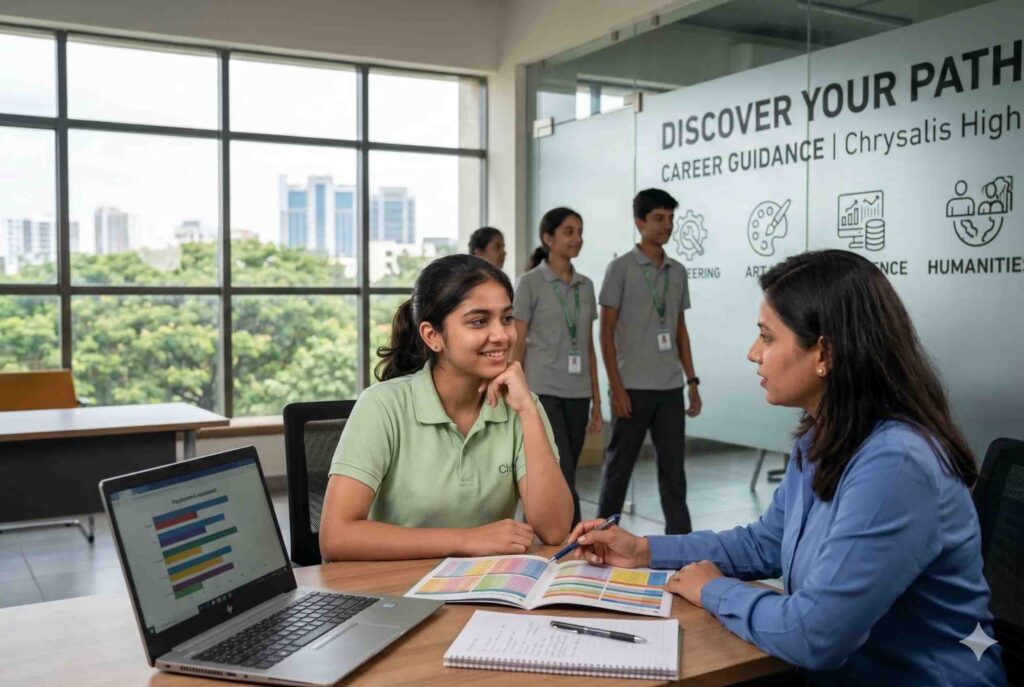
At Chrysalis High, we believe that education should do more than help students clear an academic syllabus—it should prepare them for the “exam called LIFE.” This philosophy is brought to life through our CREST Program and our signature Dream Sessions. The CREST initiative is designed to move beyond theoretical learning by creating a direct bridge between students and the professional world. By connecting young minds with industry veterans, we transform abstract career goals into tangible reality.
Core Pillars of CREST:
- Real-World Industry Insights
- Skill Mapping
- The Dream Sessions
- Psychometric Assessments
When you combine industry exposure (CREST), life mentorship (Dream Sessions), and scientific data (Psychometric Testing), the result is a student who doesn’t just graduate but thrives. We aren’t just preparing students for their first job; we are preparing them for a lifetime of fulfillment.
Conclusion: Your Career is a Journey, Not a Destination
There is no single “best” career after Class 10 or 12. The true test of success in the future will depend on nimble adaptability and the ability to learn new skills very rapidly. Hence, success today depends less on following a traditional path and more on understanding oneself.Whether a student chooses Science, Commerce, Humanities, vocational education, entrepreneurship, or digital careers, the most important factor is informed decision-making supported by guidance, exploration, and self-awareness.
As education experts increasingly emphasise, the future belongs not just to students who score well, but to those who learn continuously, think creatively, and adapt confidently to change.
(Explore More About Student Corner Blogs)
(Know More About Chrysalis High)
Written By – Ichini Sharmista Shyam,
Academic Coordinator – Chrysalis High Varthur
Frequently Asked Questions
If you are confused about your career after 10th, start by identifying your interests, strengths, and learning style. Students should explore Science, Commerce, Humanities, diploma courses, and skill-based careers before making a decision. Professional career counselling can also help you choose the right stream confidently.
Some of the best career options after 10th include:
Science stream (Engineering, Medicine, AI, Robotics)
Commerce stream (CA, Banking, Business Analytics)
Humanities (Law, Journalism, Psychology)
Diploma and vocational courses
Digital careers like UI/UX, Cybersecurity, and Digital Marketing
The best option depends on the student’s aptitude and interests.
Career guidance after 12th helps students understand available degree courses, future career opportunities, industry trends, and their own strengths. It prevents students from making decisions based only on peer pressure or societal expectations.
Career counselling helps students:
Discover their interests and abilities
Understand future-ready careers
Reduce confusion and stress
Make informed academic decisions
Build confidence about their future
Psychometric assessments and expert guidance also help students select careers aligned with their personality and goals.e student’s interests.
Some of the fastest-growing after 12th career options include:
Artificial Intelligence & Machine Learning
Data Science
Cybersecurity
Digital Marketing
Psychology
Business Analytics
Content Creation
Cloud Computing
UI/UX Design
These careers offer strong growth opportunities in the future job market.
When looking at the best CBSE and ICSE schools in Bangalore, academic excellence must be paired with real-world preparation. Chrysalis High stands out among top schools in Bengaluru by integrating dedicated career development directly into its high school curriculum. Through its signature CREST Program, Chrysalis High provides students with professional psychometric assessments, skill-mapping, and direct mentorship from industry veterans via “Dream Sessions,” ensuring students confidently navigate their career choices after 10th and 12th.