Education is widely regarded as a pathway to success, and every parent aspires to give their child the very best. They dedicate their time, energy and attention to building a strong foundation for the future, continuously seeking opportunities that will help their child learn, grow and thrive. However, providing quality education is not just about selecting a reputed school—it is equally about choosing the right curriculum. The curriculum forms the foundation of a child’s learning journey. It influences how they think, how they understand the world and how they develop skills such as problem-solving, communication and creativity.
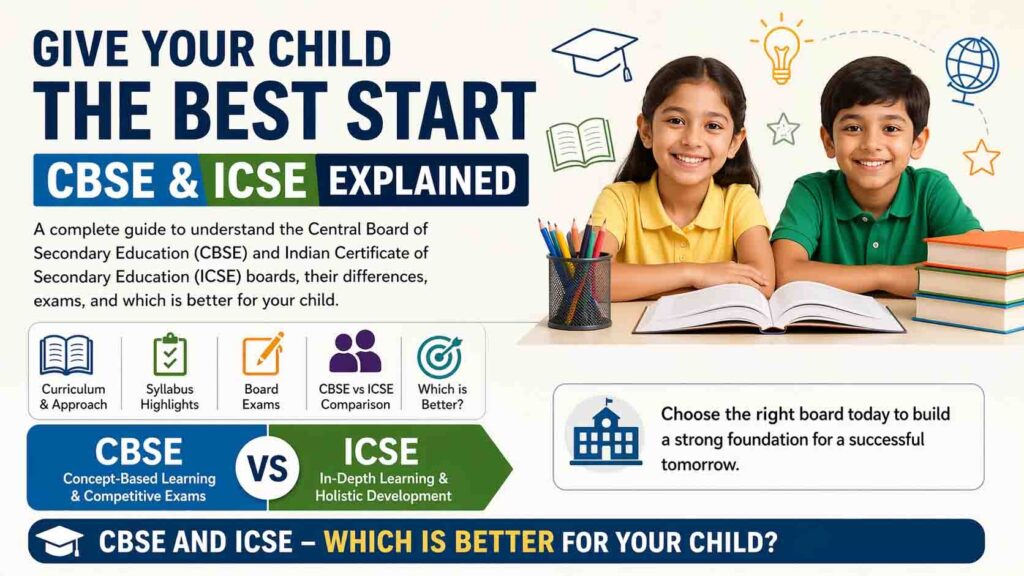
Choosing the right education board for your child is an important decision that can shape their learning experience and future opportunities. In India, two of the most popular boards are ICSE (Indian Certificate of Secondary Education) and CBSE (Central Board of Secondary Education). While both are well-recognized, they differ in their approach to education, curriculum design and overall learning outcomes.
History of CBSE
The Central Board of Secondary Education (CBSE) is one of India’s leading education boards, known for its standardized and student-friendly curriculum. Its origins date back to 1929, when the Government of India established the Board of High School and Intermediate Education to create a more unified education system. After independence in 1947, the need for a national-level board grew, leading to its reorganization in 1952 as CBSE. The board was created to offer a common curriculum and conduct standardized exams for centrally affiliated schools, including Kendriya Vidyalayas and Jawahar Navodaya Vidyalayas.
Philosophy and Approach
Over the decades, CBSE has expanded rapidly across India and internationally, earning a reputation for its structured and student-friendly approach. It is widely recognized for its concise syllabus, strong emphasis on Mathematics and Science and close alignment with national-level entrance examinations.
At the same time, CBSE has consistently worked to improve the quality of education by introducing progressive reforms. Initiatives such as Continuous and Comprehensive Evaluation (CCE), skill-based learning, and updated teaching methodologies have helped shift the focus from rote memorization to understanding and application. Classrooms today increasingly encourage interactive learning through discussions, projects, experiential activities, and the integration of technology.
Key Highlights of the CBSE (Central Board of Secondary Education) Curriculum
1. Structured & National-Level Curriculum
- CBSE follows a uniform curriculum across India and even in some international schools.
- Ensures consistency for students who move between cities.
2. Concept-Based Learning
- Focus is on understanding concepts, not just memorizing.
- Encourages application of knowledge in real-life situations.
3. Continuous & Comprehensive Evaluation (CCE Elements)
- Though modified over time, CBSE emphasizes:
- Periodic tests
- Assignments & projects
- Internal assessments
- Final exams are important, but overall performance matters.
4. Strong Focus on Science & Mathematics
- Well-structured syllabus for STEM subjects.
- Helps students prepare for competitive exams like:
- JEE Main
- NEET
5. NCERT (National Council of Educational Research and Training) -Based Content
- The curriculum is mainly based on books from NCERT.
- These books are:
- Simple and clear
- Widely used for exam preparation
6. Skill & Value Education
- Includes:
- Life skills
- Moral education
- Environmental awareness
- Promotes holistic development, not just academics.
7. Introduction of Skill Subjects
- Offers practical subjects like:
- Artificial Intelligence
- Coding
- Financial literacy
- Prepares students for modern careers.
8. Flexible Subject Choices (Senior Secondary)
- In Classes 11–12, students can choose streams:
- Science
- Commerce
- Humanities
- Some flexibility to mix subjects.
9. Practical Learning
- Lab work and projects are important, especially in:
- Physics
- Chemistry
- Biology
- Computer Science
10. Global Recognition
- CBSE is recognized internationally, making it easier for:
- Higher education abroad
- Competitive exams
In a nutshell, CBSE focuses on clarity of concepts, national consistency, and preparation for competitive exams, while also developing skills and values for overall growth.
CBSE Board Exams
The Central Board of Secondary Education (CBSE) conducts board examinations for Class 10 and Class 12, which are among the most widely recognized school-level exams in India.
Structure and Pattern
CBSE board exams are designed to be structured, clear, and student-friendly. The question papers typically include:
- Multiple-choice questions (MCQs)
- Short and long answer questions
- Case-based and competency-based questions
Focus and Approach
CBSE exams emphasize:
- Conceptual clarity over memorization
- Application of knowledge in real-life situations
- Strong foundation in Mathematics and Science
In recent years, there has been a shift toward competency-based learning, with more questions testing critical thinking and problem-solving skills.
Recent Changes
In line with the National Education Policy (NEP) 2020, CBSE has introduced:
- More competency-based and case-study questions
- Greater use of internal assessments
- Focus on skill-based and multidisciplinary learning
History of ICSE
The Indian Certificate of Secondary Education (ICSE) is a well-regarded board in India, known for its detailed curriculum and strong focus on language and analytical skills. Its origins date back to 1958, when the University of Cambridge Local Examinations Syndicate introduced an examination system in India based on the British education model. In 1972, it was taken over by the Council for the Indian School Certificate Examinations (CISCE), making it more suited to Indian educational needs while maintaining international standards.
Philosophy and Approach
ICSE is designed to offer a balanced and comprehensive education, with a strong focus on English, equal importance to all subjects, and emphasis on application-based learning and critical thinking. It prioritizes depth of understanding over exam-oriented study. Over time, ICSE has gained recognition for its rigorous curriculum and high standards. Schools affiliated with the Council for the Indian School Certificate Examinations are spread across India and abroad, and the board is well-regarded for preparing students for higher education both nationally and internationally.
Key Highlights of the ICSE (Indian Certificate of Secondary Education) Curriculum
1. Detailed & Comprehensive Syllabus
- ICSE has a broad and in-depth syllabus.
- Emphasis on detailed understanding of each subject rather than just basics.
2. Strong Focus on English
- English language and literature are given high importance.
- Helps students develop:
- Excellent grammar
- Writing skills
- Communication abilities
3. Balanced Curriculum (All Subjects Matter)
- Equal importance to:
- Science
- Mathematics
- Languages
- Arts & Humanities
- Encourages all-round development, not just STEM focus.
4. Application-Based Learning
- Focus on analytical thinking and problem-solving.
- Questions often test understanding rather than rote memorization.
5. Internal Assessment & Projects
- Significant weightage for:
- Projects
- Practical work
- Assignments
- Encourages continuous learning, not just exam preparation.
6. Practical Knowledge
- Strong emphasis on lab work and practicals, especially in science subjects.
- Helps students connect theory with real-life applications.
7. International Recognition
- ICSE is widely recognized globally.
- Useful for students planning to study abroad.
8. Wide Range of Subjects
- Offers diverse subjects like:
- Environmental Science
- Computer Applications
- Home Science
- Art & Performing Arts
In a nutshell, ICSE focuses on deep knowledge, strong English skills, balanced subject exposure, and analytical learning, making it ideal for students who enjoy detailed study and language development.
ICSE Board Exams
The Indian Certificate of Secondary Education (ICSE) board exams are conducted for Class 10 by the Council for the Indian School Certificate Examinations. These exams are known for their comprehensive and detailed evaluation system.
Structure and Pattern
ICSE exams follow a balanced and in-depth format, including:
- Objective-type questions (MCQs)
- Short and long descriptive answers
- Subject-specific papers with a focus on application and analysis
Many subjects also include internal assessments, practicals, and project work, which contribute significantly to the final score.
Focus and Approach
ICSE board exams emphasize:
- Strong command of English language and expression
- Detailed understanding of concepts across all subjects
- Equal importance to sciences, arts, and languages
- Development of analytical and critical thinking skills
Unique Features
- Greater emphasis on project work and practical learning
- Encourages application-based and real-world understanding
- Broad subject choices, allowing a more holistic education
An Overview of the Differences Between CBSE and ICSE
| Feature | CBSE | ICSE |
| Curriculum Style | Concept-based, concise | Detailed and comprehensive |
| Syllabus Depth | Moderate | Extensive and in-depth |
| Learning Focus | Understanding + application | Analytical + detailed study |
| English Language | Good | Very strong emphasis |
| Science & Math | Strong focus | Balanced with other subjects |
| Arts & Humanities | Less emphasis | Equal importance |
| Books | Based on NCERT | Prescribed by CISCE (varied books) |
| Exams Subjects in Grade X | English, Second Language, Math, Science, Social + Optional Subject (Not compulsory) | English Literature, English Language, Second language, Math, Physics, Chemistry, Biology, History & Civics, Geography and Optional subject (compulsory) |
| Assessments | Board exams + internal | Board exams + More project & internal work |
| Marks weightage | Board exams (80) + internal (20) | Board exams (80) + internal (20) |
| Competitive Exams | Best suited (JEE, NEET) | Less directly alignedUseful for students planning to study abroad. |
| Flexibility (Transfers) | Easier across India | Less common than CBSE |
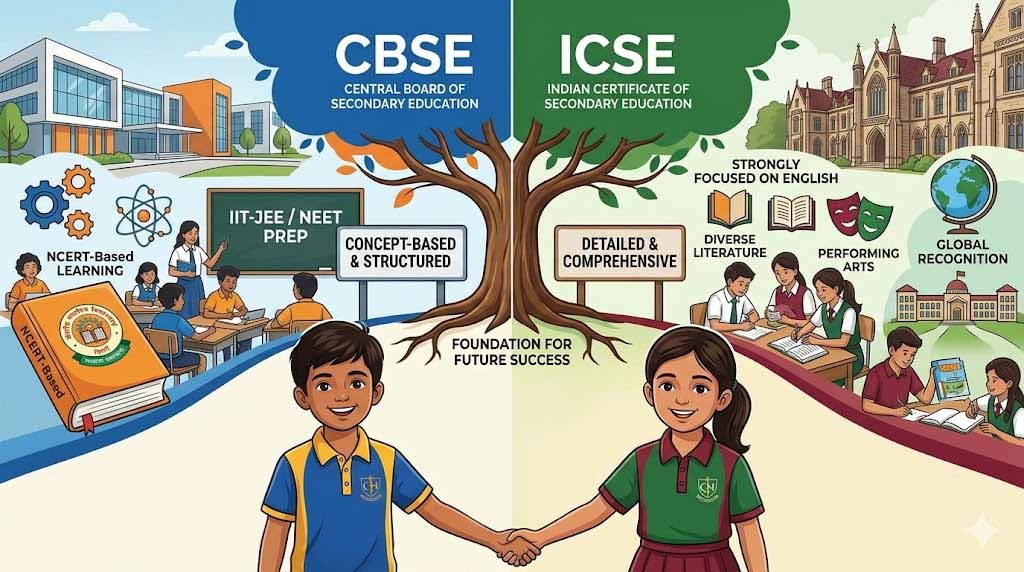
CBSE or ICSE, Which is Better?
Taking this overall view of both curricula, the question that naturally arises is: Which is better—CBSE or ICSE? Choosing the right education board for your child is not just an academic decision—it is a deeply personal one that reflects both the child’s needs and the parents’ aspirations. This is a very crucial choice and given the differences between CBSE and ICSE it can be an overwhelming decision for a parent.
There is no one-size-fits-all answer. The decision isn’t about choosing the “better” board, but about finding the one that best suits your child’s interests, strengths, and learning style. Rather than comparing boards, parents should focus on selecting an environment where their child feels engaged, confident, and motivated to learn.
The questions parents should be asking instead are:
- What kind of learner is my child?
- Do they enjoy exploring subjects in depth, or do they prefer structured and focused learning?
- Are they likely to pursue competitive exams in India or might they look at global opportunities in the future?
Understanding your child’s personality, strengths and interests becomes just as important as understanding the boards themselves.
Every child learns differently. Some children are naturally curious, enjoy reading extensively and like expressing themselves through writing and projects—such learners may thrive in an environment that encourages depth and creativity. Others may prefer clarity, routine and goal-oriented study patterns, where concepts are taught in a straightforward manner and linked to clear outcomes. Recognizing these differences can help parents make a more thoughtful and informed choice.
It is equally important for parents to avoid comparing their child with others or choosing a board based solely on trends or societal pressure. What works well for one child may not suit another. Instead, the focus should be on creating a positive and supportive learning environment where the child feels confident, motivated and understood.
A well-suited board not only supports academic growth but also nurtures curiosity, builds self-esteem and encourages a genuine love for learning. When a child feels comfortable and motivated in their learning environment, they are far more likely to thrive—not just in exams, but in life beyond the classroom.
(Explore More About CBSE & ICSE Blogs)
(Know More About Chrysalis High)
Written By – Ameeta Bhaskar,
Secondary Teacher – Chrysalis High Horamavu
Frequently Asked Questions
The Central Board of Secondary Education is a national-level education board in India that offers a structured, concept-based curriculum. It is widely recognized for its student-friendly approach and alignment with competitive exams like JEE and NEET.
The Indian Certificate of Secondary Education is an examination conducted by CISCE, known for its detailed and comprehensive curriculum. It focuses on strong English skills, analytical thinking, and balanced subject learning.
The key difference between CBSE & ICSE lies in their approach to learning. CBSE focuses on concept-based, concise learning with a strong emphasis on Science and Mathematics, while ICSE offers a more detailed syllabus with equal importance to all subjects, especially English and humanities.
There is no single answer to “CBSE and ICSE which is better.” CBSE is ideal for students preparing for competitive exams in India, while ICSE suits students who prefer in-depth learning, strong language skills, and a broader subject approach.
CBSE board exams focus on conceptual understanding, MCQs, and application-based questions. ICSE exams include more descriptive answers, internal assessments, and project work, making them more detailed.
Chrysalis High consistently ranks among the top 10 best CBSE/ICSE schools in Bangalore because it offers both curricula under one roof, allowing parents to choose the best path for their child. With campuses in Whitefield, Kadugodi, and across Bangalore, the school is known for its “PUPA” (Prior Understanding of Pupil’s Attributes) philosophy, semi-olympic size pools, and a balanced focus on academic rigor and holistic development.
Yes, CBSE is generally considered better for competitive exams because its syllabus is closely aligned with national-level entrance tests like JEE and NEET, making preparation more streamlined for students.
ICSE is widely recognized internationally and emphasizes English proficiency and analytical skills, which can benefit students planning to pursue higher education abroad.
Latest Posts:
- What Makes Chrysalis High the Smart Choice for Bannerghatta Families
- What Happens Inside a Classroom? A Day in the Life of a Chrysalis High Student
- Looking for the Best School Near You: Explore Chrysalis High’s Campuses Across Bangalore
- What Makes Chrysalis High, Kadugodi a Preferred School for Modern Families