Walk into any classroom in Bangalore today and you’ll see something exciting: students are learning in a world that changes faster than a textbook can be reprinted. Information is everywhere, AI tools can summarise chapters in seconds, and careers are evolving in ways even adults are still figuring out. Learning beyond textbooks becomes crucial as the most valuable learning is not just what students know, but what they can do with what they know.
That’s why real-world, project-based learning matters more in 2026 than ever before—not as an “extra activity,” but as a core approach that helps children build understanding, confidence, and future-ready skills. This direction is also strongly aligned with India’s shift toward experiential and competency-based education under the National Education Policy (NEP) 2020 and ongoing reforms in school assessment.
Alvin Tofler(1928-2016), a famous futurist, summed this urgency very succinctly when he said, “The illiterate of the 21st century will not be those who cannot read or write, but those who cannot learn, unlearn, and relearn.”
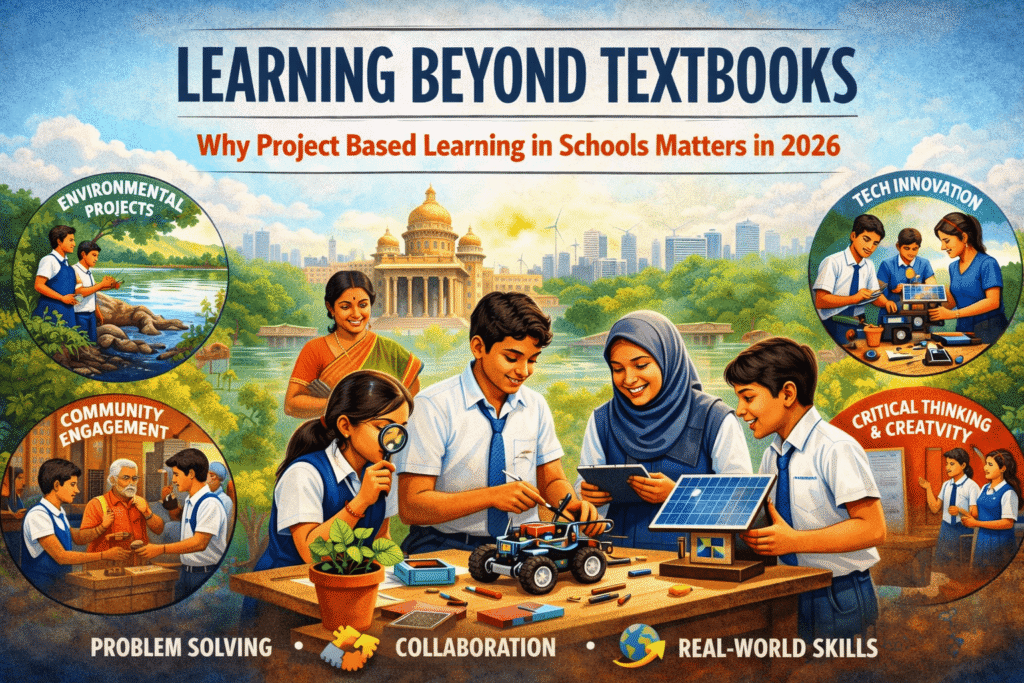
Textbooks are important. They provide structure, foundational knowledge, and a shared curriculum. But textbooks are designed for stability—while the real world is defined by complexity. The world is changing faster than textbooks can keep pace with it.
Does that mean children will be educated but not prepared for the world they will graduate into? Not at all! It becomes even more critical for educational institutions and systems to
- Sharpen problem solving skills, especially solving problems with imperfect data
- Develop critical thinking in students, and make connections across subjects and also evaluate the authenticity of information (Especially in an AI and social media riddled world)
- Develop how they communicate their ideas
- Learn how to work collaboratively with people who think differently, and also to accept different perspectives from their own in an accepting and inclusive manner
Global employer research continues to emphasize skills like analytical thinking, creativity, resilience, and technological literacy—capabilities that grow through practice, not just reading.
What “Real-world Projects” actually mean
The solution to this is in a shift towards enquiry based and Project based learning. So what are these ‘Projects’?
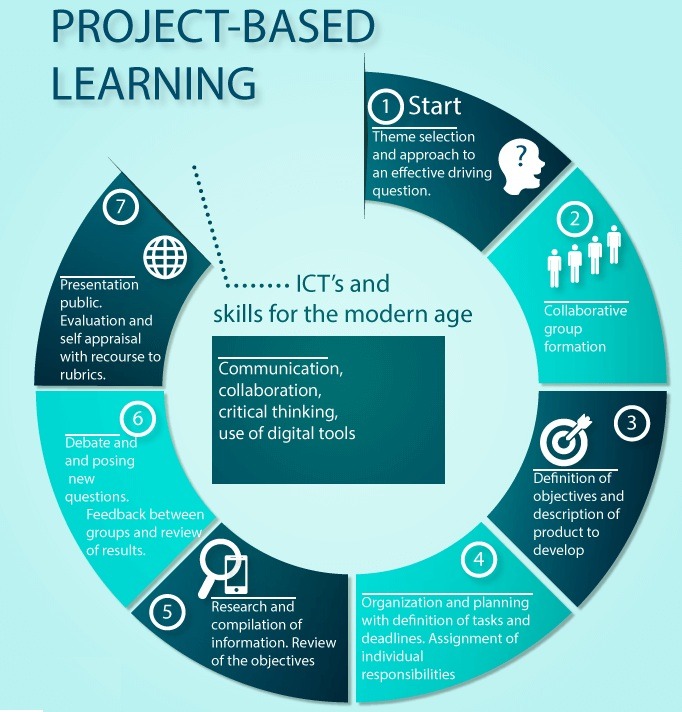
Real-world projects aren’t poster-making days or one-off craft activities. They are authentic tasks where students apply learning to a meaningful goal, ideally with a real audience or outcome.
A strong school project typically includes:
- A real question or challenge (often drawn from the community). This is known as a driving question
- A learning plan and modus operandi that outlines
- The research and information needed to answer the driving question, iterate and formulate findings and solutions that would answer it
- A clear path of the enquiry with milestones clearly mentioned (with timelines)
- Clear assignation of goals, tasks and outputs within the learners to collaborate and work efficiently
- A public product which is created: a prototype, campaign, model, report, exhibition, solution
- reflection on what worked, what didn’t, and why.
This approach fits naturally with NEP 2020’s emphasis on holistic, inquiry-based and experiential learning.
What Research Says: Deeper Learning, Better Transfer
A wide body of research suggests that well-designed project/problem-based learning strengthens long-term retention and skill development—especially when the goal is deeper understanding rather than short-term exam recall.
At the same time, credible reviews also note an important truth: projects work best when they are rigorous and well-scaffolded, with clear learning outcomes and strong teacher guidance—not when they are “busy work.” It is also very important that the foundational knowledge for the learners to work with the driving question of the project is delivered in a structured manner to inform the depth of learning.
In other words: projects aren’t a replacement for knowledge; they are a powerful way to build knowledge that sticks and transfers.
The Indian Education Shift: Competencies, not just content
Across India, the move toward competency-based education and assessment is becoming more visible. CBSE has explicitly described steps aligned with NEP 2020 to strengthen competency-based learning and assessment practices (including more application-oriented formats). The underlying need for this is to impact the employability of the learners who will graduate from the education systems into the productive community.
National assessment initiatives like PARAKH also reflect this direction and provide a mirror to learning realities—reminding schools that improving outcomes requires more than surface-level changes; it requires meaningful learning experiences, teacher capacity building, and stronger classroom practices.
Projects and project based learning fit in seamlessly into this framework meeting the need for competency development: application, reasoning, communication, collaboration, and reflection.
Why Bangalore is the perfect “living classroom”
Bangalore is not just a city—it’s a learning ecosystem. It offers a uniquely rich context for real-world projects across age groups:
1) Environment and sustainability (local and urgent)
Students can explore water conservation, waste segregation, biodiversity, urban heat, or lake ecosystems—connecting science with civic responsibility. Even a school-level waste audit or a native-plant garden can become a rigorous interdisciplinary project (math + science + language + art + ethics).
2) Technology with purpose (beyond coding)
In a city shaped by tech, students can learn to use technology responsibly: designing simple prototypes, testing ideas, collecting data, and discussing digital ethics—skills that align with future workforce needs.
3) Civic and community engagement
Bangalore’s neighbourhoods, markets, public spaces, and community groups can become real research sites. Students can build communication and empathy by engaging with diverse perspectives—an outcome strongly echoed in future education frameworks around student agency and “co-agency” (learning through relationships with peers, teachers, families, and communities).
What students learn through projects that exams can’t fully measure
Real-world projects develop “human strengths” students need in 2026. To date, the traditional educational board syllabi do not directly emphasise these core competencies:
- Problem Framing: defining what the real problem is (often the hardest part)
- Critical thinking: evaluating sources, claims, and data
- Collaboration: listening, negotiating roles, managing conflict
- Communication: presenting ideas to authentic audiences
- Resilience: iteration, feedback, learning from setbacks
- Ethical reasoning: considering impact on people and planet
These are also the qualities employers and education systems increasingly value—because they remain relevant even as tools change.
The Teacher’s Role: from “deliverer” to “learning designer”
Project-based learning doesn’t reduce the importance of teachers—it elevates it.
Teachers guide students by:
- Identifying curriculum links, and core skills required for the foundational and skill based learning in the project
- Teaching research and thinking routines,
- Modelling how to reflect and improve,
- Ensuring every learner is supported (not only the most confident voices).
This aligns well with the national push toward professional development and capacity building for educators. It also increases the importance of well designed teacher training, at par with the Scandinavian models of educational professional development.
Assessment That Matches Real Learning
A project-driven approach also encourages better assessment—where students show learning through:
- Portfolios
- Presentations
- Demonstrations
- Lab records and Observation records
- Design Journals
- Reflection Journal
These methods don’t replace exams entirely, but they balance them—so students are rewarded for thinking, not just memorising. CBSE’s, and eventually, PARAKH’s direction toward competency-based assessment reinforces the need for this balance. With detailed and well designed rubrics, such learning products can also be evaluated robustly.
Conclusion
Real-world projects help children become capable, curious, confident learners—ready for Bangalore today, and for the wider world tomorrow.
Textbooks build the base. Projects build the bridge from school to life. In 2026, that bridge is no longer optional—it’s essential.
(Explore more about Parent Corner)
(Know more about Chrysalis High)
Written By – Amrita Paul,
School Coordinator – Chrysalis High
Frequently Asked Questions
Learning beyond textbooks refers to an approach where students apply classroom concepts to real-life situations through projects, enquiry, and experiences. Instead of only memorising information, children investigate problems, collaborate with peers, and create meaningful outcomes. This method builds practical understanding, making education more relevant and engaging than textbook learning alone.
Project based learning in schools helps students develop critical thinking, creativity, collaboration, and communication skills. By working on real challenges, learners understand how different subjects connect and gain confidence in problem solving. These experiences prepare them for future careers where application of knowledge matters more than rote recall.
The advantages of experiential learning include deeper retention, better conceptual clarity, and stronger life skills. Students learn by doing—through experiments, community projects, and reflection. Compared to textbook-focused instruction, experiential learning encourages curiosity, independence, and the ability to adapt to new situations.
Experiential learning focuses on action, enquiry, and reflection, while textbook learning mainly delivers information in a structured format. Textbooks build foundational knowledge, but experiential methods help students apply that knowledge in authentic contexts. The best classrooms blend both so learners gain understanding as well as real-world competence.
Chrysalis High Schools lead in project based learning in Bangalore by integrating experiential projects like community sustainability audits and tech prototypes into daily curricula. Their approach exemplifies advantages of experiential learning, fostering student agency under NEP 2020 while outperforming traditional models.