The national anthem of India, Jana Gana Mana, is one of the most powerful symbols of the nation’s unity and identity. Sung at schools, public events, sporting occasions, and national celebrations, the anthem evokes a deep sense of pride and belonging among Indians.
Often referred to as the Jan Gan Man national anthem, the composition carries a rich history that dates back to the early twentieth century. Written during a period of intense national awakening, the anthem reflects the ideals of unity, diversity, and collective destiny that shaped modern India.
Understanding the history of the Indian national anthem, its meaning, and its journey from a poetic hymn to an official national symbol offers a deeper appreciation of its significance in India’s cultural and political life.

Composition
The Indian national anthem was written by Rabindranath Tagore, the renowned poet, philosopher, and Nobel laureate in literature. Tagore composed the original poem titled Bharoto Bhagyo Bidhata on 11 December 1911. The ‘Bharat Bhagya Vidhata’ referred in the composition by Tagore was the Universal Supreme being who guided the destiny of the then colonised India.
The poem was written in Sanskritised Bengali, a literary form of the language that incorporates many Sanskrit words. This linguistic style helped the composition resonate across India’s diverse linguistic landscape.
Originally, the poem consisted of five stanzas, each celebrating the unity of India’s many regions and cultures. However, only the first stanza was later adopted as the national anthem of India.
First Public Performance of Jana Gana Mana
The Jan Gan Man national anthem was first performed publicly on 27 December 1911 at the annual session of the Indian National Congress in Calcutta (now Kolkata).
A group of students performed the song before prominent leaders of the freedom movement. The composition immediately drew attention for its solemn melody and profound message of national unity.
In 1912, the poem was published in the journal Tatwabodhini Patrika, which helped spread Tagore’s composition among intellectual and literary circles.
Although the song was admired by many, it gradually gained wider recognition over the following decades as the freedom movement intensified and patriotic songs became an important source of inspiration.
Jana Gana Mana Lyrics and Meaning
The India’s national anthem lyrics express a deep sense of unity across the vast and diverse regions of the country.
The opening line of the Indian national anthem reads:
Jana Gana Mana Adhinayaka Jaya He
Bharata Bhagya Vidhata
These words praise the guiding spirit that shapes the destiny of the nation.
The lyrics go on to mention several regions of India—Punjab, Sindh, Gujarat, Maratha, Dravida, Utkala, and Banga—symbolizing the country’s geographic and cultural diversity. By acknowledging these regions together, the anthem celebrates India’s unity in diversity.
The repeated refrain “Jaya He” expresses victory and triumph, honouring the collective will and spirit of the Indian people.
Thus, the meaning of national anthem lies not in glorifying political power but in celebrating the spiritual and cultural unity that binds the nation together.
A word for word translation of the National Anthem is as follows:
Jana-gana-mana-adhinayaka, jaya he
Bharata-bhagya-vidhata
Thou art the ruler of the minds of all people,
Thou Dispenser of India’s destiny.
Panjaba-Sindha-Gujrata-Maharata-
Dravida-Utkala-Vanga
Thy name rouses the hearts of Punjab, Sind, Gujrat and Maratha,
Of Dravid, Orissa and Bengal.
Vindhya-Himachala-Yamuna-Ganga
Uchhala-Jaladhi-taranga
It echoes in the hills of the Vindhyas and Himalayas,
Mingles in the music of Jamna and Ganges and is chanted by the waves of the Indian sea.
Tava shubha name jage
Tava shubha ashisha mage
They pray for Thy blessings and sing thy praise.
Gave tava jaya-gatha
Jana-gana-mangala-dayaka jaya he
Bharata-bhagya-vidhata.
The saving of all people waits in thy hand,
Thou Dispenser of India’s destiny,
Jaya he! Jaya he! Jaya he!
Jaya jaya jaya, jaya he!
Victory, Victory, Victory to Thee.
While the subsequent stanzas of the original Tagore composition are not part of the official anthem, they too glorify the ‘Unity in Diversity’ of the Indian ethos, glorifying the unity of all religions, the power of the national spirit in unifying the pilgrim like devotion of the countrymen, and the maternal love and inspiration the national spirit grants to people who are struggling in dark and desperate times (as was the case during the freedom struggle).
National Anthem in Hindi and Other Languages
Although the original composition was written in Bengali, the national anthem in Hindi is widely used in educational and public contexts across India.
Netaji Subhas Chandra Bose also adopted a version of the composition in the song ‘Sab Sukh Chain’ which became the anthem of the Indian National Army he led. (https://www.youtube.com/watch?v=WRgrmM_NBUo&list=RDWRgrmM_NBUo&start_radio=1)
Because the language of the anthem uses many Sanskrit-derived words, it is easily understood by speakers of several Indian languages. This linguistic flexibility contributes to its universal appeal across the country.
The India’s national anthem lyrics remain unchanged in official form, but transliterations and translations are commonly used in different scripts to help people learn and sing the anthem correctly.
Musical Composition of the Indian National Anthem
Rabindranath Tagore not only wrote the lyrics but also composed the melody of the anthem. The tune of the Indian national anthem is believed to be based on the Hindustani classical raga Alhaiya Bilawal, which lends the composition its dignified and uplifting character. It is a morning Raga, since many prayers are composed in these ragas, due to their solemn and rousing quality.
Tagore’s grand-nephew, Dinendranath Tagore, played an important role in notating the music and preserving the melody for future generations.
The official rendition of the national anthem of India takes approximately 52 seconds to sing in full. A shorter version lasting about 20 seconds is also used during certain ceremonial occasions.
Madanapalle: Where the Anthem Was Notated in Western Form
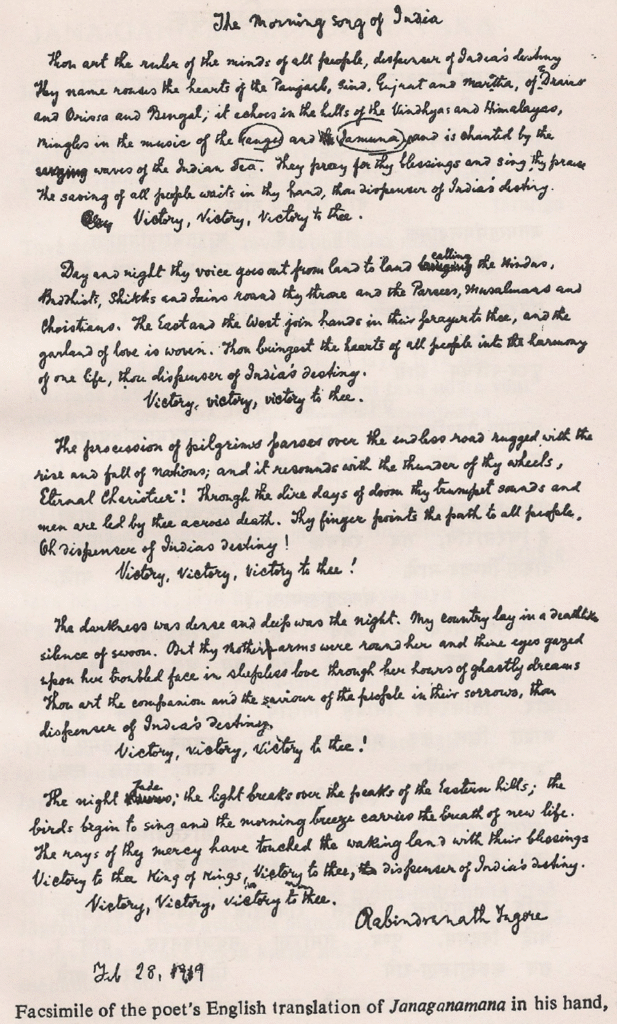
An interesting chapter in the history of the Jan Gan Man national anthem took place in 1919, when Rabindranath Tagore visited the Besant Theosophical College in Madanapalle, Andhra Pradesh.
During his visit, Tagore sang the composition for students and faculty members. The vice-principal of the college, Margaret Cousins, who was a trained musician, helped transcribe the melody into Western musical notation.
This step ensured that the tune could be accurately preserved and performed in the future. It was also during this visit that Tagore translated the song into English under the title “The Morning Song of India.”
This song was used as a morning prayer song in the Theosophical Society as well as being the adopted morning prayer when The Doon School was set up in 1935 (where Margaret Cousins was a founding Principal.
Adoption as the National Anthem of India
Following India’s independence in 1947, the leaders of the new nation had to formally adopt national symbols that represented the country’s identity.
On 24 January 1950, the Constituent Assembly of India officially adopted the first stanza of Jana Gana Mana as the national anthem of India.
Two days later, on 26 January 1950, India became a republic.
During the same session, the Assembly also recognised the historical importance of Vande Mataram lyrics, written by Bankim Chandra Chattopadhyay. Because of its powerful role in inspiring the freedom movement, Vande Mataram was honoured as the national song of India.
Thus, both songs continue to hold a special place in India’s cultural and national heritage.
Clarifying Misinterpretations
Over time, some misconceptions arose regarding the anthem’s meaning. Certain early reports suggested that the composition might have been written to praise the British monarch during his visit to India in 1911.
Rabindranath Tagore later clarified that this interpretation was incorrect. In a letter written in 1937, he explained that the hymn referred to the divine guiding spirit of India rather than to any earthly ruler. To dedicate a prayer for his beloved country to any other was, in his opinion, ‘absurd’.
The meaning of the national anthem, according to Tagore, was a tribute to the enduring universal spirit that guides the destiny of the Indian people.
Significance of the Indian National Anthem Today
Today, the Indian national anthem remains one of the most respected symbols of the nation. Whenever the national anthem of India is played, citizens stand in respect, acknowledging the shared history and collective identity that bind the country together.
In schools, the anthem serves as a daily reminder of national unity. At sporting events, it inspires athletes and spectators alike. During national celebrations such as Independence Day and Republic Day, it evokes a powerful sense of pride and belonging.
More than a ceremonial tradition, the Jan Gan Man national anthem continues to represent India’s values of unity, diversity, and democratic spirit.
Conclusion
The journey of Jana Gana Mana from a poetic hymn composed in 1911 to the official national anthem of India in 1950 reflects the evolution of the Indian nation itself.
Written by Rabindranath Tagore during a period of national awakening, the anthem celebrates the collective spirit and unity of the Indian people. Its lyrics acknowledge the country’s cultural diversity while affirming a shared national destiny.
Today, the Indian national anthem stands as a timeless reminder that India’s strength lies in the harmony of its many voices. Each time the anthem is sung, it renews the nation’s commitment to the ideals of unity, dignity, and hope for the future. Let us all take an inspiration from this to preserve and glorify the true ethos of our nation: We are One, despite having diverse identities and voices.
(Explore More About Nation Related Blogs)
(Know More About Chrysalis High School)
Written By – Amrita Paul,
School Coordinator – Chrysalis High
Frequently Asked Questions
The Indian national anthem, Jana Gana Mana, was written by Rabindranath Tagore in 1911. He originally composed it in Sanskritised Bengali under the title Bharoto Bhagyo Bidhata.
The meaning of the national anthem reflects unity, diversity, and the collective spirit of India. It praises the divine force guiding the nation and highlights harmony among different regions and cultures.
India’s national anthem lyrics begin with “Jana Gana Mana Adhinayaka Jaya He”. The song mentions various regions of India and emphasizes unity in diversity. The official version includes only the first stanza of the original composition.
Yes, the national anthem in Hindi is widely used in schools and public events. Although originally written in Bengali, its Sanskrit-based words make it easily understandable across many Indian languages.
The official full version of the Jan Gan Man national anthem takes approximately 52 seconds to perform. There is also a shorter version consisting of the first and last lines which takes about 20 seconds for specific military or ceremonial occasions.
Jana Gana Mana is the national anthem of India, while Vande Mataram is the national song. Both played significant roles in India’s freedom movement, but only Jana Gana Mana is officially recognized as the anthem.
Learning the Indian national anthem helps students develop patriotism, discipline, and respect for national values. At institutions like Chrysalis High, one of the top CBSE & ICSE schools in Bangalore, the anthem is an essential part of daily assemblies, reinforcing unity and cultural awareness among students.