The world our children will grow into looks very different from the one we knew. Artificial intelligence is no longer science fiction; it is part of everyday life. As conversations about human intelligence vs artificial intelligence grow louder, parents are left with an important question: how do we prepare our children for a future shaped by both humans and machines?
To answer this, parents first need to understand what artificial intelligence actually is, how it differs from the human brain, and whether AI can truly replace humans in the future. This discussion is not about fear or competition. It is about clarity, balance, and preparing children for a future where humans and machines work together.
What Is Human Intelligence?
Human intelligence is the natural ability of the brain to think, learn, understand emotions, and adapt to new situations. When a child learns to solve a math problem, understands a friend’s feelings, or imagines a new story, human intelligence is at work.
For example, when a Grade 2 child learns that sharing toys makes others happy, that learning is emotional and social. No one programs this lesson into the child’s brain. It comes from experience, empathy, and understanding relationships. Human intelligence allows children to ask “why,” learn from mistakes, and grow emotionally as well as academically.
Another important aspect of human intelligence is creativity. A child drawing a picture, writing a poem, or inventing a new game is doing something no machine truly understands. These actions come from imagination, emotions, and personal experience.
What Is Artificial Intelligence?
Artificial intelligence refers to machines or software designed to perform tasks that usually require human thinking. These tasks include recognizing speech, solving problems, translating languages, or analyzing large amounts of data very quickly.
For example, a learning app that adjusts math questions based on a child’s performance is using artificial intelligence. A voice assistant answering homework questions or spelling words is also AI. These systems are trained using large amounts of data and follow specific rules created by humans.
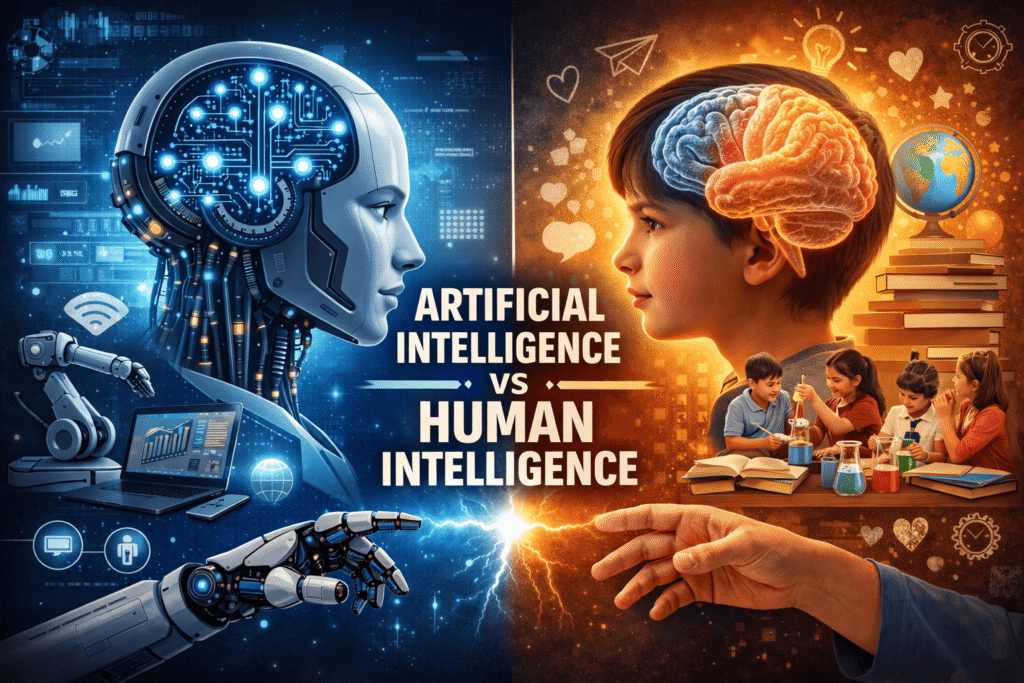
When parents compare artificial intelligence vs human intelligence, it is important to remember that AI does not think on its own. It does not understand meaning or emotions. It only processes information based on patterns it has been taught.
Difference Between AI and Human Brain
The difference between AI and human brain becomes clear when we look at how learning happens. The human brain learns through experiences, emotions, social interaction, and reflection. AI learns only from data and examples provided to it.
Imagine a child touching a hot surface and learning not to do it again. The lesson includes pain, memory, and understanding cause and effect. An AI system, on the other hand, would only “learn” if it was programmed with data about heat and damage. It does not feel pain or understand danger in a human way.
The human brain is also flexible. Children can learn new skills in many different ways. They can adapt to unexpected situations. AI systems are limited to what they are designed to do. If they face a situation outside their training, they often fail.
AI vs Human Intelligence in Education
In today’s classrooms, AI vs human intelligence should not be seen as a competition. Instead, it is more accurate to see AI as a support system for human learning.
AI can help students practice math, improve spelling, or learn a new language at their own pace. For example, a Grade 7 student struggling with algebra can use an AI-based app that gives extra practice and instant feedback. This can build confidence and improve understanding.
However, AI cannot replace a teacher who understands a child’s emotions, motivates them during failure, or encourages curiosity. A teacher notices when a student feels anxious, bored, or excited. A machine cannot truly understand these emotional signals.
Parents also play a vital role. When a child asks deep questions about life, fairness, or relationships, those conversations require human wisdom, not artificial intelligence.
Can AI Replace Humans?
One of the biggest concerns parents have is whether AI will take away jobs or make human skills less valuable. The question “Can AI replace humans?” often sounds frightening, but the reality is more balanced.
AI can replace certain repetitive tasks. For example, machines can sort data faster than humans, and AI can answer simple customer service questions. However, AI cannot replace jobs that require empathy, creativity, leadership, and ethical decision-making.
A doctor uses AI to analyze medical reports, but the doctor still talks to the patient, explains options, and shows compassion. A teacher may use AI tools for lesson planning, but teaching values, discipline, and confidence remains a human role.
So when children ask whether the future belongs to machines, parents can reassure them that human intelligence will always be essential.
Human or AI: A False Choice
The debate of human or AI is often misleading. The future is not about choosing one over the other. It is about learning how humans can use AI responsibly and wisely.
Children who understand both technology and human values will be the most successful. For instance, a student who learns coding but also learns teamwork, communication, and ethics will be better prepared than someone who relies only on machines.
Parents can help children see AI as a tool, just like books or calculators, not as a replacement for thinking.
What Is Artificial General Intelligence?
Some parents hear about Artificial General Intelligence (AGI) and worry that machines will soon think exactly like humans. AGI refers to a theoretical form of AI that could learn and perform any intellectual task a human can.
At present, artificial general intelligence does not exist. Today’s AI systems are narrow, meaning they are good at one specific task but fail outside that area. A chess-playing AI cannot teach a child empathy or understand a joke.
Even if AGI is developed in the future, it would still lack human consciousness, emotions, and moral understanding. These qualities are deeply human and shaped by culture, relationships, and experience.
Who Really Wins the Brain Battle?
So, in the discussion of AI vs human intelligence, who wins?
The answer is clear. Human intelligence wins because it is not just about speed or accuracy. It is about understanding, empathy, creativity, and wisdom. AI can process information faster, but humans give meaning to that information.
A machine can suggest answers, but only humans can decide what is right, fair, or kind.
How Parents Can Prepare Children
Parents do not need to turn their children into technology experts overnight. What matters most is balance. Encourage children to use AI tools for learning, but also encourage reading, outdoor play, conversations, and creative activities.
Teach children to ask questions, think critically, and understand the difference between information and wisdom. Help them develop emotional intelligence, which no machine can replace.
Final Thoughts
Artificial intelligence is powerful, but it is still created, guided, and controlled by humans. The real strength of the future lies in children who combine human intelligence with the smart use of AI.
In the end, this is not a battle between artificial intelligence vs human intelligence. It is a partnership. And in that partnership, humans will always lead—because only humans can think with both the mind and the heart.
(Explore more about AI blogs)
(Know more about Chrysalis High)
Written By – Swapna Paranjpe,
Secondary Teacher – Chrysalis High Marq
Frequently Asked Questions
No, AI cannot truly think like humans. It processes data and follows patterns, while the human brain understands emotions, creativity, and experiences. Human intelligence grows through feelings and relationships—something AI can never replicate.
No. While AI is an excellent support tool for repetitive tasks like grading or providing instant math feedback, it lacks the emotional intelligence required to be a teacher. A machine cannot sense when a student is feeling anxious, nor can it provide the mentorship, ethical guidance, or motivation that a human teacher offers to help a child grow as an individual.
Human intelligence involves thinking, emotions, creativity, and adapting through experiences like learning from pain or social interactions. AI processes data patterns quickly but lacks true understanding, emotions, or flexibility outside its training.
At Chrysalis High, students are encouraged to blend technology with human values. The school focuses on critical thinking, creativity, emotional intelligence, and responsible use of AI so children grow into confident leaders of the future.
Not currently. Most AI we use today is “narrow AI,” meaning it is designed for specific tasks (like playing chess or translating text). AGI, which refers to a machine that can perform any intellectual task a human can, remains theoretical. Even if it were developed, it would still lack human consciousness, moral values, and the lived experiences that shape a person’s heart and mind.
The future belongs to those who can partner with AI while excelling in “human-only” domains. Key skills include:
Critical Thinking: Knowing how to question the information AI provides.
Creativity: Inventing new ideas and solving problems in ways a data-driven machine cannot.
Emotional Intelligence: Building relationships, leading teams, and showing empathy.
Ethics: Making decisions based on what is fair and kind, rather than just what is efficient.