Every year, as Republic Day approaches, the nation waits for an important announcement which is the names of the Padma Awardees. For many families, it is a proud and emotional moment. Somewhere in India, a teacher, an artist, a doctor, or a sportsperson hears their name and realizes that their quiet years of dedication have been noticed.
The Padma Awards 2026 feel especially meaningful. They reflect not just achievement, but a shift in how India defines national service. The message is clear: serving the nation does not always mean standing in the spotlight. Sometimes, it means standing beside people who need help.
In recent years, the awards have increasingly recognized grassroots workers, tribal artists, environmental protectors, social reformers, and unsung heroes from remote villages. This broader recognition signals a New India, one that values compassion as much as accomplishment, and impact as much as fame.
National service today goes beyond traditional boundaries. It includes preserving indigenous art, improving rural healthcare, empowering women through self-help groups, protecting forests, and mentoring underprivileged children. The Padma Awards 2026 remind us that patriotism is not only expressed through grand gestures, but also through everyday acts of dedication.
In honoring such individuals, India sends a powerful message to its citizens: true greatness lies in contribution. The awards inspire young Indians to serve society in their own unique ways, proving that every sincere effort, no matter how small, strengthens the nation.
For students and parents, this year’s awards carry lessons that go beyond medals and ceremonies.
What are the Padma Awards?
The Padma Awards are among India’s highest civilian honours. They recognise individuals who have made exceptional contributions in various fields such as:
- Arts and Culture
- Education and Literature
- Science and Engineering
- Medicine
- Sports
- Social Work
- Public Affairs
- Industry and Trade
The awards are given in three categories:
Padma Vibhushan: For exceptional and distinguished service of the highest order.
Padma Bhushan: For distinguished service of a high order.
Padma Shri Award: For distinguished service in any field.
While all three are prestigious, the Padma Shri Award often touches hearts the most because it recognises individuals who may not always be widely known but have created deep and lasting impact in their communities.
Padma Awards 2026: The Numbers Behind the Stories
“The highest education is that which does not merely give us information but makes our life in harmony with all existence.” — Rabindranath Tagore
In Padma Awards 2026, 131 individuals were honoured across the three categories. The list of Padma awardees reflects diversity in profession, geography, age, and background.
What makes this year special is not just the number of awardees, but the type of people being recognised. Alongside celebrated actors, sportspersons, and public figures, there are:
- Grassroots social workers
- Tribal artists preserving heritage
- Doctors serving underserved communities
- Environmental activists
- Educators transforming rural schools
- Individuals working quietly for decades without publicity
This balanced list signals a powerful idea: India is broadening its understanding of what it means to serve the nation.
The Heart of the Change: Padma Shri Award 2026
The Padma Shri Award 2026 highlights individuals whose stories feel deeply human.
Imagine:
- A doctor who dedicated years to improving child healthcare in underserved areas.
- A tribal musician who preserved ancient songs so that future generations would not lose their roots.
- A retired officer who spent his retirement cleaning his city and inspiring others to respect public spaces.
- A librarian who created access to books for children who had never owned one.
These are not glamorous stories. They are stories of patience, consistency, and compassion.
The Padma Shri Award reminds us that national service is not always dramatic. Often, it is steady and silent.
Padma Shri 2026 Awardees:
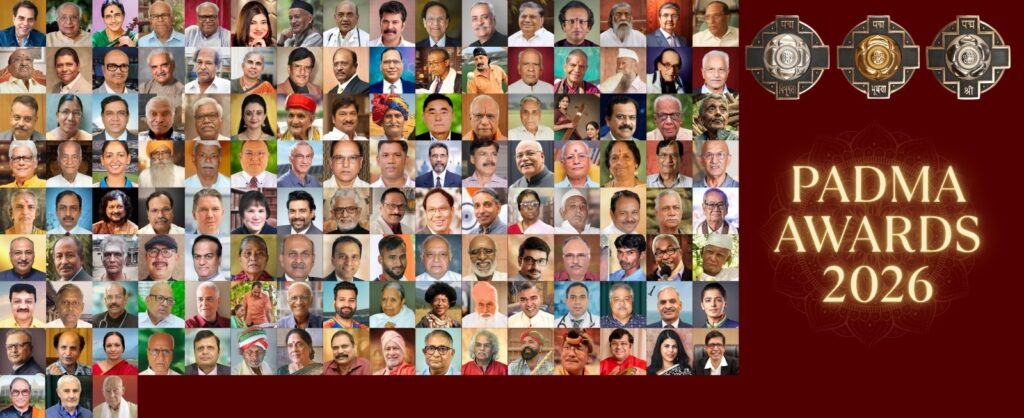
Sports: Rohit Sharma, Harmanpreet Kaur, Savita Punia, Baldev Singh, Bhagwandas Raikwar, K Pajanivel, Praveen Kumar, Vladimir Mestvirishvili (Posthumous).
Art: R. Madhavan, Anil Kumar Rastogi, Bharat Singh Bharti, Sangyusang S Pongener, Sarat Kumar Patra, Satish Shah (Posthumous), Gayatri & Ranjani Balasubramanian.
Literature & Education: Asok Kumar Haldar, Ratilal Borisagar.
Medicine: Ramchandra Godbole and Suneeta Godbole (Duo), Saroj Mandal, Dr. Padma Gurmet, Dr. Palkonda Vijay Anand Reddy.
Others: Anke Gowda M (Library), Charan Hembram (Literature), Sant Niranjan Dass (Spiritualism)
A Shift in India’s Definition of National Service
For many years, when we thought of national service, we often imagined soldiers guarding borders, politicians shaping policies, or famous personalities representing India on global platforms.
While these contributions remain important, the Padma Awards 2026 suggest that the definition of national service has grown wider and more inclusive.
Service Is Not Limited to Power
National service is no longer seen only in positions of authority. A school teacher shaping young minds is serving the nation. A nurse working night shifts in a rural hospital is serving the nation. A sportsperson inspiring discipline and teamwork is serving the nation.
Service is now being recognised at every level.
Impact Matters More Than Fame
Some Padma awardees are household names. Others are known only within their communities. Yet they stand side by side at Rashtrapati Bhavan.
This sends a powerful message to students: you do not have to be famous to make a difference. What matters is the lives you touch.
Diversity Is Strength
The list of Padma awardees 2026 reflects India’s diversity — from villages to metropolitan cities, from tribal communities to urban innovators, from young achievers to elderly contributors who have dedicated a lifetime to service.
This diversity shows that national progress is not driven by one type of person. It is built by many hands.
Service Begins at Home and Community
Many Padma Shri Award 2026 recipients began by solving local problems:
- Starting small health initiatives
- Preserving regional art forms
- Teaching underprivileged children
- Promoting cleanliness and environmental awareness
Their efforts grew because they stayed committed.
This teaches students that service does not begin with large platforms. It begins with small, meaningful action.
Lessons for Students
Dear students, the Padma Awards 2026 are not just news headlines. They are life lessons.
Start Small
You do not need a title or position to serve. Helping a friend understand homework, respecting public spaces, volunteering during school activities these are steps toward responsible citizenship.
Value Education
Many awardees are educators and scholars. Knowledge is a powerful form of service. When you study sincerely, you are preparing yourself to contribute meaningfully to society.
Respect Culture
Artists preserving traditions show us that protecting culture is also national service. Whether it is classical music, tribal art, or regional literature, heritage connects us to our roots.
Pursue Excellence with Integrity
Sportspersons honoured this year remind us that discipline, teamwork, and honesty matter as much as victory.
Practice Compassion
Many Padma Shri Award 2026 recipients worked in healthcare and social service. Compassion is not weakness; it is strength.
A Reflection for Parents
For parents, the Padma Awards 2026 offer an important reminder.
In today’s competitive world, success is often measured by income, fame, or high positions. But the award list encourages families to redefine success.
True success includes:
- Character
- Responsibility
- Empathy
- Contribution to society
When parents encourage children to think beyond personal achievement and consider community impact, they nurture responsible citizens.
The shift in national recognition reflects a deeper social change — valuing meaningful contribution over mere visibility.
Why This Shift Matters for India’s Future
India is a young nation with a large student population. The dreams of today’s children will shape tomorrow’s country.
By honouring diverse forms of service, the Padma Awards 2026:
- Encourage innovation in social work
- Promote respect for grassroots efforts
- Inspire young people to choose purpose-driven careers
- Highlight ethical leadership
- Strengthen national unity through shared recognition
When children see that kindness, perseverance, and community work are celebrated at the highest level, they begin to believe that such paths are valuable.
This builds a culture where service becomes aspiration.
Beyond the Medal
At the ceremony, the medal shines brightly. Cameras flash. Applause fills Ashoka Hall.
But behind every medal are years of quiet effort:
- Early mornings
- Financial struggles
- Personal sacrifices
- Moments of doubt
- Continued determination
The real story of the Padma Awards 2026 lies in these unseen efforts.
National service is not about one grand act. It is about consistent commitment over time.
Conclusion: Serving India Means Serving People
The Padma Awards 2026 reflect a thoughtful and heart-warming shift in India’s understanding of national service.
They remind us that:
- Service can be artistic or scientific.
- It can happen in cities or villages.
- It can be loud or quiet.
- It can begin with one person deciding to care.
For students, the message is inspiring: your everyday actions matter.
For parents, the message is reassuring: nurturing values is as important as nurturing ambition.
The Padma Shri Award 2026 and the broader list of Padma awardees show that India is celebrating not just excellence, but empathy; not just achievement, but integrity.
In the end, serving the nation is about serving its people — with dedication, humility, and heart.
And that is a goal every family can strive toward, starting today.
(Explore more about Nation related blogs)
(Know more about Chrysalis High)
Written By – Swapna Paranjpe,
Secondary Teacher – Chrysalis High Marq
Frequently Asked Questions
The Padma Awards 2026 are among India’s highest civilian honours, recognising exceptional contributions in fields like arts, sports, medicine, education, social work, and public affairs. They celebrate individuals who have made significant impact in society.
The official list of Padma awardees 2026 is released annually ahead of Republic Day by the Government of India. The list includes recipients of Padma Vibhushan, Padma Bhushan, and Padma Shri Award 2026 across various categories.
The Padma Shri Award 2026 emphasizes grassroots impact. It honors “unsung heroes” like environmentalist Kollakkayil Devaki Amma and social worker Anke Gowda M., signaling a shift toward valuing quiet, consistent community service over mere fame.
In Padma Awards 2026, 131 individuals were honoured across three categories — Padma Vibhushan, Padma Bhushan, and Padma Shri Award — reflecting diversity in profession, geography, and social contribution.
The Padma Shri Award is widely respected because it often recognises grassroots workers, educators, tribal artists, doctors, and social reformers who may not be widely known but have made lasting contributions to their communities.
Schools like Chrysalis High, one of the best CBSE & ICSE schools in Bangalore, can use the stories of Padma awardees to teach students about integrity, compassion, leadership, and national service. By encouraging community involvement and value-based education, schools help nurture future citizens who may one day earn honours like the Padma Shri Award.